
Every ecommerce team has seen the same problem.
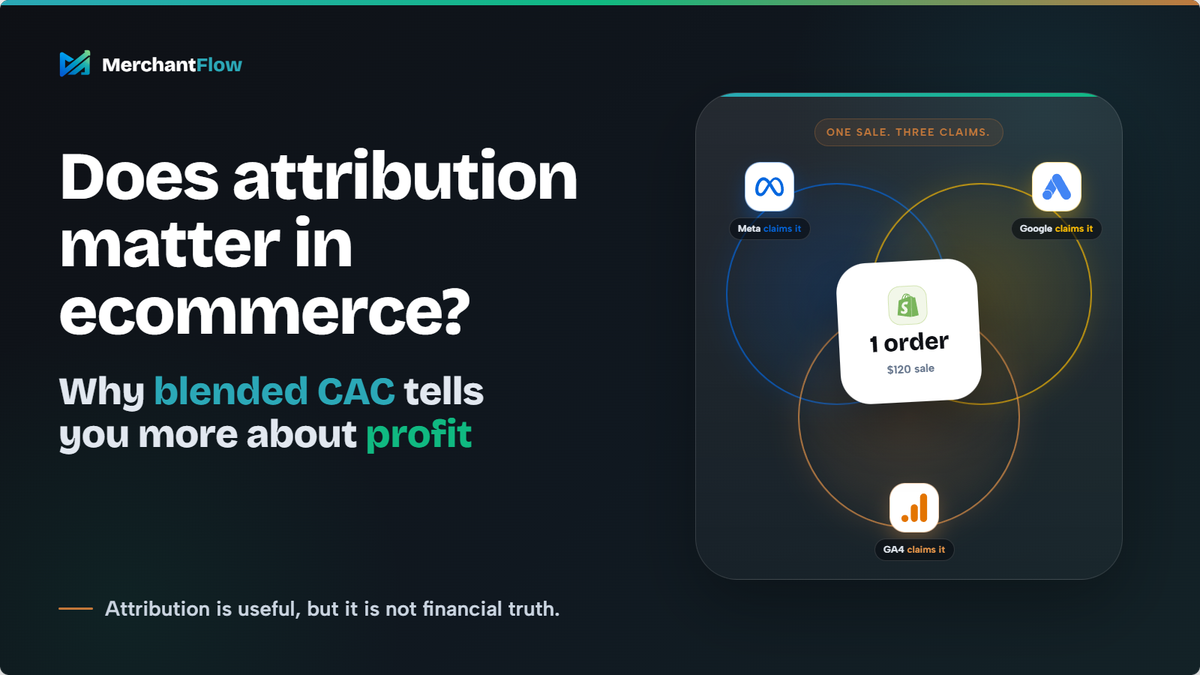
Meta says it drove the sale. Google Ads says it drove the sale. GA4 shows something different again. Shopify records the order, but it does not always settle the argument.
Then the founder checks the bank account and asks the only question that really matters:
Why are we not making more profit?
That is where attribution starts to lose its power as the main source of truth.
Attribution can be useful. It helps you understand customer journeys, compare campaigns, check tracking and spot obvious issues. But if you use attribution as the final answer for where to scale, cut or shift budget, you can end up optimising for the platform that claims the most credit, not the products and customers that actually make money.
For ecommerce brands, the better question is not only:
Which channel gets credit for this order?
The better question is:
Are we acquiring customers profitably after ad spend, product costs, shipping, refunds, payment fees and fulfilment?
That is why blended CAC, blended MER, contribution margin and product-level profitability matter more than most attribution reports.
For the merchants we speak to at MerchantFlow, especially brands doing over $1M in GMV, this is where the conversation usually lands. Attribution can be interesting, but it is rarely the number that helps them make the best growth decision.
The metrics they keep coming back to are simpler and more commercially useful:
- Blended CAC
- Blended MER
- Contribution margin
- Product-level profitability
Because at that stage, the question is no longer just “which ad platform performed best?” It is “which products, campaigns and channels are helping us grow profitably after costs?”
Attribution is useful, but it is not financial truth
The phrase “attribution does not matter” gets attention because it challenges a real problem.
Many ecommerce teams have become too attached to platform-level reporting. They treat Meta ROAS, Google Ads conversion value or GA4 attribution as if those numbers explain the whole business.
But attribution is not useless. It still matters in the right context.
Attribution helps you understand how customers discover your brand, which campaigns are influencing behaviour and whether your tracking setup is working properly. It can help you diagnose performance problems and compare campaigns inside the same platform.
The mistake is treating attribution like truth.
Attribution is a model. It is a way of assigning credit based on the data available to a platform or analytics tool. It does not fully capture every touchpoint, every offline influence, every repeat purchase effect or every cost that determines whether an order was profitable.
Most importantly, attribution does not usually tell you whether the order made money.
A platform can say it drove a $120 sale. It may not tell you that the order included a discount, a low-margin product, expensive shipping, a refund risk and payment fees that left almost no contribution profit.
That is the real issue.
Revenue attribution without cost context can make bad growth look good.
Even premium attribution tools cannot give you perfect truth
This is not just a problem with native ad platform reporting.
It is also not something that disappears because a brand pays for a more advanced ecommerce analytics platform.
Tools like Triple Whale and Polar Analytics are well-known, premium platforms in the ecommerce analytics space. They can help merchants centralise data, improve reporting, analyse performance and move beyond the limitations of native ad dashboards.
They are popular for a reason.
But even platforms like Triple Whale, Polar and other attribution-focused tools still rely on attribution models, tracking logic, attribution windows, pixel data, first-party data, customer journey assumptions and available platform signals.
That means they can improve attribution visibility.
They cannot make attribution 100% accurate.
This is the point many ecommerce teams miss. The issue is not simply whether you trust the data platform. The deeper issue is whether the metric itself is useful enough to guide a profitable decision.
Better attribution can give you a better model.
It does not give you perfect truth.
If you are deciding whether to scale a product, increase ad spend, cut a campaign, adjust pricing or change your offer, credit is not enough.
You need to know whether the sale was profitable.
That is why blended CAC, blended MER and contribution margin are often more valuable than attribution. They are not trying to perfectly reconstruct every step in the customer journey. They are showing whether the business is becoming more or less efficient as it grows.
Why ecommerce attribution gets messy
Ecommerce buying journeys are rarely clean.
A customer might see a TikTok video, click a Meta ad, search your brand on Google, compare products through Google Shopping, open an email, read reviews and finally buy directly from your Shopify store.
Each platform sees part of that journey.
Meta may count the sale because the customer clicked or viewed an ad. Google Ads may count it because the customer later clicked a Shopping ad. GA4 may assign credit differently again. Shopify may show the order source in a way that does not match either ad platform.
None of these tools are necessarily wrong. They are just answering different questions with different data.
This creates three common problems.
1. Multiple platforms can claim the same sale
A single order can appear in more than one platform’s reporting.
Meta may claim it. Google may claim it. An email platform may claim it. Shopify still only processed one order.
The problem starts when a merchant adds up platform-reported revenue and treats it as total business revenue. That can inflate performance, overstate ROAS and make paid acquisition look healthier than it really is.
This is especially dangerous when budgets are increasing. A brand may think it is scaling profitably because every platform is reporting strong performance, while total profit is barely moving.
2. Attribution often rewards the easiest touchpoints to measure
Attribution tends to favour touchpoints close to purchase.
Branded search, retargeting and shopping comparison activity can look highly efficient because they capture demand that already exists. Meanwhile, prospecting, creator content, organic social, influencer activity and upper-funnel creative can look weaker because their influence is harder to measure.
This can lead to a bad decision: cutting the activity that creates demand and overfunding the activity that harvests it.
A retargeting campaign may look like the hero in platform reporting, but it may be closing customers who were already going to buy. A prospecting campaign may look less efficient, but it may be introducing new customers who would never have found the brand otherwise.
3. Attribution usually ignores margin
This is the biggest issue for ecommerce brands.
Most attribution reports focus on revenue, conversion value, CPA or ROAS. Those metrics matter, but they are incomplete.
A campaign can drive high revenue and still be unprofitable if the products sold have weak margins.
For example, two products can sell for the same price and produce completely different profit outcomes once COGS, shipping, fees, refunds and fulfilment are included.
From an attributed revenue view, both products may look similar.
From a profit view, they can be completely different.
That is why ecommerce teams need to connect acquisition data to product-level economics.
What blended performance tells you instead
Blended performance looks at the whole business instead of asking each platform to grade its own homework.
This is why many experienced merchants end up relying more on blended CAC and blended MER than attribution.
Not because attribution has no value.
Because blended metrics are closer to the commercial reality of the business.
Rather than asking which platform claims the order, blended reporting asks:
How much revenue did we generate, how much did we spend to generate it and did that growth leave enough margin?
The most useful blended metrics include blended ROAS, MER and blended CAC.
Blended ROAS
Blended ROAS is total revenue divided by total ad spend.
If your store generated $100,000 in revenue and spent $25,000 on ads, your blended ROAS is 4.0.
This tells you the overall relationship between revenue and ad spend. It does not care whether Meta, Google, TikTok or another channel claimed the sale. It looks at the business outcome.
Blended ROAS is useful because it reduces platform noise. But it still has a limitation: it does not tell you whether the revenue was profitable after product costs and fulfilment costs.
MER
MER stands for marketing efficiency ratio. It is usually calculated as total revenue divided by total marketing spend.
Some brands use MER and blended ROAS interchangeably. Others use MER to include a broader marketing cost base, such as paid media, agency fees, creative costs and other acquisition-related spend.
MER is useful for understanding whether the business is becoming more or less efficient as it scales.
If revenue grows but marketing spend grows faster, MER falls. That may be acceptable for a short period if you are intentionally investing in growth, but it needs to be understood.
Blended CAC
Blended CAC is total acquisition spend divided by the number of new customers acquired.
For example, if you spend $30,000 on acquisition in a month and acquire 1,000 new customers, your blended CAC is $30.
This number matters because it reflects what the business actually paid to acquire customers across all channels.
It is often more useful than platform-reported CAC because platforms can overlap. Meta might report a $25 CAC. Google might report a $30 CAC. But if both platforms are claiming some of the same customers, the business-level CAC may be much higher.
Blended CAC cuts through that overlap.
This is the measurement layer MerchantFlow is built around.
Not because attribution is ignored completely, but because ecommerce teams need a clearer view of the metrics that actually affect profitability: blended CAC, blended MER, product costs, contribution margin and product-level profit.
A founder does not just need to know that Meta claimed a sale or Google Ads reported a stronger ROAS.
They need to know whether the business made money after the sale was fulfilled.
Why blended CAC often matters more than attributed CAC
Imagine this scenario.
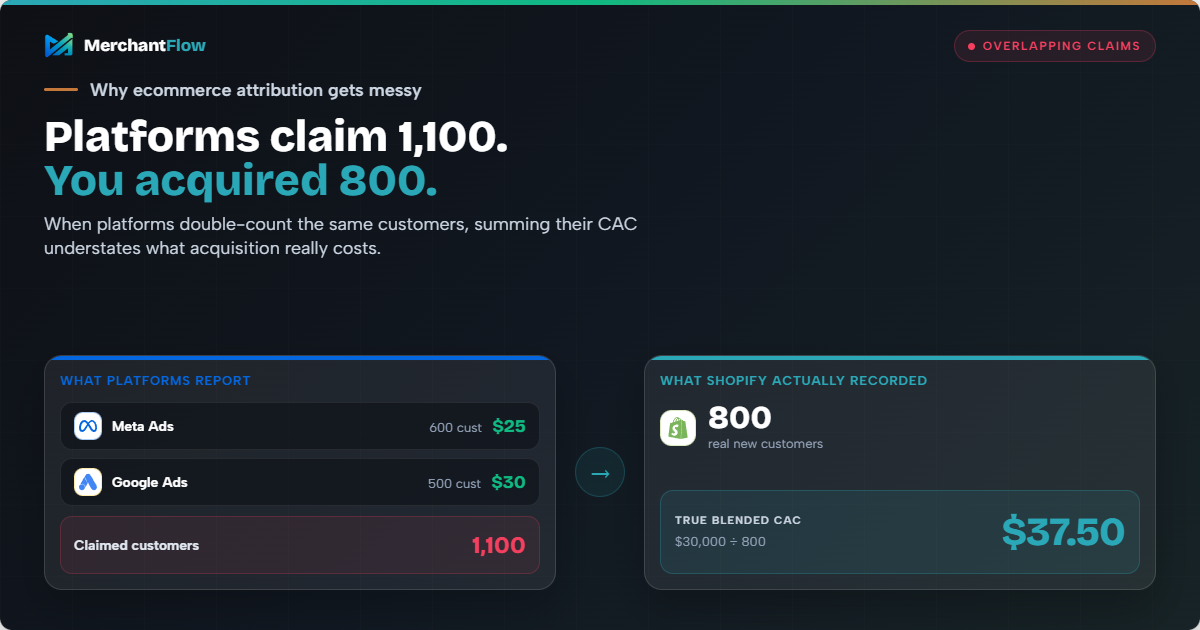
Meta reports:
- Spend: $15,000
- Attributed new customers: 600
- Attributed CAC: $25
Google Ads reports:
- Spend: $15,000
- Attributed new customers: 500
- Attributed CAC: $30
On the surface, both platforms look efficient.
But when you look at Shopify, the business only acquired 800 new customers in total.
That means the true blended CAC is:
$30,000 divided by 800 = $37.50
The platforms together claimed 1,100 new customers, but the business only acquired 800.
That is not a small reporting difference. It changes the economics of scaling.
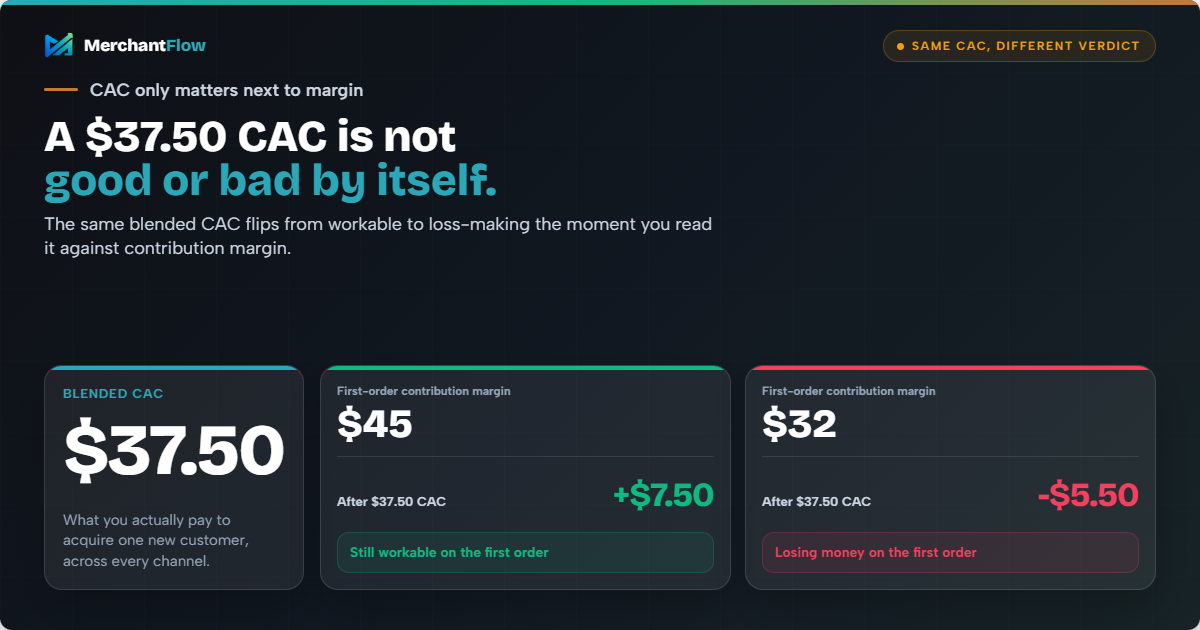
If your first-order contribution margin before acquisition is $45, a $25 platform CAC looks healthy and a $37.50 blended CAC might still be workable.
But if your first-order contribution margin before acquisition is $32, a $25 platform CAC looks profitable while a $37.50 blended CAC means you are losing money on the first order.
This is why blended CAC should sit above platform CAC in your decision hierarchy.
Platform CAC helps you investigate performance.
Blended CAC helps you understand commercial reality.
This is also why attribution-heavy dashboards can still leave merchants unsure what to do next.
A platform might show a more advanced attribution view, but the founder still needs to decide whether to increase spend, protect margin, cut a product, adjust pricing or change the offer.
Those decisions need profitability context.
Blended CAC tells you what acquisition really costs. Contribution margin tells you whether that acquisition is affordable. Product-level profitability tells you where the business should lean in or pull back.
CAC only matters when you compare it to margin
CAC is not good or bad by itself.
A $20 CAC can be terrible for one brand and excellent for another. A $70 CAC can be perfectly acceptable for a high-margin repeat purchase brand, but dangerous for a low-margin one-time purchase product.
The difference is margin, repeat purchase behaviour and customer lifetime value.
For ecommerce brands, the first step is understanding contribution margin.
A practical contribution margin view might start with:
| Contribution profit calculation |
|---|
| Revenue |
| minus discounts |
| minus refunds |
| minus cost of goods sold |
| minus shipping |
| minus fulfilment |
| minus payment fees |
| minus ad spend |
| = Contribution profit |
What is left is the money the order contributes after variable costs.
This is where profitability becomes visible.
A product with strong revenue can still be a poor scaling candidate if it has weak contribution margin. A campaign with average ROAS can still be valuable if it brings in high-margin customers who buy again.
That is why CAC needs context.
The real question is not:
Is our CAC low?
The real question is:
Is our CAC low enough for the products, margins and customer behaviour we are acquiring?
A simple example: attribution says scale, profit says check the numbers
Let’s say you sell skincare products through Shopify.
Your Meta campaign reports:
- Revenue: $50,000
- Spend: $12,500
- Platform ROAS: 4.0
On the dashboard, that looks like a winner.
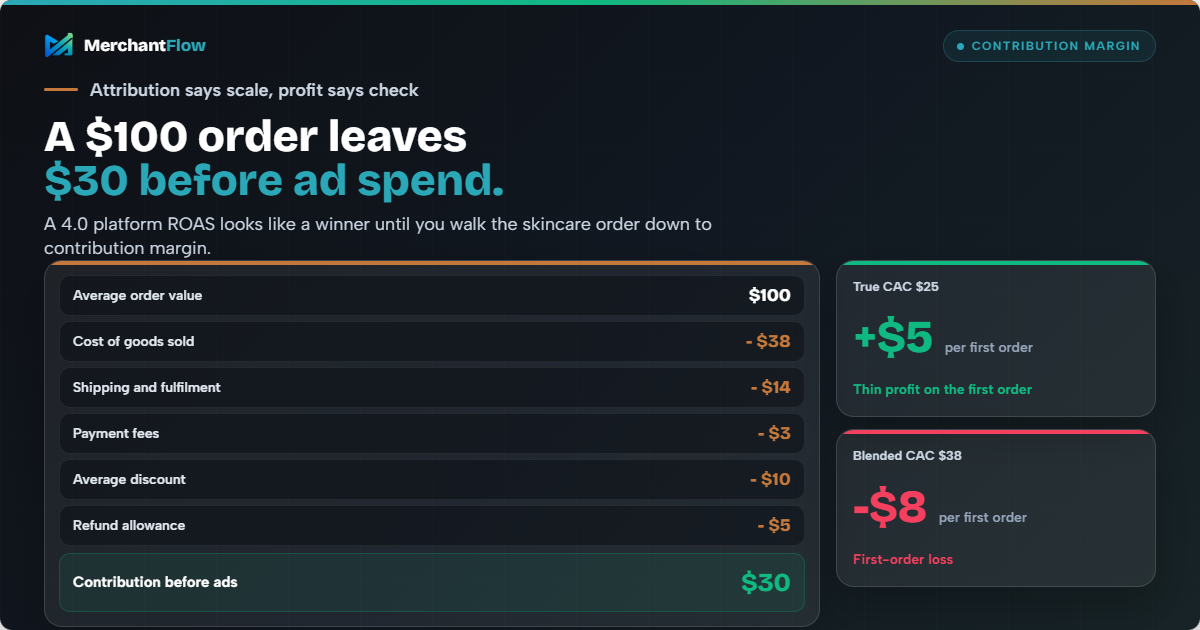
But now look at the order economics:
| Metric | Amount |
| Average order value | $100 |
| COGS | $38 |
| Shipping and fulfilment | $14 |
| Payment fees | $3 |
| Average discount | $10 |
| Refund allowance | $5 |
| Contribution margin before ad spend | $30 |
Before ad spend, the order has $30 of contribution margin.
If your true CAC is $25, you are making about $5 contribution profit on the first order.
If your blended CAC is actually $38, you are losing about $8 on the first order.
That does not automatically mean the campaign should be turned off. If the product has strong repeat purchase behaviour, subscriptions or high lifetime value, acquiring customers at a first-order loss may be intentional.
But you need to know that before you scale.
Attribution alone will not show it.
The ecommerce measurement hierarchy: what to trust first
A better ecommerce measurement system does not start with platform ROAS.
It starts with business economics.
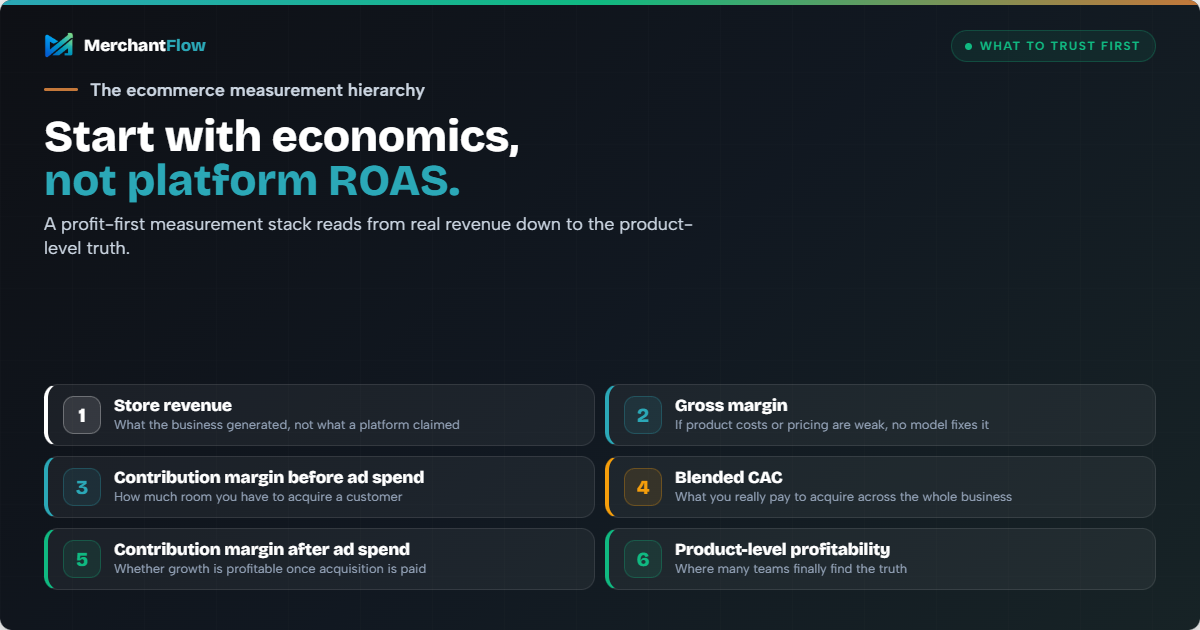
First, look at actual store revenue from Shopify, WooCommerce or your ecommerce platform. This is what the business generated, not what an ad platform claimed.
Then look at gross margin. If your product costs are too high or your pricing is too weak, no attribution model will fix the problem.
Next, look at contribution margin before ad spend. This tells you how much room you have to acquire a customer before the order becomes unprofitable.
Then review blended CAC. This shows what you are actually paying to acquire new customers across the whole business.
After that, look at contribution margin after ad spend. This tells you whether growth is profitable after acquisition costs.
Finally, look at product-level profitability. This is where many ecommerce teams find the truth.
Two products can generate the same revenue and produce very different profit outcomes.
Product A might have strong margin, low returns, cheap shipping and strong repeat purchase behaviour.
Product B might have weaker margin, expensive shipping, high return rates and little repeat purchase behaviour.
If you only look at attributed revenue, both products may look equally attractive.
If you look at product-level profitability, one may be worth scaling and the other may be quietly draining cash.
Where attribution still matters
Blended performance matters more than attribution for financial decisions, but attribution still has a role.
Use attribution when you are trying to diagnose marketing performance.
It can help answer questions like:
- Which campaigns are influencing conversions?
- Are UTMs and pixels working properly?
- Which creative angles are driving interest?
- Are certain campaigns overclaiming results?
- Did a tracking issue cause a sudden reporting change?
Attribution is also useful when comparing campaigns inside the same platform.
For example, comparing one Meta campaign against another Meta campaign can be helpful because the reporting logic is relatively consistent. The same applies when comparing Google Ads campaigns against other Google Ads campaigns.
The mistake is comparing Meta ROAS directly against Google Ads ROAS and assuming the higher number deserves more budget.
That can push spend towards the platform with the most favourable attribution logic rather than the channel creating the best incremental profit.
Three simple rules help:
- Use attribution for diagnosis.
- Use blended metrics for business performance.
- Use contribution margin for decisions.
How this applies to Shopify and Google Shopping brands
Shopify merchants often start with revenue dashboards because revenue is easy to see.
That works in the early days. But once a brand is doing serious volume, especially over $1M in GMV, the questions usually change.
It is no longer enough to ask:
- Which channel drove the sale?
- Which campaign had the best ROAS?
- Which platform reported the lowest CAC?
The more useful questions are:
- Which products are actually profitable?
- Which campaigns are acquiring customers we can afford?
- Which channels are improving blended MER?
- Which products are draining margin even though they generate revenue?
- Which Google Shopping products should we scale, exclude, reprice or fix?
That is where MerchantFlow’s view of ecommerce analytics is different.
The goal is not to give merchants another dashboard full of attribution arguments. The goal is to give them the metrics that help them make better commercial decisions.
Google Shopping is an especially strong example because product-level economics matter so much.
A Shopping campaign can drive sales across many products, but not every sale is equally valuable.
A product with a 6.0 ROAS might be less profitable than a product with a 3.0 ROAS if the first product has poor margin and the second product has strong margin.
For example:
| Metric | Product A | Product B |
| Selling price | $80 | $80 |
| COGS | $24 | $46 |
| Shipping and fulfilment | $10 | $14 |
| Payment fees | $2 | $2 |
| Ad cost per sale | $18 | $14 |
| Contribution profit | $26 | $4 |
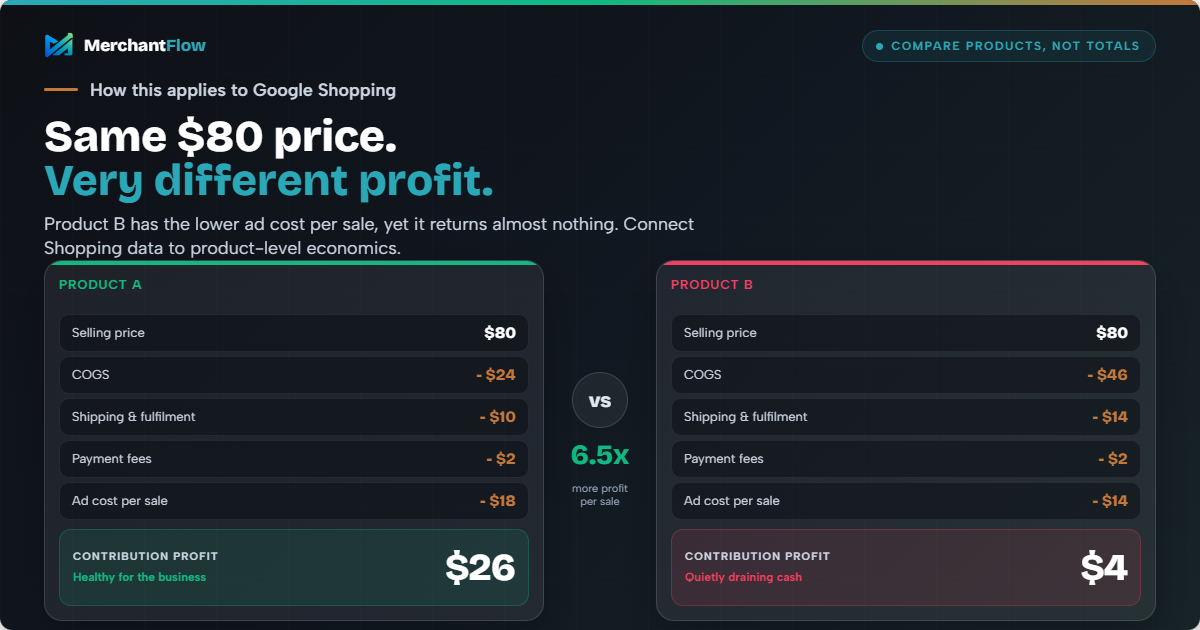
Product B may look attractive if you only focus on ad cost per sale. But Product A is much healthier for the business.
That is why Google Shopping decisions should not rely only on campaign ROAS. You need to connect Shopping performance to product cost, gross margin, contribution margin and actual product-level profitability.
For Google Shopping brands, the strongest setup is not just clean feed data.
It is clean feed data connected to profit data.
This is where many ecommerce analytics tools still stop short.
They may improve attribution. They may centralise channel reporting. They may give a cleaner view of ROAS, CAC or customer journeys.
But for Google Shopping brands, the highest-value insight is often more practical:
Which products should we spend more on because they are profitable after costs?
That is the level of clarity MerchantFlow is designed to provide.
Common CAC mistakes ecommerce brands make
CAC is one of the clearest ways to understand whether growth is sustainable, but it is easy to misuse.
Mistake 1: Using total customers instead of new customers
CAC should focus on new customers acquired during the period.
If you include returning customers in the calculation, CAC can look artificially low. Returning customers are often cheaper to convert because they already know the brand.
Mixing new and returning customers hides the true cost of acquisition.
Mistake 2: Looking at CAC without product mix
Your blended CAC can stay stable while profitability gets worse.
For example, CAC might remain at $35, but more customers are buying discounted bundles with higher shipping costs and lower margins.
Revenue looks fine. CAC looks fine. Profit declines.
That is why CAC should be reviewed alongside product mix and contribution margin.
Mistake 3: Treating high CAC as automatically bad
A high CAC is not always a problem.
If customers buy again quickly, purchase high-margin products or join a subscription, the business may be able to support a higher first-order CAC.
A consumable supplement brand may tolerate a higher CAC because repeat purchase behaviour is strong. A one-off gift brand may need first-order profitability because repeat purchase behaviour is weaker.
The issue is not CAC in isolation.
The issue is CAC without margin and lifetime value context.
So, does attribution actually matter in ecommerce?
Yes, attribution matters.
But for many ecommerce brands, it matters less than they think.
Based on the merchants we speak to at MerchantFlow, especially brands already doing over $1M in GMV, attribution is rarely the metric that changes the decision.
Blended CAC does.
Blended MER does.
Contribution margin does.
Product-level profitability does.
Attribution can help explain what may have happened. These metrics help decide what to do next.
This does not mean attribution tools have no place. It means attribution should support decision-making, not replace the profit metrics that determine whether growth is sustainable.
That means tracking:
- Actual revenue
- Total ad spend
- New customers acquired
- Blended CAC
- Blended MER
- Gross margin
- COGS
- Shipping
- Fulfilment
- Refunds
- Payment fees
- Contribution margin
- Product-level profitability
Attribution answers:
Who gets credit?
Blended profitability answers:
Did we actually make money?
Only one of those questions keeps the business healthy.
What to track instead of obsessing over attribution
If you want a more useful ecommerce dashboard, start with the numbers that connect marketing to profit.
Track blended CAC so you know what you are really paying to acquire new customers.
Track blended MER so you can see whether the whole business is becoming more or less efficient as spend increases.
Track first-order contribution margin so you know whether acquisition is profitable before repeat purchases.
Track breakeven CAC so you know how much you can afford to spend by product, category or offer.
Track product-level profit so you can see which products make money after COGS, shipping, fees, refunds and ad spend.
Track new versus returning customer revenue so you know whether growth is coming from acquisition, retention or both.
Track refund and return impact so hidden margin leakage does not get ignored.
These metrics are less flashy than platform ROAS, but they are far more useful for making growth decisions.
Final takeaway
Attribution is not dead.
It is just overpromoted.
Even premium ecommerce analytics platforms like Triple Whale and Polar can improve attribution visibility, but they still cannot make attribution 100% accurate. No tool can perfectly reconstruct every customer journey, every touchpoint and every buying influence.
That is why the real question is not simply:
Which attribution platform should we trust?
The better question is:
Which metrics actually help us make profitable decisions?
For ecommerce brands, attribution should be treated as a diagnostic tool, not a financial truth.
The more important layer is blended performance. The most important layer is blended performance connected to CAC, MER, contribution margin and product-level profitability.
Because scaling is not about finding the platform that claims the most revenue.
It is about finding the products, campaigns and customers that create real profit after costs.
FAQ
Does attribution matter in ecommerce?
Yes. Attribution matters because it helps you understand customer journeys, diagnose campaign performance and check tracking quality. But it should not be treated as the final source of truth for profitability. For financial decisions, blended CAC, contribution margin and product-level profit are usually more useful.
What is blended CAC?
Blended CAC is the total cost of acquiring new customers across all acquisition channels divided by the number of new customers acquired in the same period. It gives you a business-wide view of acquisition efficiency rather than relying only on platform-reported CAC.
What is blended MER?
Blended MER, or marketing efficiency ratio, compares total revenue to total marketing spend. It helps ecommerce brands understand whether the business is becoming more or less efficient as marketing spend increases.
Is blended CAC better than platform CAC?
Blended CAC is better for understanding business-level acquisition efficiency. Platform CAC is still useful for diagnosing performance within a channel, but it can be affected by attribution windows, tracking gaps and overlapping conversion claims.
What is the difference between blended ROAS and platform ROAS?
Platform ROAS shows the return reported by a specific ad platform. Blended ROAS compares total business revenue to total ad spend across channels. Blended ROAS is usually more useful for understanding overall marketing efficiency, while platform ROAS is better for campaign-level diagnosis.
Why can attribution be misleading?
Attribution can be misleading because multiple platforms may claim the same sale, different tools use different attribution windows and reporting logic, and most attribution reports do not include product costs, shipping, refunds, payment fees or fulfilment costs.
Is attribution ever 100% accurate?
No. Attribution is based on models, tracking data, customer journey assumptions and platform rules. More advanced attribution tools can improve visibility, but they cannot make every customer journey perfectly measurable. For ecommerce decisions, attribution is best used alongside blended CAC, blended MER, contribution margin and product-level profitability.
Are tools like Triple Whale and Polar useful for ecommerce attribution?
Yes. Tools like Triple Whale and Polar can be useful for ecommerce analytics, attribution visibility and performance reporting. The limitation is that attribution itself is still model-based. These platforms can improve how you understand marketing performance, but they cannot make attribution perfectly accurate. For profit decisions, merchants still need blended CAC, blended MER, contribution margin and product-level profitability.
How do I know if my CAC is too high?
CAC is too high when it exceeds what your margins and customer lifetime value can support. A $50 CAC may be profitable for a high-margin repeat purchase brand, but unprofitable for a low-margin one-time purchase product.
See what is actually profitable
When your store data, ad spend and product costs live in separate places, it is hard to know what is really driving profit.
MerchantFlow gives ecommerce brands a clearer view of the metrics that actually guide profitable growth: blended CAC, blended MER, contribution margin and product-level profitability.
By combining revenue, ad spend, COGS, shipping, refunds, payment fees and fulfilment costs into one profit-focused dashboard, MerchantFlow helps you see which products, campaigns and channels are actually making money after costs.
If you want to stop relying on disconnected dashboards and start making decisions from real margin data, start your free trial with MerchantFlow.

About the author
Georgia CarapetisGeorgia Carapetis is Head of Marketing at MerchantFlow, helping ecommerce brands stop obsessing over ROAS and start focusing on profit. She writes about Google Shopping, contribution margins, and scaling without shrinking your margins.