
For ecommerce brands, Meta Ads can look incredible on the surface.
A campaign shows 3.8x ROAS. Purchases are coming in. Revenue is up. The account looks healthy.
Then you check the bank account, and come to find out...profit isn't moving the same way.
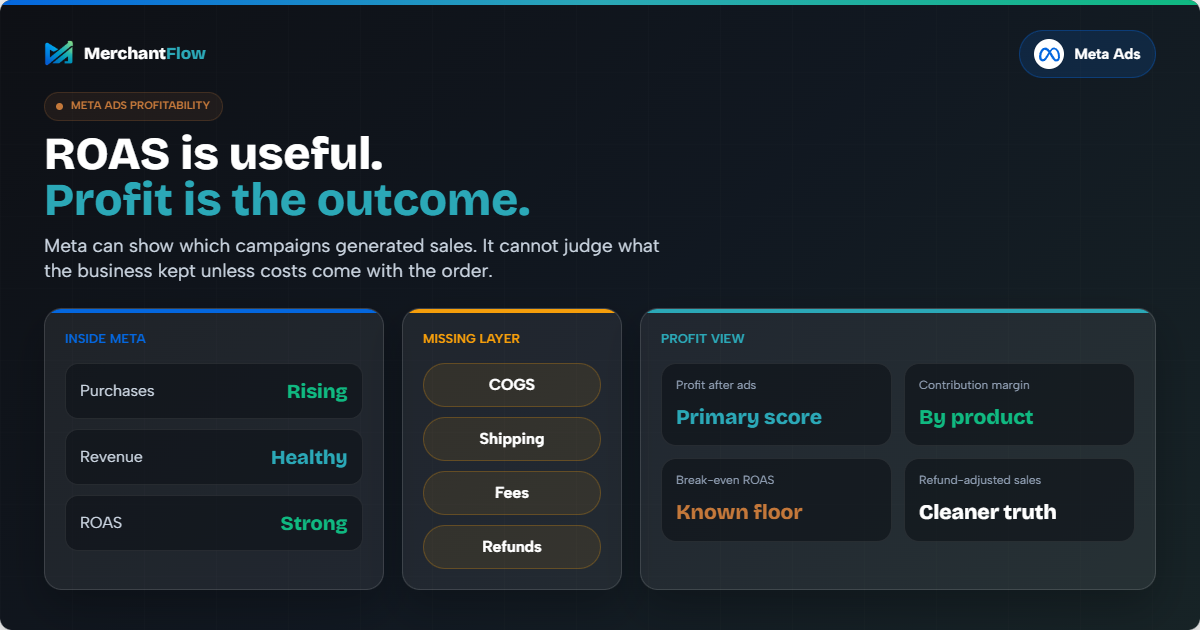
This is one of the biggest problems with Meta Ads in ecommerce; the platform is built to optimise for conversions, revenue and return on ad spend, but your business survives on contribution margin.
Meta might tell you which campaign generated sales. It will not automatically tell you whether those sales were profitable after:
- Ad spend
- Cost of goods sold
- Shipping
- Fulfilment
- Transaction fees
- Discounts
- Refunds
- Returns, and
- Product-level margin differences
That is why scaling Meta Ads in 2026 requires more than better creatives or broader audiences. It requires a better way to measure what happens after the sale.
The problem with relying on Meta Ads ROAS
ROAS is useful, but it isn't the same as profit.
A 4x ROAS campaign can be profitable for one product and unprofitable for another.
For example:
Product B sells for $100 with a 30% gross margin.
Both products can show the same Meta Ads ROAS, but Product A may create real profit while Product B barely breaks even after ad spend and fulfilment costs.
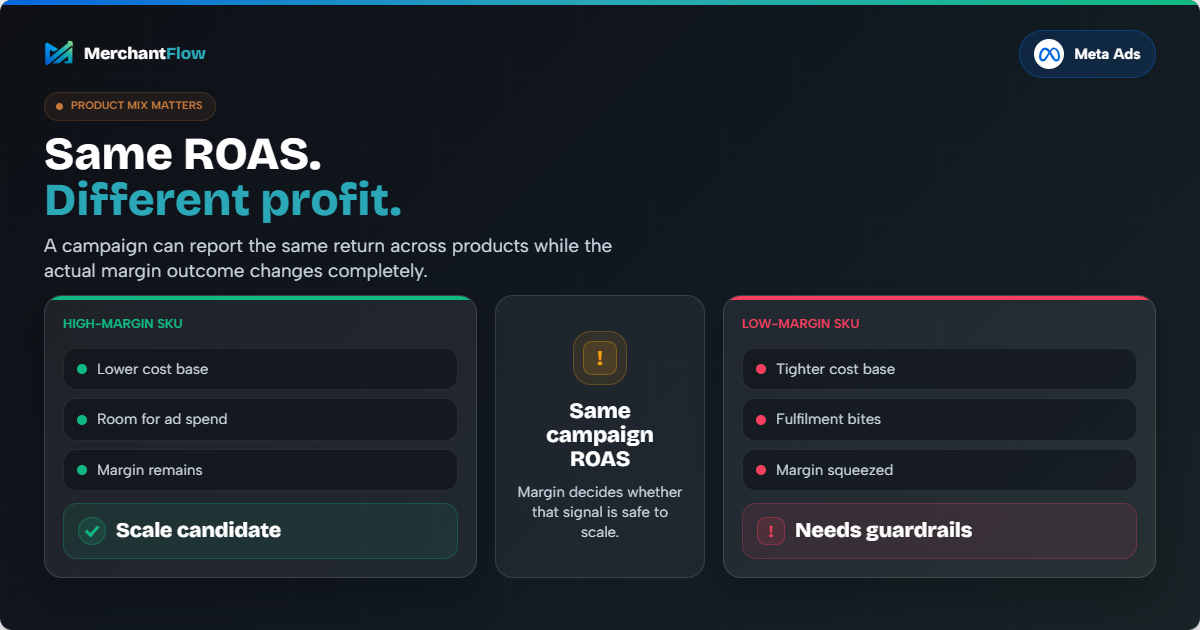
This is where many ecommerce brands get caught. They scale the campaign with the best reported ROAS, not the product mix with the best profit outcome.
Meta Ads reporting can help you understand ad performance, but it does not give you a full margin view by default. To understand real performance, you need to connect ad spend with ecommerce order data, COGS, fees and product-level profitability.
Meta Ads are becoming more automated
Meta’s advertising ecosystem has continued moving toward automation. Advantage+ Shopping Campaigns are designed to automate campaign setup and optimise delivery, creative and sales outcomes using Meta’s AI systems.
This is not necessarily a bad thing. Automation can be powerful, especially when an account has enough conversion data and strong creative inputs.
But automation also changes the operator’s role.
The job is no longer just:
“Which interest should we target?”
It is now:
“Are we feeding Meta the right signals, and are we measuring the business outcome correctly?”
Meta can optimise toward purchases, but it does not know your true margin unless your measurement stack does. If a low-margin product converts easily, the algorithm may push more spend toward it. That can increase revenue while quietly damaging profit.
The real Meta Ads question: what should you scale?
Most ecommerce operators ask:
“Which campaign has the best ROAS?”
But, a better question is:
“Which campaign is acquiring profitable customers through profitable products?”
That shift changes how you read the account.
Instead of only looking at campaign-level ROAS, you should be looking at:
- Profit after ad spend
- Contribution margin by product
- Break-even ROAS by product
- New customer acquisition cost
- Repeat purchase behaviour
- Refund and return impact
- Discount usage
- Product bundles versus single-product orders
- Blended profitability across Meta, Google, TikTok and organic
This is especially important for brands selling products with different margins. A store might have one hero product with strong revenue but weak margin, while a quieter product generates better profit after fulfilment and ad costs.
Without product-level profit visibility, Meta Ads optimisation becomes guesswork.
Why attribution still needs a reality check
Meta Ads attribution can be useful, but it should not be treated as the full truth.
Meta allows advertisers to compare reported conversions across different attribution settings, including 1-day view, 1-day click, 7-day click and 28-day click windows.
That matters because attribution windows influence how performance is reported. A campaign may look stronger when view-through attribution is included, especially if customers were already likely to buy.
This does not mean Meta is wrong. It means Meta is measuring from its own platform perspective.
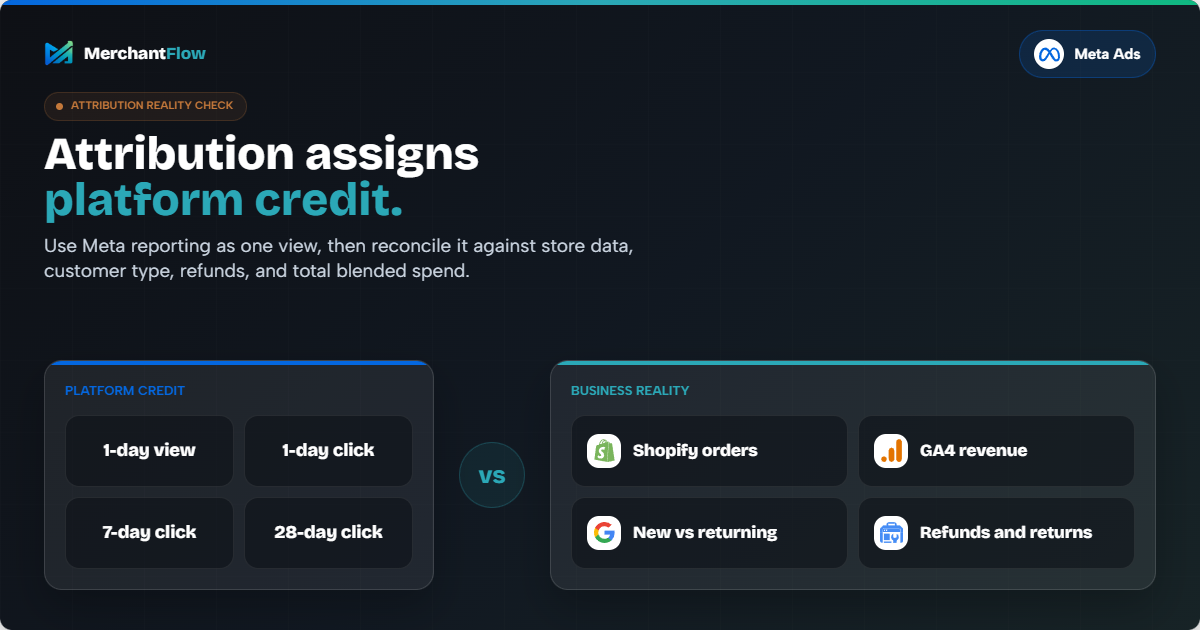
As an ecommerce operator, you should compare Meta-reported results against:
- Shopify or WooCommerce orders
- GA4 revenue
- New customer revenue
- Returning customer revenue
- Product margin
- Refunds and returns
- Total blended ad spend
- Actual profit after costs
The goal is not to ignore Meta’s numbers. The goal is to stop making margin decisions from platform-reported ROAS alone.
Tracking matters more than ever
Good Meta Ads performance depends on strong event tracking.
Meta’s Conversions API is designed to create a connection between an advertiser’s marketing data, such as website events, app events and business messaging events, and Meta’s systems.
Meta also recommends using the Conversions API alongside the Meta Pixel and sharing the same events through both tools.
However, if you send the same event through both the Pixel and Conversions API, deduplication needs to be handled properly so Meta can tell the difference between duplicate and distinct events.
For ecommerce brands, this matters because messy tracking can lead to messy decisions.
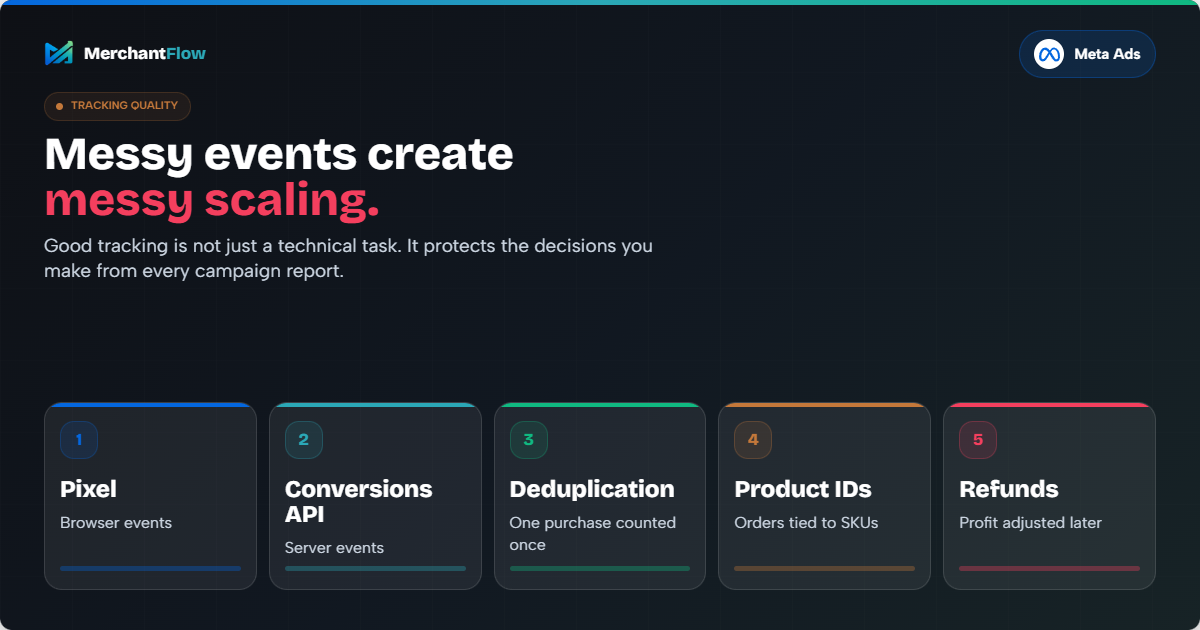
If purchases are duplicated, ROAS can look inflated.
If events are missing, campaigns can look weaker than they are.
If product IDs are inconsistent, product-level analysis becomes harder.
If refunds are ignored, profit gets overstated.
The cleaner your data, the better your decisions.
Meta Ads creative still does the heavy lifting
Automation does not replace creative.
In many accounts, the biggest performance gains still come from better angles, better offers and better product storytelling.
For ecommerce, strong Meta Ads creative usually does one of five things:
- Shows the product in use
- Makes the problem instantly recognisable
- Explains the outcome clearly
- Handles an objection before the click
- Gives the customer a reason to act now
The mistake is assuming creative performance should only be measured by CTR, CPC or ROAS.
Those metrics matter, but they do not tell the whole story.
A creative that attracts cheap clicks but low-quality buyers may look good in Ads Manager while hurting profitability. A creative with a higher CPA may still be better if it drives higher-margin products, larger bundles or better repeat customers.
The best Meta Ads teams do not just ask which ad gets attention.
They ask which ad brings in profitable customers.
The metrics ecommerce brands should track for Meta Ads
To make better decisions, ecommerce operators should look beyond the default Ads Manager view.
Here are the core metrics worth tracking.
1. Break-even ROAS
Break-even ROAS tells you the minimum ROAS required before a product becomes profitable.
A product with a 50% margin has a very different break-even point from a product with a 25% margin.
If your Meta Ads campaign is driving sales below break-even ROAS, it may be growing revenue while losing money.
2. Profit after ad spend
This is one of the clearest metrics for Meta Ads.
Revenue tells you how much came in.
Profit after ad spend tells you what is left.
For example:
- Revenue: $20,000
- Ad spend: $6,000
- COGS: $8,000
- Fees, shipping and fulfilment: $2,000
- Profit after ad spend: $4,000
That number is more useful than ROAS alone.
3. Product-level contribution margin
Not every sale is equal.
Product-level contribution margin helps you see which SKUs are worth pushing and which ones should be treated carefully.
This can influence:
- Campaign budget allocation
- Creative testing
- Product bundles
- Discount strategy
- Landing page focus
- Email follow-up offers
- Inventory decisions
4. New customer CAC
Meta Ads often performs differently for new customers versus returning customers.
If a campaign is mostly converting existing customers, the ROAS may look strong, but the incremental value may be weaker.
Tracking new customer CAC helps you understand how much you are paying to acquire fresh demand.
5. Refund-adjusted revenue
Refunds can distort ad performance.
If a product has a high return rate, the original ROAS may overstate the quality of the campaign.
Refund-adjusted revenue gives a more realistic view of whether Meta Ads are attracting customers who keep the product.
How to optimise Meta Ads for profit, not just revenue
A profit-first Meta Ads workflow looks different from a ROAS-first workflow.
Step 1: Calculate break-even ROAS by product
Before scaling campaigns, know the minimum ROAS each product needs.
This should include:
- Product price
- Gross margin
- Payment fees
- Refund rate
- Shipping or fulfilment cost
- Average discount
Once you know break-even ROAS by product, you can judge campaigns more accurately.
Step 2: Segment performance by product
Do not stop at campaign-level ROAS.
Look at which products each campaign is actually selling.
A campaign may have a strong blended ROAS but still be pushing too much spend toward low-margin SKUs.
Step 3: Separate acquisition from retention
New customers and returning customers should not always be judged the same way.
A campaign that acquires new customers at break-even may still be valuable if those customers repeat purchase. A retargeting campaign with strong ROAS may be less impressive if most of those customers were already going to buy.
Step 4: Test creative by profit outcome
When reviewing creative tests, look beyond hook rate, CTR and CPA.
Ask yourself:
- Did this creative sell high-margin products?
- Did it drive bundles or single-item purchases?
- Did it attract customers who refunded?
- Did it bring in new customers or returning customers?
- Did it improve profit after ad spend?
This turns creative testing into business optimisation, not just ad account optimisation.
Step 5: Use automation, but keep financial control
Advantage+ campaigns can help simplify structure and improve delivery, but they still need strong inputs and strong measurement.
Meta’s Advantage+ catalogue ads are designed to automatically show people relevant products based on interests, intent and actions.
That makes your product data and profitability data even more important.
If Meta is deciding which products to show, you need to understand whether those products are worth selling at scale.
Common Meta Ads mistakes ecommerce brands make
Mistake 1: Scaling campaigns based on ROAS alone
ROAS does not account for margin differences.
A 3x ROAS campaign can be excellent or terrible depending on the product being sold.
Mistake 2: Ignoring COGS
If COGS are not included in reporting, profit is being guessed.
This is especially risky for stores with multiple suppliers, variable landed costs or seasonal cost changes.
Mistake 3: Treating Meta revenue as final truth
Meta Ads reporting is useful, but it should be reconciled against store data and financial reality.
Mistake 4: Not checking product mix
Campaigns can shift toward products that are easy to sell but weak on margin.
This can make the ad account look healthy while the business becomes less profitable.
Mistake 5: Not adjusting for refunds and returns
Products with high return rates can make campaigns look better than they really are.
Refund-adjusted reporting gives a more honest view.
Where MerchantFlow fits in
MerchantFlow helps ecommerce brands understand what Meta Ads are really doing to profit.
Instead of switching between Meta Ads, Shopify, WooCommerce, spreadsheets and manual margin calculations, MerchantFlow brings the key data into one profit-focused dashboard.
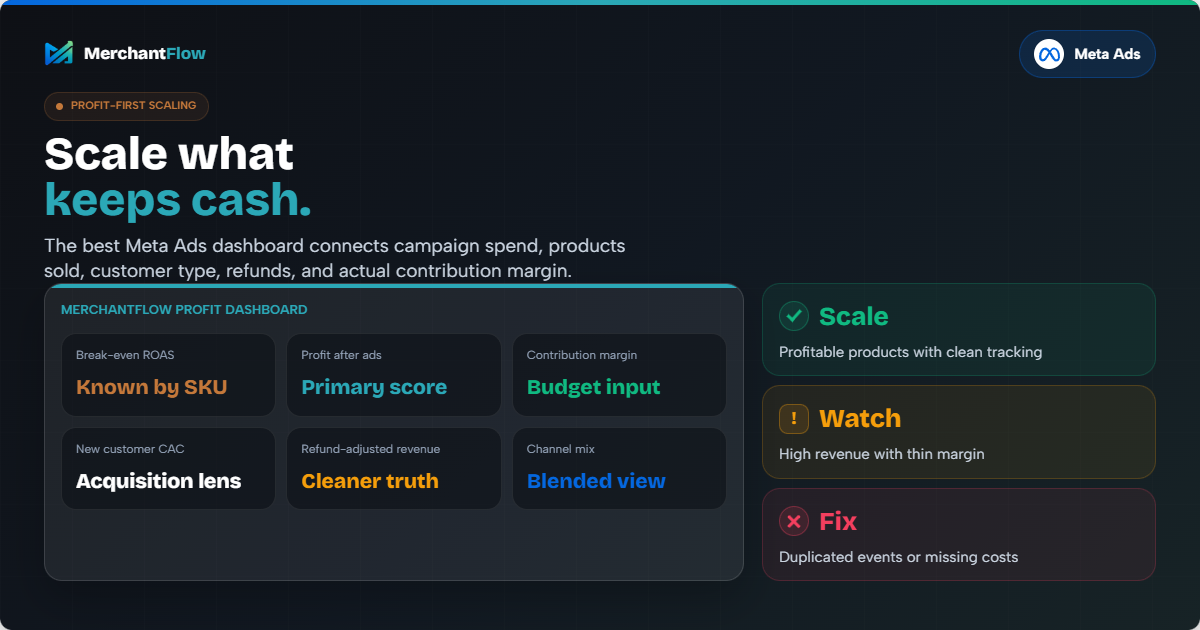
You can see:
- Meta Ads spend
- Store revenue
- COGS
- Fees
- Fulfilment costs
- Product-level margin
- Profit after ads
- Channel performance
- SKU-level profitability
The result is a clearer answer to the question most ecommerce dashboards still do not answer well:
Which products are actually making money after ads and cost of goods?
Final thoughts: Meta Ads are not the problem. Blind scaling is.
Meta Ads can still be one of the strongest growth channels for ecommerce brands.
But in 2026, the brands that win will not be the ones blindly chasing the highest ROAS.
They will be the ones that understand the full economics behind every sale.
That means knowing:
- Which campaigns drive profitable revenue
- Which products are safe to scale
- Which creatives attract valuable customers
- Which SKUs quietly drain margin
- Which channels contribute to real growth
Revenue is a signal. ROAS is a signal. But profit is the outcome.
If you are spending serious money on Meta Ads, you do not need another dashboard full of vanity metrics.
You need to know what is actually making money.

About the author
Georgia CarapetisGeorgia Carapetis is Head of Marketing at MerchantFlow, helping ecommerce brands stop obsessing over ROAS and start focusing on profit. She writes about Google Shopping, contribution margins, and scaling without shrinking your margins.