
TikTok can make a weak acquisition strategy look like a strong one.
That is the real risk.
You open Ads Manager and see healthy ROAS, rising conversions, low CPMs, and plenty of activity. On the surface, everything looks like it is moving in the right direction. But once you compare that performance against contribution margin, repeat purchase behaviour, and actual customer value, the picture can change fast.
This is where a lot of ecommerce brands get caught.
TikTok is very good at creating demand. It is also very easy to over-credit for revenue that was influenced by other channels, closed later through branded search or email, or driven by customers who never become meaningfully profitable.
That does not make TikTok a bad channel. It makes it a channel that needs to be measured properly.
If you care about profit, not just platform-reported performance, TikTok cannot be judged by ROAS alone.
Why TikTok often looks more profitable than it really is

The biggest reporting mistake brands make on TikTok is treating attributed revenue as if it were the same thing as incremental revenue.
It is not.
Depending on your attribution settings, TikTok can take credit for both click-through and view-through conversions. So someone might see your ad, do nothing immediately, then return later through Google, direct traffic, or email and still show up inside TikTok’s reporting.
That does not mean TikTok had no role in the sale.
It does mean TikTok should not automatically get full credit for causing it.
This is the gap that trips brands up. A campaign can look great in-platform while telling a very different story when you look at what the business actually kept.
And attribution is only one part of the problem.
TikTok reports conversions. It does not tell you whether those conversions came from high-quality customers.
A customer who buys once, never returns, and orders a low-margin product is not as valuable as a customer who comes back, buys again, and pays back CAC quickly. TikTok can show you conversion volume. It cannot tell you the full economic value of those customers unless you connect that data yourself.
That is why experienced operators ask different questions:
- How much did it cost to acquire the customer?
- What was left after COGS, shipping, fees, and discounts?
- Did the customer come back?
- How long did payback take?
- How does TikTok compare with Google, Meta, email, and organic when you look at profit, not just revenue?
Those are the questions that protect margin.
The five metrics that matter more than TikTok ROAS
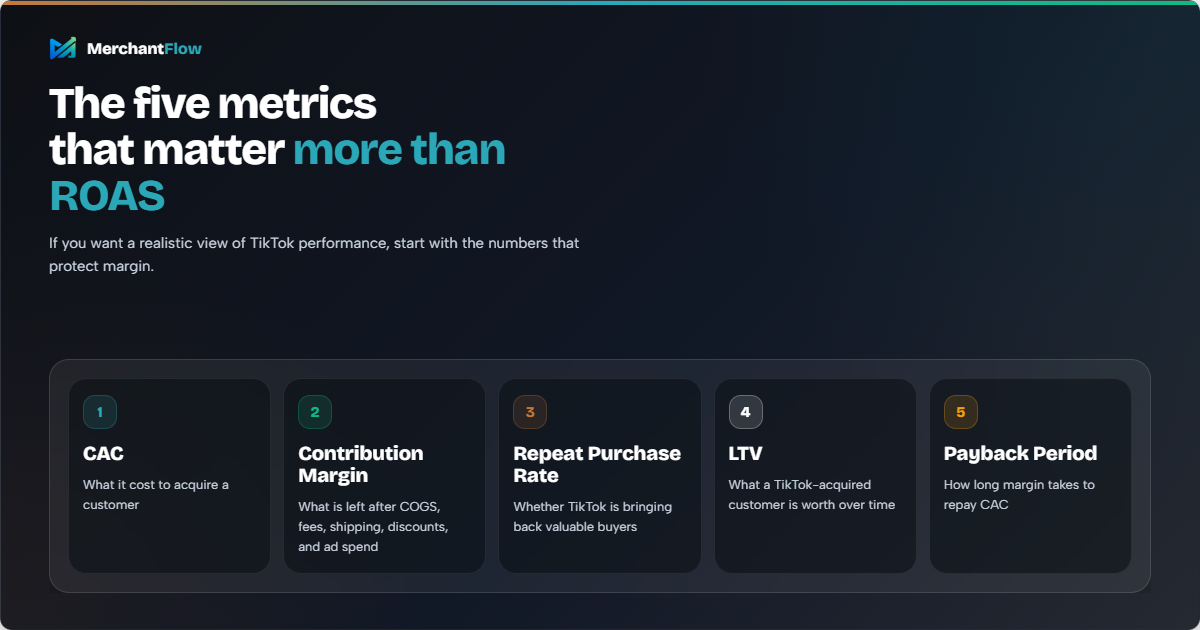
If you want a realistic view of TikTok performance, start with five core metrics.
- Customer acquisition cost
How much are you actually paying to acquire a customer from TikTok? Not a click. Not a landing page view. Not an add to cart. A customer.
Track CAC by campaign, product category, and cohort where possible. Blended numbers hide too much. A channel can look fine at a high level while specific products or campaigns are quietly losing money.
- First-order contribution margin
Revenue is not profit. Look at what is left after COGS, shipping, transaction fees, platform fees, discounts, and ad spend. This is one of the fastest ways to spot the difference between a campaign that drives revenue and one that drives usable margin.
A product can convert well on TikTok and still be the wrong product to scale if contribution margin is too thin.
- Repeat purchase rate
This is where customer quality starts to show.
Some brands find TikTok drives strong first-order volume but weaker repeat behaviour than channels like email or branded search. Others find specific products or creative angles bring in surprisingly strong repeat buyers. The point is not to assume either way. The point is to measure it.
- Customer lifetime value
Your CAC ceiling should be shaped by what a customer is worth over time.
If you do not know what a TikTok-acquired customer is worth over six or twelve months, you are making budget decisions with only half the picture.
- Payback period
How long does it take for contribution margin to cover the cost of acquisition?
That matters a lot when cash flow gets tighter.
But, the broader point is simple... TikTok can help create demand, but your business needs to judge whether that demand is profitable.
Why your TikTok tracking might be lying to you
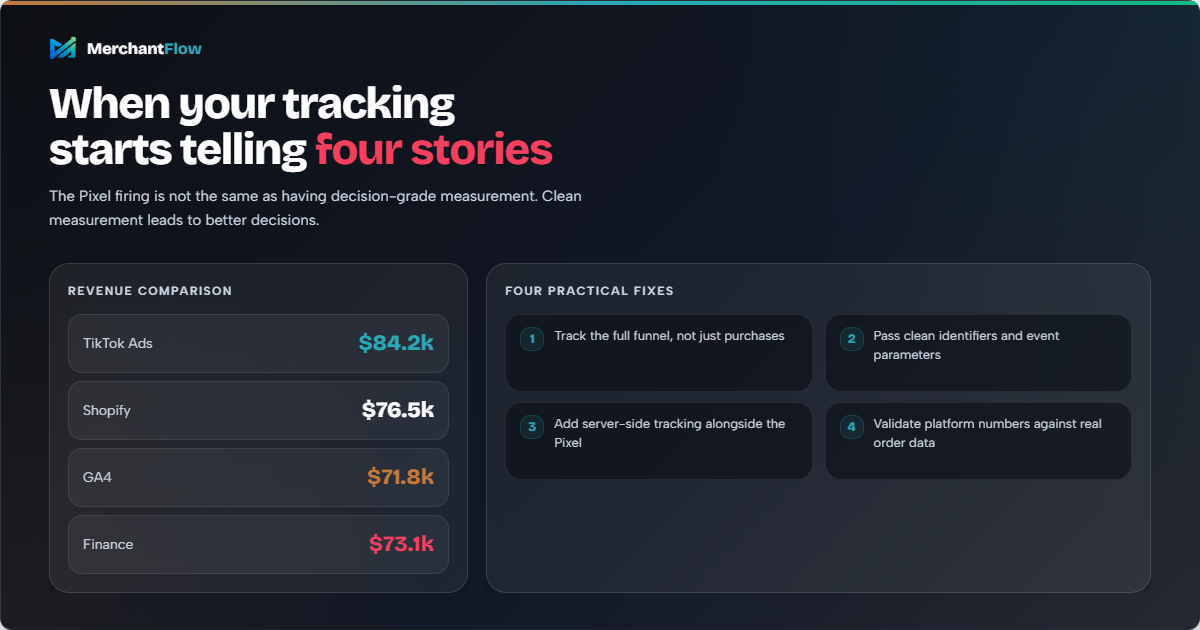
A lot of TikTok performance problems are really measurement problems.
The account gets set up. The Pixel fires. Purchases appear in Ads Manager. Everyone assumes tracking is good enough.
Then a few months later, TikTok, Shopify, GA4, and finance are all telling slightly different stories.
This is not unusual.
Browser-side tracking is less dependable than it used to be. Privacy changes, blockers, cookie limitations, and implementation issues all create gaps. That is why a more durable setup matters.
At a practical level, there are four things worth getting right.
First, track the full funnel, not just the purchase. Product views, add-to-cart, checkout initiation, and completed purchases all matter. If you only measure the end of the journey, you lose visibility into where quality starts to drop.
Second, pass the right parameters and customer identifiers where appropriate. Better matching usually means cleaner measurement.
Third, use server-side tracking alongside the Pixel when possible. It will not make the data perfect, but it usually makes it far more reliable.
Fourth, validate your reporting regularly. Compare TikTok’s numbers against actual order data, backend revenue, and what shows up in the store. Look for gaps, duplication, or changes after site updates.
Perfect measurement does not exist.
Reliable enough measurement to make good decisions does.
How much data TikTok needs before you trust the results
One of the easiest ways to get bad answers from TikTok is to ask too many questions at once.
Too many audience splits. Too many creative tests. Too many campaigns. Not enough spend or not enough conversion signal.
When that happens, performance becomes noisy. The algorithm struggles to stabilise, and you struggle to tell what is actually working.
This is where many brands talk themselves into false confidence. A creative looks like a winner after a few days. An audience looks cheap early on. A campaign appears to be scaling. Then the numbers shift because there was never enough data to trust the first read in the first place.
The fix is usually not more complexity. It is less.
Test fewer things at once. Consolidate where needed. Give campaigns enough time and signal to settle before making big calls. If spend is limited, a simpler structure usually produces better learning than trying to test every possible variable at the same time.
TikTok can be a powerful channel. It is not a magic one. It still needs enough clean data to do its job.
The creative mistake that quietly kills margin
TikTok is excellent at rewarding content that gets attention.
That does not mean it is rewarding content that brings in the best customers.
This is where many ecommerce teams get misled.
A creative can generate huge reach, cheap engagement, and plenty of front-end conversions while still attracting low-intent buyers, high return rates, weak repeat purchase behaviour, or poor-margin orders. Another creative might bring in fewer conversions, but better customers.
If you only optimise for clicks, views, CPA, or even front-end ROAS, you can easily back the wrong winner.
The better question is not, “Which ad got the most attention?”
It is, “Which ad brought in the best customers?”
That means looking beyond CTR and CPA. Look at first-order contribution margin. Look at AOV. Look at refund rate. Look at repeat purchase behaviour by creative angle after 30, 60, or 90 days.
This matters even more when your product mix has very different economics.
A low-margin bestseller is not always the right product to push hardest on TikTok. A product with healthy margin, strong differentiation, and better repeat potential may be far more scalable, even if it does not win on raw conversion volume.
The best TikTok creative usually does two things well.
It grabs attention quickly.
It pre-qualifies the buyer.
That means leading with a clear benefit, a strong use case, a specific pain point, or a credible point of differentiation. Not just chasing views for the sake of it.
Attention matters.
Qualified attention matters more.
How to measure TikTok's true incremental value

This is the uncomfortable question most brands avoid:
If TikTok disappeared tomorrow, how much of that reported revenue would still happen anyway?
That is what incrementality is really trying to answer.
Attribution tells you who got credit. Incrementality tells you what changed because the ads actually ran.
That is a much harder question, but it is the one that matters when budgets get bigger.
The cleanest way to get closer to the truth is through controlled testing. That could be a holdout test, a geo test, a lift study, or a broader measurement approach depending on your scale.
The logic is straightforward.
One comparable group sees TikTok ads.
Another does not.
You compare the difference in purchasing behaviour.
If the exposed group performs better, TikTok likely created incremental value. If the gap is smaller than the platform-reported result suggests, that tells you some of the attributed conversions would probably have happened anyway.
This is not about proving TikTok is ineffective.
It is about understanding how much value it is actually adding, so you can budget with more confidence.
At some scale, this becomes non-negotiable. Otherwise, you are not really measuring contribution. You are measuring platform claims.
Where TikTok belongs in a profit-first media mix
TikTok is not the same kind of channel as email, branded search, or retention.
For many brands, it plays an earlier role in the journey. It creates discovery. It broadens reach. It introduces the product to people who were not already looking for it.
That can be incredibly valuable.
But it also means TikTok should not always be judged by the same standards as channels that capture intent or drive repeat purchase more directly.
For many ecommerce brands, the strongest profit channels still sit closest to intent or retention:
- Email and SMS
- Branded search
- Organic search
- Referral
- Retention flows
Then you have acquisition channels like Google Shopping, Meta, and TikTok, which can all drive scale, but often with more volatility in CAC, customer quality, and downstream profit.
TikTok tends to work best when the product has strong visual appeal, obvious differentiation, fast comprehension in-feed, or a compelling reason to stop scrolling.
That does not automatically make it a top-tier profit channel.
It makes it a channel that needs to earn its place through the numbers.
The mistake is letting platform excitement decide budget allocation.
Your unit economics should decide that.
Why most brands scale TikTok too early
Most brands do not fail on TikTok because the channel suddenly stops working.
They fail because they scale before they understand what is actually working.
A better process usually looks like this.
Phase 1: Test
Start with a small number of audience and creative combinations. Keep the structure focused enough that you can learn something useful from the results.
At this stage, you are trying to answer:
Which products can support acquisition?
Which hooks attract the right customer?
Which campaigns gather enough signal to judge properly?
Phase 2: Prove
Once you find something promising, resist the urge to declare victory too early.
Give it enough time and enough density to see whether the economics remain healthy. This is where weak customer quality, poor repeat behaviour, and margin issues often begin to show up.
A campaign can look strong in month one and still turn mediocre once spend rises or creative fatigue starts to set in.
Phase 3: Scale
If the numbers still hold, scale carefully.
This is where brands often push too fast. Spend rises. CAC creeps up. Customer quality softens. Efficiency starts to erode. Sometimes slowly, sometimes very quickly.
That does not mean the channel is broken. It means you are reaching the point where marginal performance gets worse.
Phase 4: Know your ceiling
Every paid channel has a point where scale starts to cost more than it used to.
The strongest operators do not ignore that point. They plan around it.
That might mean holding spend steady, refreshing creative, shifting budget to better-margin products, or reallocating spend into channels with stronger downstream performance.
Scaling is not about how much the platform lets you spend.
It is about how much profitable growth your business can absorb.
Common TikTok mistakes that destroy profit
Most TikTok mistakes do not look like mistakes in the moment.
They look like momentum.
That is why they are expensive.
The first is optimising for views, engagement, or low CPMs without asking whether those signals are bringing in profitable customers.
The second is running without a clear CAC ceiling tied to actual LTV.
The third is treating every product the same, even when margin profiles are completely different.
The fourth is scaling based on front-end ROAS before enough time has passed to judge repeat purchase behaviour, return rate, and contribution margin.
The fifth is relying on blended reporting, which hides weak products, weak creatives, and weak cohorts.
The sixth is trusting platform attribution without pressure-testing it against incrementality and business outcomes.
The seventh is expecting TikTok to behave like a retention channel, when for many brands it works more like a discovery engine that needs email, Google, SMS, and brand strength to turn attention into long-term value.
TikTok can absolutely be profitable.
But it gets much more profitable when you stop asking only what TikTok says happened and start asking what the business actually kept.
Build a TikTok profitability dashboard that reflects reality
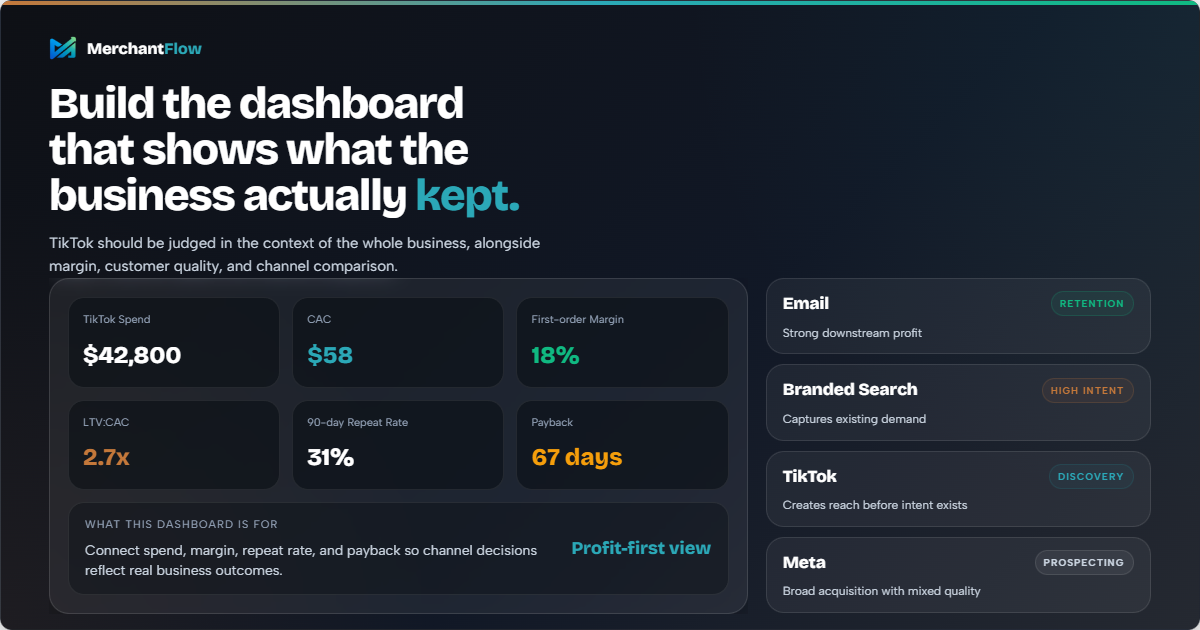
If you only use TikTok Ads Manager to judge performance, you are looking at the channel through the platform’s lens.
That is useful, but incomplete.
A better dashboard connects ad spend to real commercial outcomes.
At minimum, you should be tracking:
- Total TikTok spend
- Orders acquired
- Customer acquisition cost
- First-order contribution margin
- CAC by product or category
- Repeat purchase rate at 30, 60, and 90 days
- Estimated customer lifetime value
- LTV:CAC ratio
- Payback period
- Comparison with Google, Meta, email, and organic
This is where clarity starts.
You can see which products actually support paid acquisition. You can spot when customer quality starts slipping. You can tell the difference between a campaign that looks strong in-platform and one that is genuinely worth more budget.
For ecommerce teams, that is the difference between reporting and decision-making.
Why this matters more in 2026
Ecommerce brands are not short on data in 2026.
They are drowning in it.
TikTok has its numbers. GA4 has its numbers. Shopify has its numbers. Meta has its numbers. Google has its numbers. Finance has its own version of the truth again.
The problem is no longer access to data.
It is clarity.
Brands do not need another dashboard full of disconnected ad metrics. They need one place that connects spend, revenue, COGS, and product-level profitability so they can see what is actually happening underneath the platform reporting.
That is the gap MerchantFlow is built to solve.
MerchantFlow gives ecommerce brands a clearer view of the numbers TikTok alone cannot answer:
Which campaigns are driving profitable customers?
Which products can genuinely support paid acquisition?
Which SKUs look strong on revenue but weak on contribution margin?
Which channels deserve more budget based on real business outcomes, not just reported ROAS?
Because TikTok should not be judged in isolation.
It should be judged in the context of the whole business.
Final Thoughts
TikTok is not a bad channel.
It is not a scam. It is not impossible to make profitable. And for the right brand, it can be one of the most powerful acquisition engines in the mix.
But it is also one of the easiest channels to misread if you only look at the numbers inside the platform.
If you measure TikTok by attributed ROAS alone, you will often overestimate how well it is performing.
If you measure it by CAC, contribution margin, repeat purchase rate, LTV, and payback period, you will make much better decisions.
That is the difference between running TikTok ads and actually understanding whether TikTok is helping your business grow profitably.
And that is exactly where MerchantFlow makes a difference.
MerchantFlow helps ecommerce brands move beyond platform-reported performance and see what is really driving profit at the product and channel level, so you can scale with more confidence and less guesswork.

About the author
Georgia CarapetisGeorgia Carapetis is Head of Marketing at MerchantFlow, helping ecommerce brands stop obsessing over ROAS and start focusing on profit. She writes about Google Shopping, contribution margins, and scaling without shrinking your margins.