
A few years ago, solving almost any problem in your Shopify store meant one thing: finding an app.
Need better product descriptions? Install an app.
Need another report? Install an app.
Need customer segmentation, SEO help, image editing, an automation or a custom workflow? There was probably an app for that too.
For many merchants, the result was predictable. Ten, fifteen or twenty subscriptions, overlapping features, data scattered across different dashboards and an app bill that quietly kept growing.
Then AI arrived.
Shopify now has Sidekick and Shopify Magic built into its platform. Merchants can use AI to analyse store information, create content, manage products, build workflows and even generate certain internal Shopify apps using everyday language. Shopify also supports connections between stores and third-party AI tools.
So it is reasonable to ask:
Do Shopify stores still need apps at all?
Yes.
But probably not as many as they used to.
AI is beginning to replace some of the things merchants previously needed standalone apps for. At the same time, it is making another category of ecommerce software more valuable: the platforms that provide AI with reliable data, calculations and specialised capabilities it cannot create for itself.
That distinction matters.
The future is unlikely to be AI instead of apps.
It is much more likely to be AI sitting on top of a smaller number of specialised systems that actually understand and run the business.
And technologies such as the Model Context Protocol, or MCP, are beginning to make that future possible.
AI Is Changing What a Shopify App Needs to Be
Shopify's ecosystem now contains more than 16,000 apps covering areas such as marketing, fulfilment, merchandising, analytics and customer service.
Historically, many apps solved two problems at once.
They provided some underlying functionality, and they gave merchants a dashboard or interface for accessing it.
AI is rapidly reducing the value of the second part.
If you previously needed specialised software simply because it provided an easier way to write copy, query information, build a segment or configure a simple workflow, AI may now provide a faster interface.
Instead of working out where a report lives, you can ask a question.
Instead of manually building a customer segment, you can describe the customers you want.
Instead of navigating a workflow builder, you can explain the outcome you are trying to achieve.
Shopify Sidekick already works this way. It can analyse store information, complete tasks, generate content and work with supported third-party apps from a conversational interface.
That does not make specialised software obsolete.
It changes where the value lives.
Think of AI as the Interface, Not the Infrastructure
This is probably the most important distinction for ecommerce operators to understand.
AI is exceptionally good at interpreting requests.
It can summarise information, identify patterns, write content, generate code, explain results and help merchants interrogate data without learning complicated reporting tools.
But ecommerce businesses still need systems that reliably collect, store, synchronise and calculate that data.
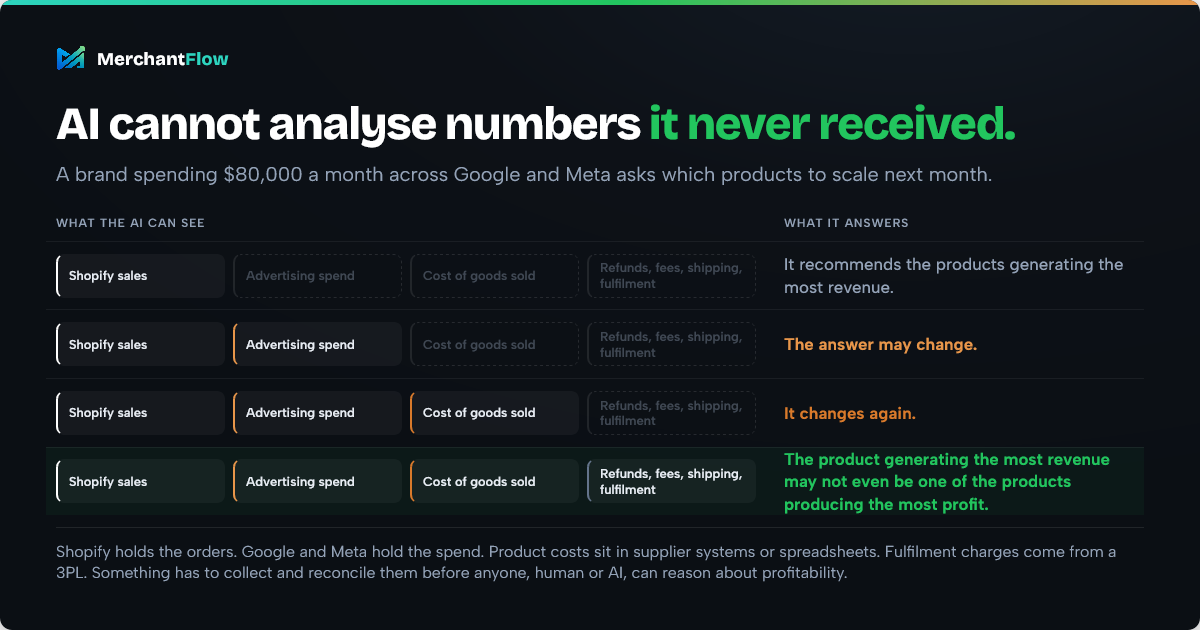
Consider a Shopify brand spending $80,000 a month across Google Ads and Meta Ads.
The founder asks an AI assistant:
"Which products should I scale next month?"
That sounds like an AI question.
But the quality of the answer depends almost entirely on what the AI can actually see.
If it only sees Shopify sales, it might recommend the products generating the most revenue.
Give it advertising spend and the answer may change.
Add cost of goods sold and it changes again.
Then add refunds, payment fees, shipping and fulfilment expenses.
Suddenly the product generating the most revenue may not even be one of the products producing the most profit.
The AI can reason about the numbers.
But first, something needs to collect, reconcile and structure those numbers correctly.
This is where MCP becomes interesting
Model Context Protocol, commonly called MCP, is an open standard for connecting AI applications with external data sources and tools. In practical terms, it allows an AI assistant to request information from another system rather than relying only on information pasted into a conversation.
For ecommerce, that is a major shift.
Instead of:
Export report → download CSV → upload CSV to AI → explain columns → ask question
the experience can become:
Ask the question.
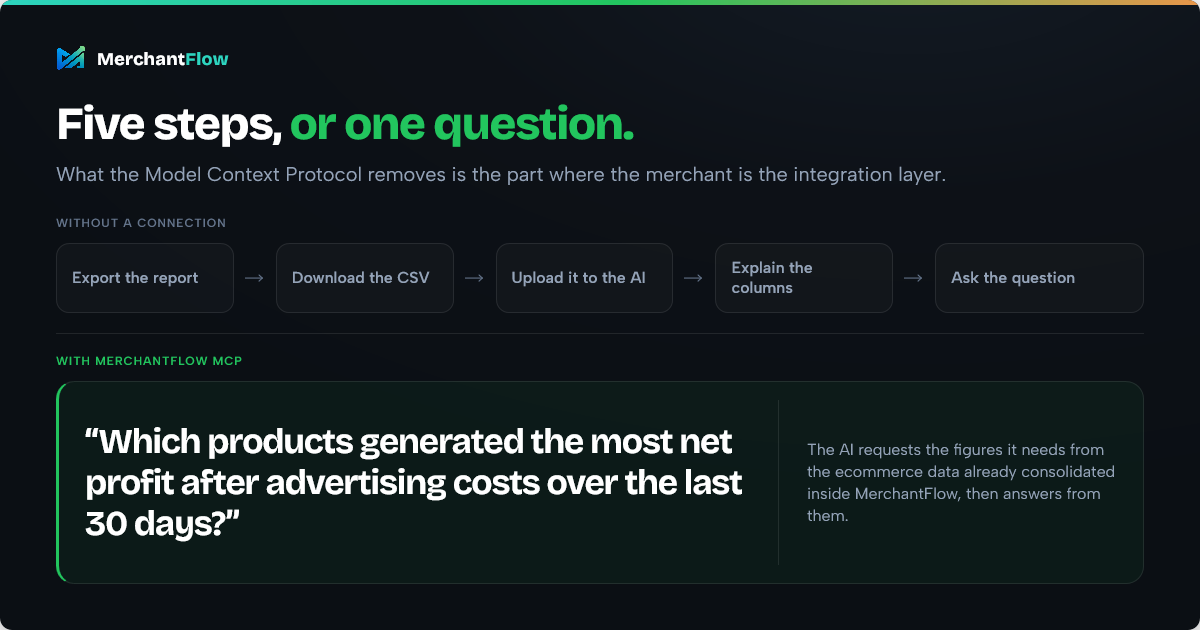
The AI retrieves the relevant information from a connected ecommerce system and uses it to answer.
This is already possible with MerchantFlow.
What MerchantFlow MCP Actually Changes
MerchantFlow's MCP connects compatible AI clients to the ecommerce data already consolidated inside MerchantFlow.
That means the merchant is not asking a generic AI model to guess what is happening in their store.
The AI can request structured information about the actual business.
MerchantFlow currently exposes more than 50 read-only MCP tools across areas including P&L, products, advertising, customers, COGS, inventory, orders, fulfilment, markets, reporting, business valuation and store audits.
So instead of opening multiple dashboards, a merchant could ask questions such as:
"What was my net profit over the last 30 days compared with the previous 30?"
"Which SKUs lost money after Meta ad spend this week?"
"Which products increased revenue but became less profitable?"
"What is my blended marketing efficiency ratio across Google, Meta, TikTok and Snapchat?"
"Which products have low margins despite strong ROAS?"
"Which inventory is moving slowly and tying up cash?"
"Summarise this week's P&L and tell me what changed most."
The important part is not simply that AI can answer a question.
It is what sits underneath the answer.
MerchantFlow already brings together commerce, advertising, cost and operational data. MCP then gives the AI a controlled way to query that information.
That is a very different proposition from copying last month's spreadsheet into ChatGPT and asking it to find patterns.
The Shopify Apps AI Can Already Replace or Reduce
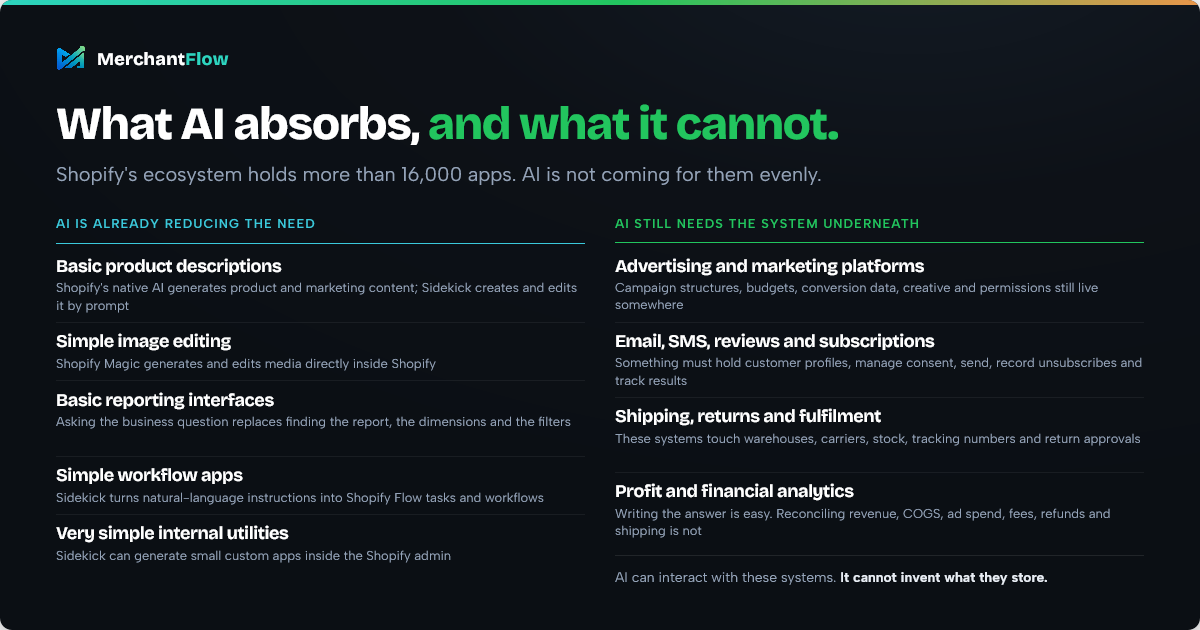
Not every app in your current stack deserves permanent protection.
Some categories are becoming increasingly vulnerable to Shopify's native AI capabilities and general-purpose AI tools.
Basic Product Description Apps
If you are paying for an app purely to produce straightforward product descriptions, that subscription is becoming harder to justify.
Shopify's native AI capabilities can already generate product and marketing content, while Sidekick can create and edit store content through natural-language prompts.
A specialised content app may still make sense if it provides large-scale catalogue management, localisation, brand governance or another significant workflow.
But "generates product descriptions using AI" is no longer much of a moat.
Simple Image Editing Apps
A similar shift is happening with basic creative work.
Shopify Magic can generate and edit media directly inside Shopify, including creating assets and changing product imagery.
Dedicated creative platforms will continue to matter for advanced workflows and professional teams.
But merchants increasingly need to question subscriptions that exist to perform a single simple task.
Basic Reporting Interfaces
This category could experience one of the biggest changes.
Traditional ecommerce reporting makes the merchant figure out which dashboard to open, what dimensions to select, which filters to apply and how to interpret the output.
AI reverses that interaction.
Instead of finding the report, you ask the business question.
"Why did revenue fall last week?"
"Which products have become less profitable this quarter?"
"What should I investigate from yesterday?"
This does not necessarily eliminate analytics platforms.
It raises the bar for them.
A reporting tool that simply reproduces information already available elsewhere may become harder to justify.
A platform that combines data the AI could not otherwise access becomes considerably more valuable.
That is an important difference.
Simple Workflow Apps
Some lightweight automation apps may also become unnecessary.
Sidekick can work with Shopify Flow and other parts of the Shopify admin to turn natural-language instructions into tasks and workflows.
What once required a dedicated tool may increasingly become:
"When this happens, do this."
Describe it.
Review it.
Activate it.
Very Simple Internal Utilities
Shopify has pushed this even further by allowing Sidekick to generate certain custom applications inside the Shopify admin.
Shopify gives examples including reorder recommendations, discount tools and internal task trackers. There are still limitations. Generated apps currently work within the Shopify admin and cannot access areas such as themes, checkout or customer account applications.
So this is not the end of the Shopify App Store.
But simple software is becoming much easier to create.
The Shopify Apps AI Is Much Less Likely to Replace
Now consider the opposite category.
These tools are valuable not because they have dashboards, but because they provide infrastructure, integrations, specialised calculations, proprietary datasets or persistent business logic.
Advertising and Marketing Platforms
AI can help interpret advertising performance.
It does not eliminate the infrastructure required to operate campaigns across Google, Meta, TikTok and other channels.
Campaign structures, budgets, conversion data, creative assets, account permissions and historical performance still live somewhere.
AI may become the interface.
The underlying systems still matter.
Email, SMS, Reviews and Subscriptions
Ask an AI assistant:
"Build a win-back campaign for customers who have not ordered in 120 days."
The AI can potentially help define the segment and write the campaign.
But something still needs to maintain customer profiles, manage consent, send the emails, record unsubscribes and track campaign performance.
The same applies to subscription schedules, loyalty points and verified reviews.
AI can interact with these systems.
It cannot simply invent the underlying records.
Shipping, Returns and Fulfilment
These applications interact with physical operations.
Warehouses.
Carriers.
Stock.
Tracking numbers.
Return approvals.
Fulfilment systems.
AI may improve decision-making around those processes, but reliable infrastructure is still required underneath.
Profit and Financial Analytics
This is where the difference between AI capability and data capability becomes especially clear.
Ask:
"What was my profit last month?"
Writing the answer is easy.
Calculating the right answer is not.
The system may need to reconcile:
Revenue, discounts, refunds, cost of goods sold, advertising spend, payment fees, shipping, fulfilment costs and operating expenses.
An AI assistant can analyse that information brilliantly once it has it.
But it should not be expected to manufacture missing financial data.
Profit Analytics Shows Why Specialised Apps Still Matter
Imagine a Shopify merchant asks:
"What were my best-performing products this month?"
Their Shopify data says:
| Product | Revenue |
|---|---|
| Product A | $80,000 |
| Product B | $55,000 |
| Product C | $42,000 |
Product A looks like the obvious winner.
Then you add advertising spend.
| Product | Revenue | Ad Spend |
|---|---|---|
| Product A | $80,000 | $30,000 |
| Product B | $55,000 | $9,000 |
| Product C | $42,000 | $5,000 |
The picture changes.
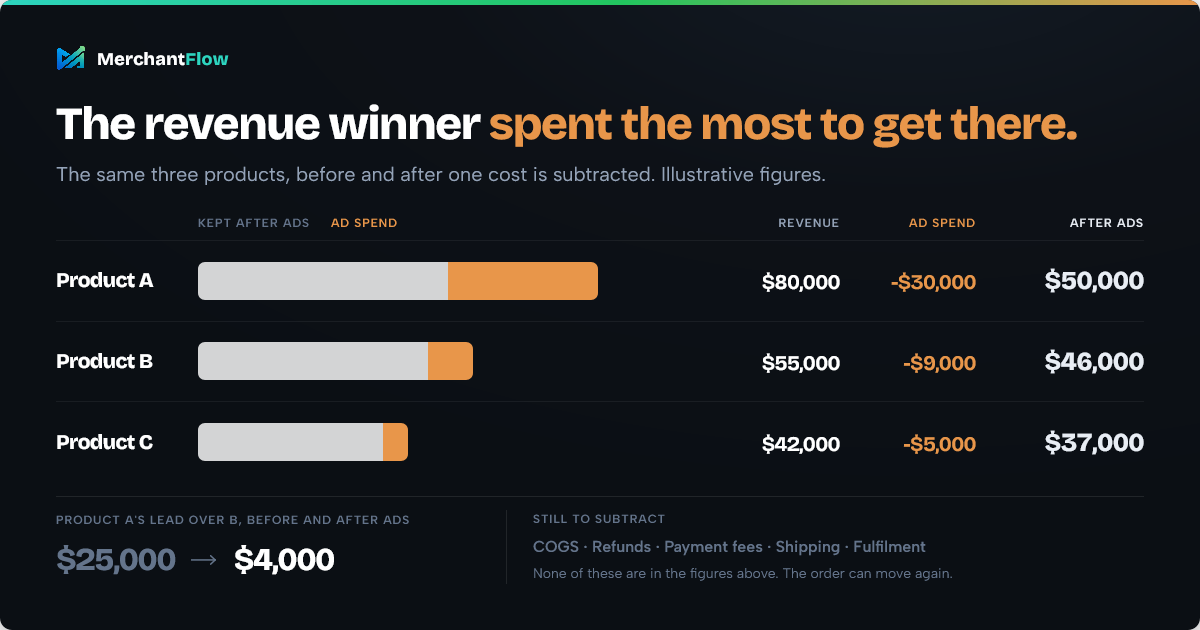
Now add COGS.
Then refunds.
Payment fees.
Shipping.
Fulfilment.
The product generating the most revenue may no longer be the product creating the most contribution profit.
This is not primarily an AI problem.
It is a data integration and profitability calculation problem.
And this is precisely where the relationship between MerchantFlow and AI becomes useful.
MerchantFlow performs the specialised ecommerce work underneath. It connects sources such as Shopify or WooCommerce with advertising channels, costs and other ecommerce data to create a unified view of performance.
MCP then makes that data available to the merchant through an AI interface.
So instead of asking AI:
"Here is a CSV. Can you tell me which products look profitable?"
you can ask:
"Which products generated the most net profit after advertising costs over the last 30 days?"
That distinction sounds small.
Operationally, it is enormous.
MCP Could Be the Missing Link Between AI and Your Ecommerce Stack
For years, ecommerce software has been built around dashboards.
Every application has its own login.
Its own navigation.
Its own reports.
Its own definition of important metrics.
The merchant becomes the integration layer.
You check Shopify.
Then Google Ads.
Then Meta.
Then your fulfilment platform.
Then your spreadsheet.
Then your analytics platform.
Then you try to reconcile what all those systems are telling you.
AI has the potential to dramatically reduce that friction, but only when it has a reliable way to interact with those systems.
That is what makes MCP important.
The Model Context Protocol is designed as an open standard rather than something tied exclusively to one AI vendor. Anthropic originally created MCP and later donated it to the Agentic AI Foundation under the Linux Foundation. It has since been adopted across a growing range of AI products and developer tools.
For a merchant, the technical details are less important than the practical outcome:
Your AI assistant can become a new interface for your ecommerce stack.
MerchantFlow's implementation is a good example.
Connect MerchantFlow to a compatible AI client, and that client can request the specific MerchantFlow data required to answer a question.
You are no longer limited to whatever charts happen to be on today's dashboard.
You can investigate the business conversationally.
That might look like:
"My revenue is up this month. Am I actually making more money?"
Followed by:
"Which products explain the difference?"
Then:
"Is the decline coming from higher ad spend, worse product margins or refunds?"
Then:
"Which three products should I investigate first?"
The interaction becomes a conversation instead of a reporting workflow.
AI May Actually Make the Best Shopify Apps More Valuable
This is why the claim that "AI will kill Shopify apps" misses the most interesting part of what is happening.
AI could make weak apps less necessary.
It could make strong apps more valuable.
Imagine a specialised platform has already done the difficult work of integrating years of orders, product costs, advertising spend, fulfilment data and customer behaviour.
Before AI, the merchant's ability to extract value from that data depended heavily on the interface.
They had to know which report to open.
Which filters to use.
Which date range mattered.
Which metric answered their question.
Once that platform can expose its capabilities to an AI assistant, the same dataset becomes dramatically easier to explore.
This is essentially the model MerchantFlow MCP uses.
MerchantFlow remains the specialised ecommerce data and calculation layer.
The AI becomes another way to access it.
That separation is important because it means the AI does not have to become your ecommerce database, attribution platform, inventory system and profit engine.
It can concentrate on what AI is particularly good at:
understanding what you are asking and helping you reason about the answer.
But Can You Trust AI With Your Store Data?
This is another question merchants should ask more often.
Convenience should not mean giving an AI unrestricted control over the business.
MerchantFlow's MCP is currently designed as a read-only connection. Its MCP tools can retrieve information, but they cannot create, edit or delete store data through the connection. Access is scoped and can be revoked.
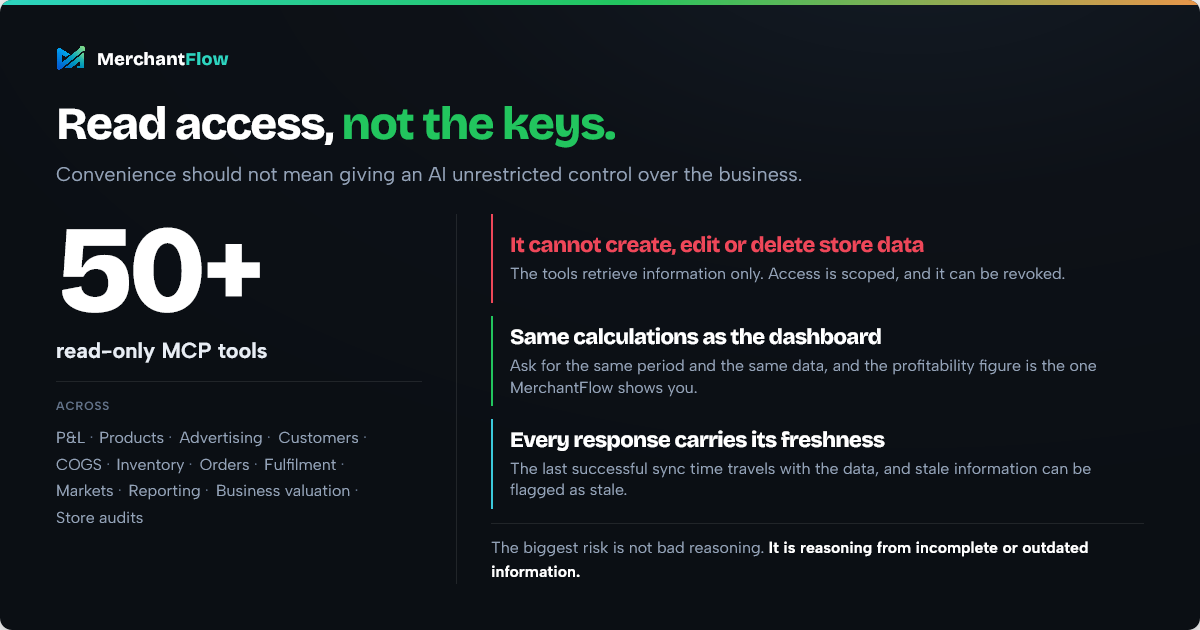
MerchantFlow also states that MCP queries use the same underlying calculations as the MerchantFlow dashboard. If the same period and data are requested, the goal is for the profitability calculation exposed to the AI to match what the merchant sees inside MerchantFlow.
There is another useful detail.
MerchantFlow includes data freshness information in its MCP responses, including the last successful sync time, and can flag when information is stale.
That matters because one of the biggest risks with AI business analysis is not necessarily bad reasoning.
It is reasoning from incomplete or outdated information.
The Real Future: Fewer Apps, Better Apps, Better Connections
The average Shopify merchant should not interpret AI as a reason to delete every application.
It should be a reason to audit the stack.
The question is no longer simply:
"Does this app have AI?"
Almost everything will eventually claim to have AI.
A better set of questions is:
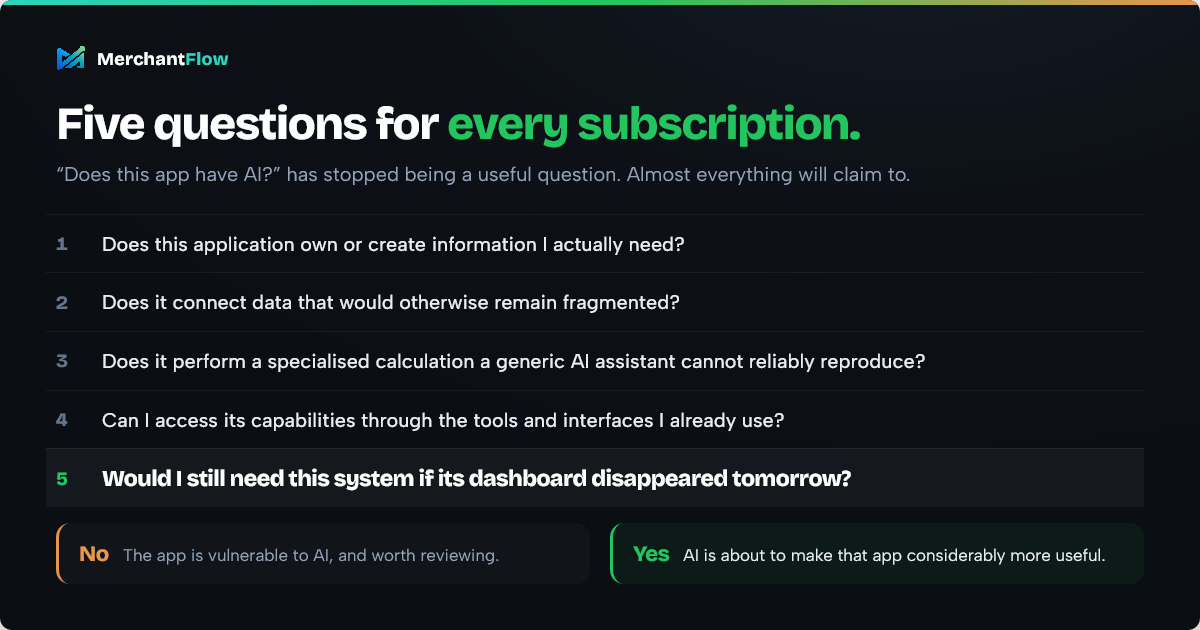
Does this application own or create information I actually need?
Does it connect data that would otherwise remain fragmented?
Does it perform a specialised calculation or workflow that a generic AI assistant cannot reliably reproduce?
Can I access its capabilities through the tools and interfaces I already use?
Would I still need this system if its dashboard disappeared tomorrow?
That final question is particularly useful.
If the answer is no, the app may be vulnerable to AI.
If the answer is yes because the application is collecting, calculating, integrating or operating something important, AI may actually make that application more useful.
A Better Shopify Tech Stack for the AI Era
One useful way to think about the future ecommerce stack is as three layers.
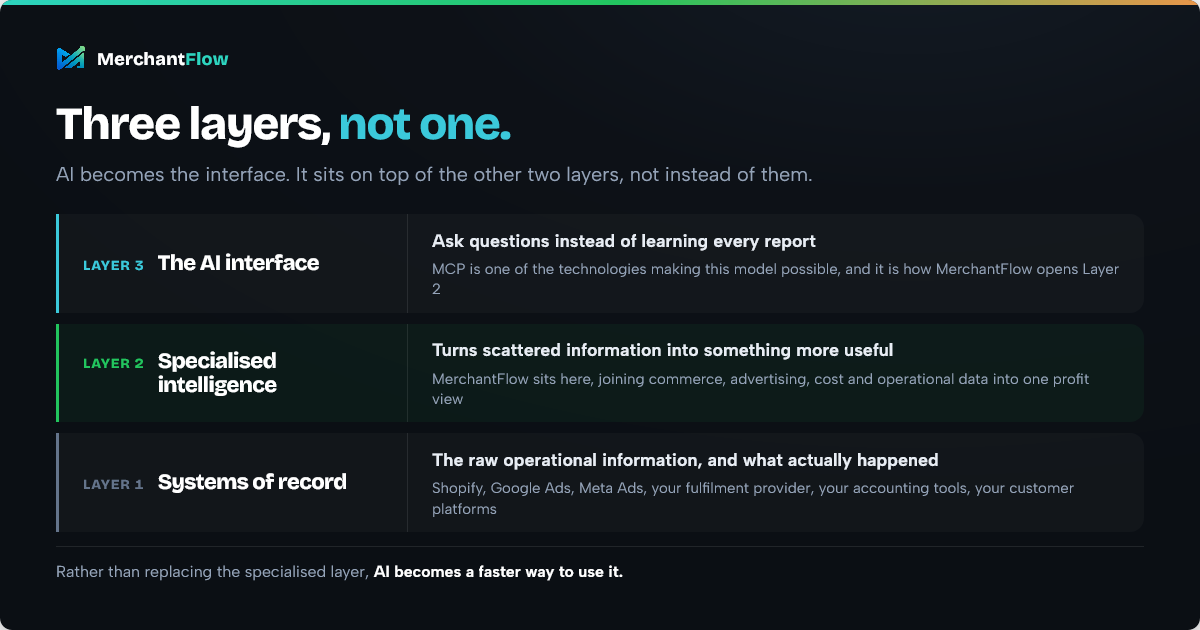
Layer 1: Systems of Record
These contain the raw operational information.
Shopify. Google Ads. Meta Ads. Your fulfilment provider. Your accounting tools. Your customer platforms.
They need to be reliable because they represent what actually happened.
Layer 2: Specialised Intelligence
This layer takes information from different systems and turns it into something more useful.
MerchantFlow sits here.
Shopify knows what was ordered.
Meta knows what was spent on Meta.
Google knows what was spent on Google.
Your cost records know what products cost.
Your fulfilment system knows what it cost to deliver them.
MerchantFlow brings those signals together so merchants can analyse the business around profitability rather than isolated platform metrics.
Layer 3: The AI Interface
Now add AI.
Instead of learning every report in Layer 1 and Layer 2, the merchant can increasingly ask questions across them.
MCP is one of the technologies making that model possible.
MerchantFlow's MCP effectively opens the specialised intelligence layer to compatible AI clients.
So rather than replacing MerchantFlow, AI can become a faster way to use MerchantFlow.
That is an important glimpse into what ecommerce software may look like over the next several years.
Your AI Is Only as Good as the Data You Give It
This may be one of the defining ecommerce lessons of the AI era.
Merchants are gaining extraordinary new ways to interrogate their businesses.
But asking smarter questions does not fix fragmented data.
A store owner might ask:
"Are my Meta ads profitable?"
An AI could analyse Meta ROAS.
But ROAS is not profit.
It might analyse Shopify revenue.
But revenue alone does not tell you what the business kept. Our guide to how to calculate true Shopify net profit breaks down the costs that need to sit underneath that number.
To answer properly, the system may need ad spend, attributed revenue, COGS, transaction fees, refunds, shipping and fulfilment costs.
Without those inputs, the AI can produce a very convincing explanation of an incomplete version of the business.
Shopify itself warns that AI-generated output can contain errors and recommends reviewing AI-generated information and actions.
So the competitive advantage may not come from having access to AI.
Almost every merchant will have access to AI.
The advantage will come from what the AI has access to.
Good context. Accurate costs. Connected platforms. Reliable calculations. Current data.
That is where specialised platforms still matter.
So, Should You Delete Your Shopify Apps?
Probably some of them.
Not all of them.
If you have accumulated applications over several years, now is an excellent time to review what each one actually contributes.
AI is making basic content generation, simple reporting, lightweight automation and small internal utilities dramatically easier.
Those categories will continue to face pressure.
But software that provides genuine infrastructure, integrations, persistent data, specialised calculations or proprietary business logic is not disappearing.
It is evolving.
And increasingly, you may not interact with those systems by clicking through another dashboard.
You may interact with them through AI.
That is the more interesting future.
You spend less time asking:
"Where is that report?"
And more time asking:
"What happened?"
"Why did it happen?"
"What is costing me money?"
"Which products should I investigate?"
"What should I do next?"
The interface changes.
The need for trustworthy ecommerce data does not.
FAQ
Will AI replace Shopify apps?
AI will likely replace or reduce the need for some Shopify apps, particularly basic content generators, simple reporting interfaces, lightweight automations and small administrative utilities. Apps that provide integrations, persistent business data, operational infrastructure or specialised calculations are much harder to replace.
Can ChatGPT or Claude replace Shopify analytics apps?
They can perform impressive analysis when given the right data, but they do not automatically have access to every part of an ecommerce business. The quality of the analysis depends on the information available to the model. Technologies such as MCP can help specialised analytics platforms expose relevant data to compatible AI assistants.
What is MCP in ecommerce?
MCP stands for Model Context Protocol. It is an open standard that allows AI applications to connect with external tools and data sources. For ecommerce, this can allow an AI assistant to retrieve authorised information from platforms such as analytics or operational systems rather than requiring merchants to manually export and upload reports.
What is MerchantFlow MCP?
MerchantFlow MCP is a read-only connection between MerchantFlow and compatible AI clients. It lets merchants ask questions about areas such as P&L, product profitability, advertising, customers, inventory, orders and COGS using data available through MerchantFlow. MerchantFlow currently exposes more than 50 read-only MCP tools.
Can Shopify Sidekick replace third-party apps?
In some cases. Sidekick can create content, analyse Shopify data, complete tasks and generate certain internal applications. It can also work with supported third-party Shopify apps. That suggests Shopify's own direction is not simply to eliminate apps, but to make AI a new interface for working with them.
Which Shopify apps will still matter in an AI-first world?
Apps that own important integrations, infrastructure, datasets or business logic are likely to remain valuable. Examples include fulfilment platforms, subscription systems, email infrastructure, accounting systems, attribution platforms and profit analytics software. AI can make those systems easier to use without necessarily replacing the systems themselves.
Give Your AI Better Ecommerce Data
The next generation of ecommerce analytics may not start with another dashboard.
It may start with a question.
"Why did profit fall yesterday?"
"Which products are actually making money after advertising costs?"
"Where am I losing margin?"
"What changed this week that I should care about?"
MerchantFlow brings your ecommerce, advertising and cost data together into one profit-focused analytics layer.
And with MerchantFlow MCP, you can connect that intelligence to compatible AI tools and ask questions about your actual business data in plain English.
No manually exporting last month's CSV.
No piecing together five dashboards before you can ask the question.
No pretending revenue and ROAS are the same thing as profit.
Connect your store, give your AI better context and start making decisions around the numbers that actually matter.
Explore MerchantFlow MCP and start your free trial.

About the author
Georgia CarapetisGeorgia Carapetis is Head of Marketing at MerchantFlow, helping ecommerce brands stop obsessing over ROAS and start focusing on profit. She writes about Google Shopping, contribution margins, and scaling without shrinking your margins.