Most ecommerce brands try to fix profitability after the sale has already happened.
They adjust ad campaigns. They test new creatives. They raise prices. They push bundles. They look for a better ROAS target.
All of that can help, but it does not solve one of the biggest margin problems sitting underneath the business: the product may simply cost too much to sell profitably.
If your cost of goods sold is too high, every other part of the business has less room to work. Google Shopping becomes harder to scale. Meta Ads need to perform more efficiently. Discounts become riskier. Free shipping thresholds become harder to justify. A product that looks like a winner in Shopify can quietly become a weak-margin product once product costs, ad spend, refunds, payment fees, shipping and fulfilment costs are included.
That is why negotiating better COGS is not just a supplier conversation. For ecommerce brands, it is a margin lever, a marketing lever and a growth lever.
This guide explains how to identify which products are worth negotiating, calculate your true landed cost, prepare a stronger supplier case and measure whether the negotiation actually improves profitability.
What does COGS mean in ecommerce?
COGS stands for cost of goods sold. In ecommerce, it usually refers to the direct cost of acquiring, manufacturing or producing the products you sell.
Depending on your business model, COGS may include the wholesale or manufacturing cost of the product, materials, components, product packaging, customisation, labelling, inbound freight, duties, import costs and quality control costs tied directly to production.
It usually does not include ad spend, platform fees, payment fees, software subscriptions, warehouse rent or general overheads. Those costs still matter, but they sit outside basic COGS.
The distinction matters because COGS affects gross margin.
Gross margin shows how much revenue is left after direct product costs are removed. A simple version is:
Gross margin = (Revenue - COGS) / Revenue
Shopify’s profit reporting documentation explains that gross margin is calculated using net sales and cost, and that discounts and refunds can affect reported margin. Shopify also notes that profit reporting depends on cost being recorded for products and variants at the time they were sold.
For ecommerce operators, there are three related numbers worth separating:
COGS is the direct cost of the product.
Landed cost is the full cost of getting the product ready to sell, which may include inbound freight, duties, packaging and other direct import or production costs.
Contribution margin shows what remains after variable selling costs, such as ad spend, fulfilment costs, shipping subsidies and payment fees.
A product can have a healthy gross margin and still produce weak contribution profit if it is expensive to advertise, ship, fulfil or refund.
Why better COGS can be more powerful than more revenue
Revenue growth can hide margin problems.
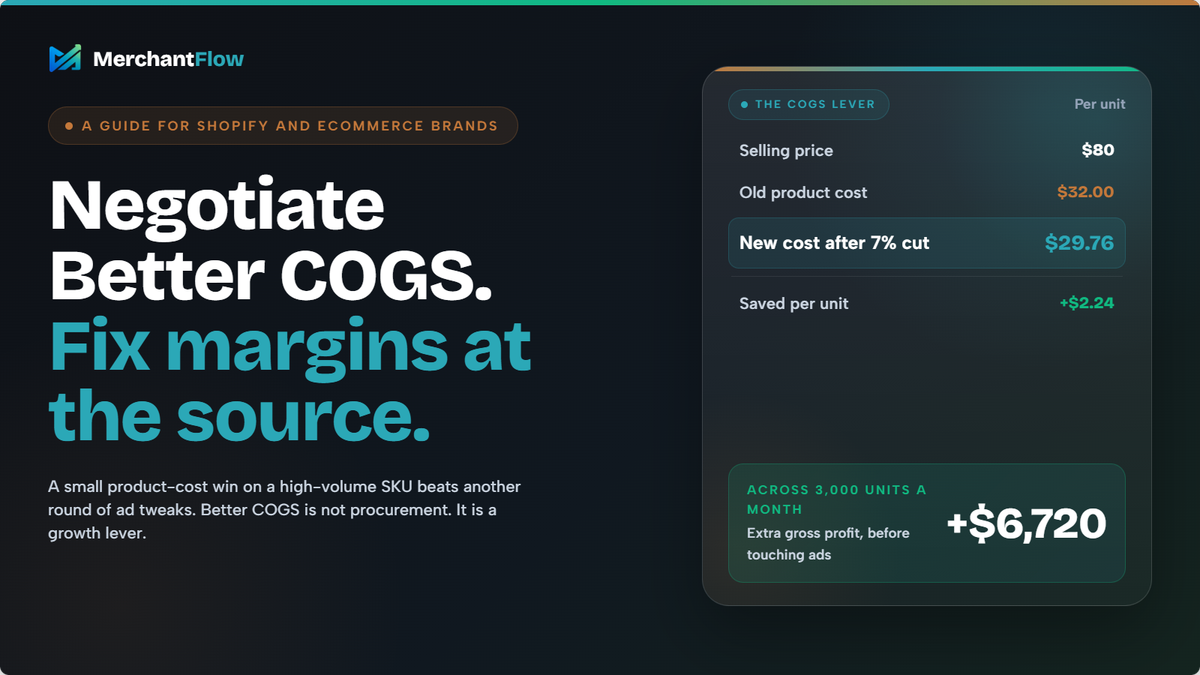
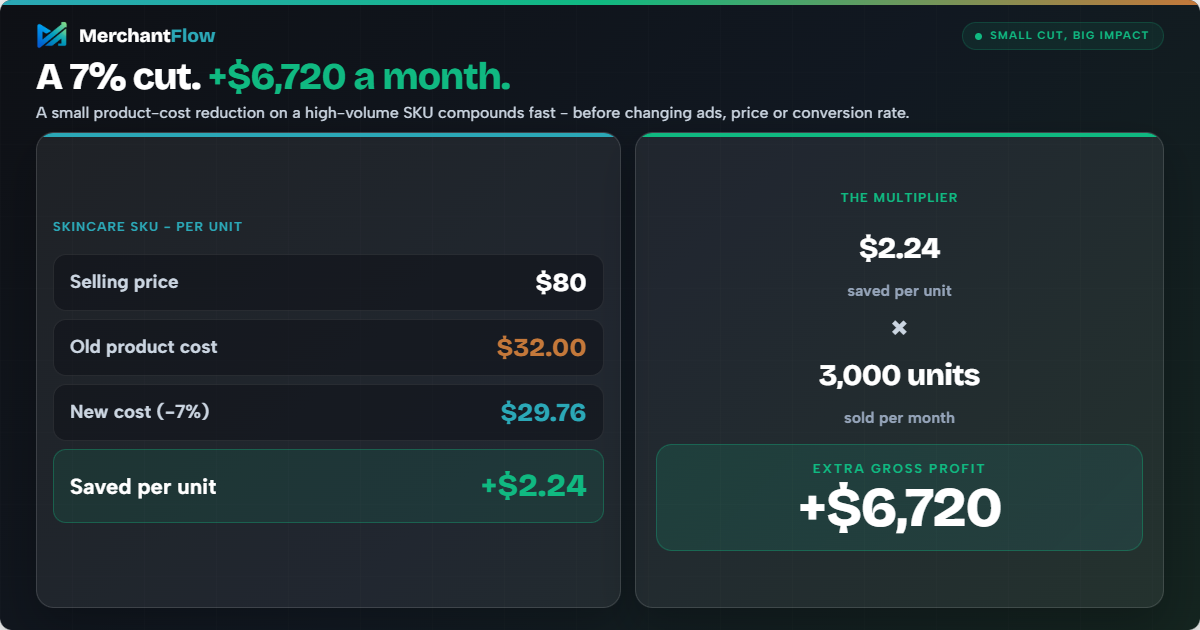
Imagine a Shopify brand sells a skincare product for $80.
The current numbers look like this:
- Selling price: $80
- Product COGS: $32
- Gross profit: $48
- Gross margin: 60%
At first glance, that looks healthy.
But once the brand adds ad spend, fulfilment, shipping subsidies, payment fees and refunds, the actual profit per order may be much lower.
Now imagine the brand negotiates a 7% reduction in product cost.
- Old COGS: $32
- New COGS: $29.76
- Saving per unit: $2.24
That $2.24 may not sound dramatic, but if the brand sells 3,000 units per month, that is $6,720 in additional gross profit before changing ads, pricing or conversion rate.
This is why COGS matters so much.
A small improvement on a high-volume product can create meaningful profit impact. It can also make paid acquisition more forgiving. A product with stronger margin can tolerate higher customer acquisition costs, absorb occasional discounting, support better bundles and remain viable when ad costs fluctuate.
The common mistake: negotiating from emotion instead of data
Many ecommerce founders approach suppliers with a vague request:
“Can you do a better price?”
The problem is that this gives the supplier very little to work with. It sounds like a demand, not a commercial plan.
A stronger negotiation starts with data.
Before asking for better pricing, you need to understand:
- Which products matter most to revenue
- Which products have weak gross margin
- Which products have strong revenue but weak contribution profit
- Which products are being pushed heavily through Google Shopping, Performance Max or Meta Ads
- Which variants have the highest reorder volume
- Which products have high refund, return or defect costs
- Which products are close to becoming unprofitable
This is where many ecommerce brands struggle.
Supplier invoices sit in one place. Shopify product costs sit somewhere else. Google Ads and Meta Ads show platform performance, but not always true product-level profit. Fulfilment costs may live in a warehouse export or spreadsheet. Refunds and payment fees may be reviewed separately.
The result is a common negotiation problem: brands often negotiate the products they notice, not necessarily the products that would create the biggest profit improvement.
Step 1: Identify which products are worth negotiating first
You do not need to renegotiate every product at once.
Start with the products where a COGS improvement would have the highest commercial impact.
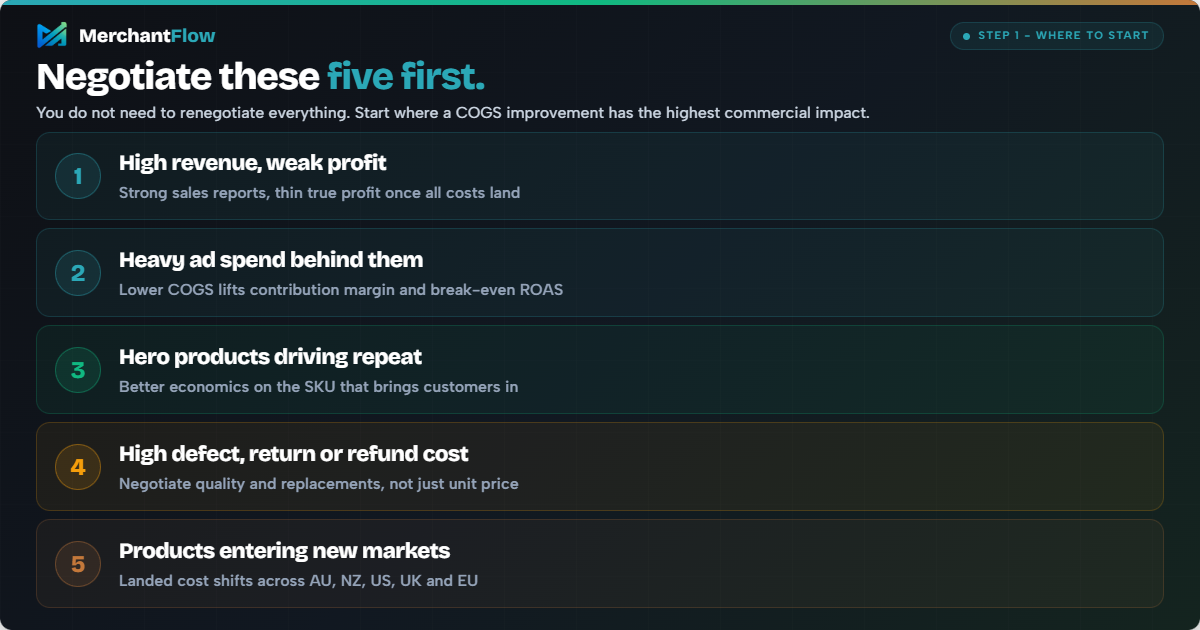
High-revenue products with weak contribution profit
These are products that look strong in Shopify revenue reports but disappoint once true costs are included.
For example, a homewares brand may have a bestselling lamp that generates strong monthly sales. On the surface, it looks like a hero product. But the lamp is bulky, expensive to ship and often sold during promotions. Once shipping subsidies, fulfilment fees and ad spend are included, the true profit per order may be thin.
A COGS reduction on this type of product can immediately improve store-level profitability.
Products with serious ad spend behind them
If a product is being pushed heavily through Google Shopping, Performance Max or Meta Ads, COGS matters even more.
A small product cost reduction can improve contribution margin and give the marketing team more room to scale.
For example, if a product has a tight margin, the campaign may need a very high ROAS just to break even. If you lower COGS, the same campaign performance may produce stronger profit.
This does not mean every low-margin product should keep receiving budget. It means COGS should be part of the decision before increasing spend.
Hero products that drive repeat purchases
Some products are strategically important even if they are not the highest-margin items in the catalogue.
A supplement brand might have a hero product that brings in new customers, then rely on repeat purchases or bundles for profit. In that case, improving COGS on the hero SKU can improve the economics of customer acquisition.
Products with high defect, return or refund costs
Sometimes the issue is not only the unit price.
A cheaper product can become expensive if it creates refunds, replacements or poor reviews. If quality issues are increasing your cost base, the negotiation should not only focus on price.
It may need to include better quality control, defect allowances, replacement terms, stronger packaging or credit for faulty units.
Products expanding into new markets
If you sell into Australia, New Zealand, the United States, the United Kingdom or Europe, landed cost can vary by market.
A product that is profitable domestically may become weak-margin internationally once shipping, duties, local fulfilment, return rates and payment fees are included.
This is where margin by region becomes useful. It is not enough to know that the product sells in a new market. You need to know whether it makes money there.
Step 2: Calculate your true landed cost
Before negotiating, map the full cost of getting the product ready to sell.
Many ecommerce brands only look at the supplier’s unit price. That can be misleading.
For each priority product, calculate:
- Supplier unit cost
- Packaging cost
- Labelling or customisation cost
- Inbound freight
- Duties and import fees
- Quality control or inspection costs
- Currency conversion impact
- Wastage, defects or replacement costs
- Minimum order quantity requirements
- Storage or handling costs, if directly tied to the product
This gives you a clearer landed cost.
For example, two suppliers may quote different unit prices:
Supplier A:
- Unit cost: $14.20
- Inbound freight per unit: $2.90
- Defect rate: 4%
Supplier B:
- Unit cost: $15.10
- Inbound freight per unit: $1.40
- Defect rate: 1%
Supplier A looks cheaper at first. But Supplier B may be more profitable once freight and defect costs are included.
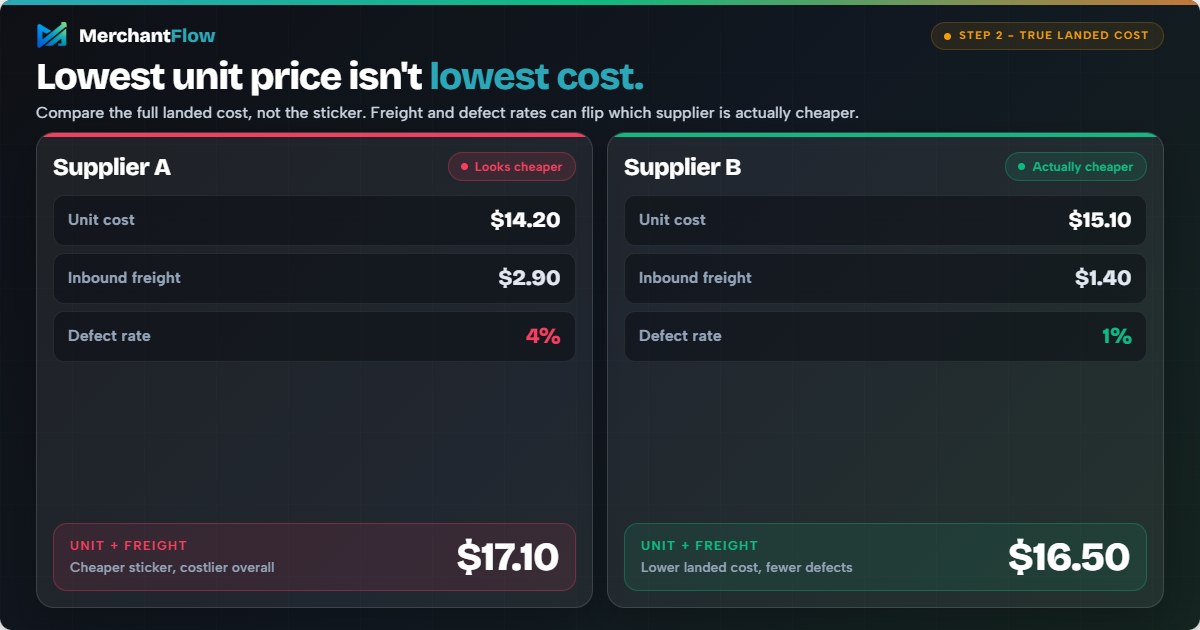
This is why COGS negotiation should not be treated as “find the lowest unit price”. The goal is to improve margin without damaging product quality, fulfilment reliability or customer experience.
For formal accounting treatment, check with your accountant or finance team. The commercial goal is to understand the real cost of selling the product, but your reporting method should be applied consistently.
Step 3: Build a supplier negotiation scorecard
Before speaking to your supplier, create a simple scorecard.
Your scorecard should show:
- Total units ordered over the last 3, 6 or 12 months
- Total spend with the supplier
- Reorder frequency
- Forecasted future volume
- Current unit cost
- Current landed cost
- Current gross margin
- Contribution margin after ad spend and fulfilment
- Defect rate or quality concerns
- Lead time performance
- Products or variants you plan to scale
This changes the conversation.
Instead of saying:
“Can you lower our cost?”
You can say:
“Over the last six months, we have ordered 12,000 units across these three SKUs. We are planning to increase volume next quarter, but the current landed cost makes it difficult to scale paid acquisition profitably. If we can bring the landed cost from $18.40 to around $16.80, we can commit to a larger forward order and keep this product in our main acquisition campaigns.”
That is a much stronger commercial case.
It shows the supplier that you are not asking for a random discount. You are trying to build a more sustainable growth plan.
Step 4: Know the COGS negotiation levers
Reducing COGS does not always mean asking for a simple discount.
The best supplier negotiations often combine several levers.
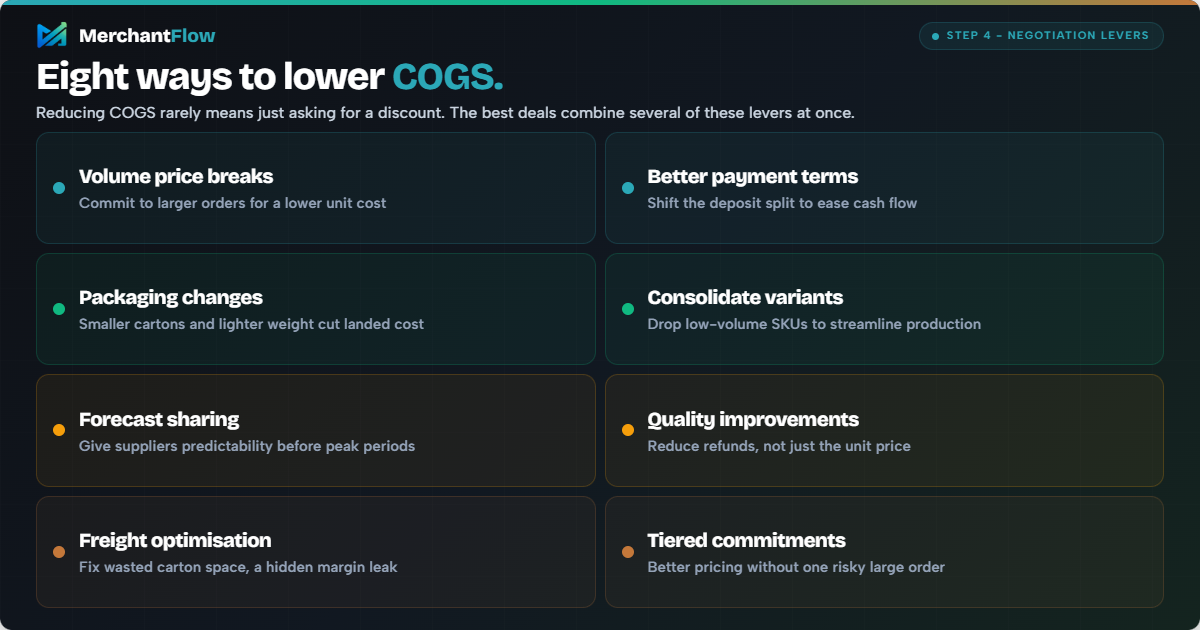
Volume-based price breaks
This is the most obvious lever. If you can commit to a larger order quantity, the supplier may be able to reduce the unit cost.
The risk is overcommitting.
A lower unit cost does not help if you end up with excess inventory, slow-moving variants or cash tied up in stock that does not sell. Use product-level sales velocity before committing to larger orders.
Better payment terms
Sometimes payment terms matter as much as unit price.
For example, moving from 50% upfront and 50% before shipment to 30% upfront and 70% before shipment may improve cash flow. Net terms can also help, but suppliers usually only offer them once there is trust and order history.
Better cash flow can support inventory planning, reduce short-term pressure and give the brand more room to invest in marketing.
Packaging and carton optimisation
Packaging is often overlooked.
A supplier may not be able to reduce the product cost, but they may be able to reduce packaging cost, carton size or shipment weight. That can improve landed cost, storage efficiency and fulfilment economics.
This matters for ecommerce because shipping cost and speed can affect conversion. Google Merchant Center notes that shipping speed and cost are common reasons customers abandon purchases, and that accurate shipping settings are used across Google features such as Shopping ads and free product listings.
Variant consolidation
Too many low-volume variants can make production inefficient.
If you sell 14 colours but only 4 drive most of the volume, your supplier may be able to offer better pricing if you consolidate production around the best-selling variants.
This is especially relevant for apparel, accessories, cosmetics and homewares brands where variant complexity can quietly increase costs.
Forecast sharing
Suppliers value predictability.
If you can share a credible forecast for the next quarter, season or campaign period, you may be able to negotiate better terms. This is particularly useful before peak periods such as Black Friday, Christmas, EOFY or major campaign launches.
The forecast does not need to be perfect. It does need to be realistic and backed by previous sales data.
Quality improvements
If refunds, replacements or negative reviews are hurting profitability, negotiate quality improvements rather than only pushing for a lower unit price.
This could include stronger packaging, better inspection standards, improved materials, a lower defect tolerance, credit for defective units or replacement stock for faulty products.
A slightly higher unit cost may still be better if it reduces refunds and protects customer trust.
Tiered commitments
If you are not comfortable placing a larger order immediately, propose tiered pricing.
For example:
- Current order: 2,000 units at $12.80
- Next tier: 4,000 units at $12.10
- Next tier: 6,000 units at $11.70
This gives both sides a path to better pricing without forcing the brand into a risky inventory commitment too early.
Step 5: Set your target cost using product profitability
Do not enter the negotiation without a target.
A useful target is based on the margin you need, not the discount you want.
For example, a brand might sell a product for $95. After discounts and refunds, net revenue is closer to $86. The current landed COGS is $34. Fulfilment and payment fees add $9. Average ad spend per order is $24.
The profit calculation looks like this:
- Net revenue: $86
- Landed COGS: $34
- Fulfilment and payment fees: $9
- Ad spend: $24
- Contribution profit: $19
If the brand wants to increase contribution profit to $24 per order without raising price, it needs to find $5 per order in savings or efficiency.
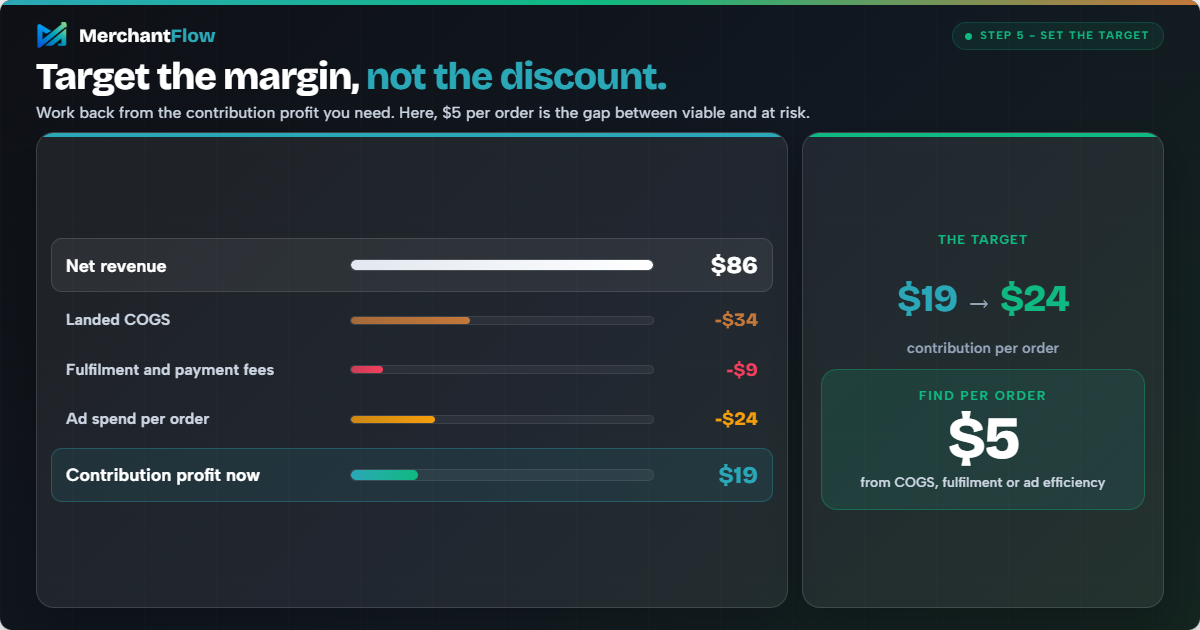
Some of that may come from COGS. Some may come from fulfilment. Some may come from ad efficiency.
This gives you a realistic negotiation target. You are not asking for a random 20% reduction. You are identifying the cost level required to keep the product commercially viable.
Step 6: Prepare your supplier message
Once you know your target, prepare a message that is specific, commercial and collaborative.
Do not make the supplier the enemy. The goal is to show that better pricing or terms can support more future volume.
Copy and adapt this supplier negotiation template before your next reorder. Replace the bracketed sections with your own product, volume and cost data.
Supplier negotiation email template
Hi [Supplier Name],

We are reviewing our upcoming order plan for [Product / SKU] and wanted to discuss pricing before confirming the next production run.

Over the last [time period], we have ordered approximately [units] units across [variants], with total spend of around [amount]. This product remains important for our store, and we are planning to continue scaling it through our ecommerce channels.

The challenge is that our current landed cost is making it difficult to maintain the margin needed as ad costs, fulfilment costs and shipping costs increase. Our current landed cost is approximately [amount] per unit, and we are aiming to bring this closer to [target amount] per unit.

Could you please review whether we can improve the cost through one or more of the following:

- A better unit price based on increased order volume
- Packaging or carton optimisation
- A price break across our best-selling variants
- Improved payment terms
- Any production efficiencies you would recommend

If we can reach a more sustainable landed cost, we would be in a stronger position to increase future order volume and keep this product as a priority SKU in our growth plan.

Thanks,
[Name]
This message works because it gives the supplier context. It shows order history, explains the commercial problem and connects better terms to future growth.
Step 7: Avoid negotiating yourself into a worse business
Lower COGS is not always better.
A supplier may offer a cheaper unit cost by reducing material quality, weakening packaging, increasing minimum order quantities or extending lead times. That can create bigger problems later.
Be careful if the cost reduction creates:
- Higher refund rates
- More damaged products
- Poorer reviews
- Longer stockouts
- Increased inventory risk
- Reduced perceived product quality
- Worse customer experience
- Lower repeat purchase rate
For ecommerce brands, margin quality matters.
A product that is cheaper but damages customer trust is rarely a good deal.
This is especially important when scaling through paid ads. Google Shopping and Meta campaigns can help drive demand, but stronger acquisition only helps if the promoted products are profitable, reliable and supported by accurate product data. Google’s Merchant Center product data specification explains that accurate and correctly formatted product data is essential for ads and free listings, and that incorrect or missing product information can cause disapprovals or display issues. Source: Google Merchant Center product data specification.
Step 8: Renegotiate at the right moments
Timing matters.
The best time to renegotiate is usually when you have evidence of momentum, not when you are desperate.
Good moments include:
- After several consistent reorders
- Before a major seasonal buying period
- Before increasing ad spend on a product
- When you can share a credible volume forecast
- When expanding into new markets
- When supplier costs have changed
- When you are consolidating variants
- When quality issues need to be addressed
- When you are considering a second supplier
Poor moments include:
- When you have no purchase history
- After repeatedly placing rushed orders
- When invoices are overdue
- When you cannot explain your target cost
- When you are threatening to leave without a real alternative
Negotiation is easier when the supplier sees you as a reliable long-term customer with a clear growth plan.
Step 9: Consider dual sourcing carefully
For many growing ecommerce brands, supplier risk becomes margin risk.
If one supplier controls your hero product, you may have limited leverage. You may also be exposed to delays, price increases or quality issues.
A second supplier can give you benchmark pricing, backup supply and more negotiating leverage. But it can also create complexity. Quality may vary. Packaging may differ. Lead times may change. Customer experience may become inconsistent.
Before switching or splitting suppliers, compare true landed cost, defect rates, lead times and customer outcomes.
Do not move based on unit price alone.
Step 10: Track the impact after the negotiation
The negotiation is not finished when the supplier agrees to a new price.
You need to measure whether the new cost actually improves profitability.
After updating your product cost, monitor:
- Gross margin by product
- Gross margin by variant
- Contribution margin after ad spend
- Product-level profit
- Refund and return rates
- Shipping and fulfilment cost changes
- Campaign performance by product
- Inventory sell-through
- Market-level profitability
This is where accurate product cost data becomes essential.
Shopify notes that profit reporting depends on cost being recorded for products and variants at the time they were sold. If your cost data is missing, incomplete or outdated, your margin reporting can become misleading. Source: Shopify Profit reports.
For ecommerce brands, the rule is simple:
If you negotiate better COGS, update your cost data immediately.
Otherwise, you may continue making pricing, campaign and inventory decisions based on old margin assumptions.
How better COGS changes your marketing decisions
COGS negotiation should not sit separately from marketing.
When COGS improves, your marketing economics change.
A product that was previously hard to scale may become viable in Google Shopping. A Meta campaign that looked break-even may become profitable. A bundle that had weak margin may become worth promoting. A discount that was too aggressive may become manageable during a seasonal campaign.
This does not mean lower COGS magically fixes every campaign. Poor creative, weak positioning, low conversion rate and poor product-market fit still matter.
But better COGS gives the marketing team more room to work.
For example, imagine two products both sell for $100.
Product A:
- COGS: $25
- Gross profit: $75
Product B:
- COGS: $52
- Gross profit: $48
If both products require $30 in ad spend to acquire a sale, Product A has far more room left for fulfilment, payment fees and profit. Product B may need a much higher AOV, stronger repeat purchase rate or lower CAC to make sense.
This is why product-level profitability should influence campaign strategy.
Not every high-revenue product deserves more budget. The best product to scale is often the one with the strongest contribution profit, not just the highest sales volume.
What to do if your supplier will not reduce COGS
Not every negotiation will succeed.
If your supplier cannot reduce product cost, you still have options.
You can review whether:
- The product price needs to increase
- Bundles can improve average order value
- Packaging can be simplified
- Fulfilment costs can be reduced
- Discounts need to be limited
- The product should be removed from paid acquisition
- A higher-margin variant should be promoted instead
- A second supplier should be tested
- The product should be repositioned as premium
Sometimes the right answer is not “negotiate harder”.
It is to stop scaling products that do not have the margin structure to support growth.
That can be a difficult decision, especially when a product generates strong revenue. But revenue without profit can create a false sense of progress.
How MerchantFlow helps ecommerce brands manage COGS and profit visibility
COGS negotiation is much easier when you know which products are actually worth negotiating.
MerchantFlow helps ecommerce brands bring the key profitability numbers into one clear dashboard, including revenue, product costs, ad spend, shipping, refunds, payment fees and fulfilment costs.
Instead of looking only at Shopify revenue or platform ROAS, merchants can see which products, campaigns and channels are actually making money after costs.
That matters because supplier negotiation should be driven by product-level profit, not guesswork.
With clearer visibility, you can identify:
- Products with strong revenue but weak profit
- Products where COGS is limiting scale
- Products that need better supplier terms
- Products that should receive more ad budget
- Products that should be bundled, repriced or deprioritised
- Markets where shipping and fulfilment costs are reducing margin
- Products where updated COGS has changed the break-even point
Better COGS is powerful. Better visibility makes it actionable.
Frequently Asked Questions (FAQs)
What is a good COGS percentage for ecommerce?
There is no universal good COGS percentage because it depends on your category, pricing power, fulfilment model and acquisition costs. A fashion brand, supplement brand, furniture brand and electronics brand will all have different margin structures. Instead of chasing a generic benchmark, calculate the gross margin and contribution margin required for your business model to stay profitable after ad spend, shipping, refunds, payment fees and fulfilment costs.
How do I calculate landed cost for ecommerce products?
Start with the supplier unit cost, then add direct costs required to get the product ready to sell. This may include inbound freight, duties, import fees, packaging, labelling, quality control and currency conversion impact. The key is to calculate cost at the product or SKU level, not only at the shipment level.
How often should ecommerce brands renegotiate COGS?
Most ecommerce brands should review COGS before major reorder cycles, seasonal campaigns, new market expansion or large increases in ad spend. A practical rhythm is to review priority SKUs every quarter and conduct deeper supplier negotiations before large purchase orders. High-volume products deserve more frequent review because even small cost changes can materially affect profit.
Should I always choose the cheapest supplier?
No. The cheapest supplier can become more expensive if product quality, packaging, lead times or defect rates are poor. Compare suppliers based on landed cost, reliability, refund rates, quality consistency and customer experience. Unit price is only one part of the real cost.
How does COGS affect ROAS?
COGS affects how much profit is left after a sale. Two products can have the same ROAS but very different profitability if one has much higher product costs. Lower COGS can reduce the break-even ROAS and give paid campaigns more room to scale profitably.
What should be included in ecommerce COGS?
At a minimum, ecommerce COGS should include the direct cost of the product. Depending on your accounting method, it may also include packaging, inbound freight, duties, manufacturing costs and other costs directly tied to getting the product ready for sale. The most important thing is to apply the method consistently and understand the difference between product cost, landed cost and contribution profit.
How can I track whether COGS improvements actually helped profitability?
Update your product cost data as soon as supplier pricing changes, then monitor gross margin, contribution margin, refund rates, fulfilment costs and product-level profit. If the product is promoted through Google Shopping or Meta Ads, review whether the lower COGS improves campaign-level profitability, not just revenue.

About the author
Georgia CarapetisGeorgia Carapetis is Head of Marketing at MerchantFlow, helping ecommerce brands stop obsessing over ROAS and start focusing on profit. She writes about Google Shopping, contribution margins, and scaling without shrinking your margins.