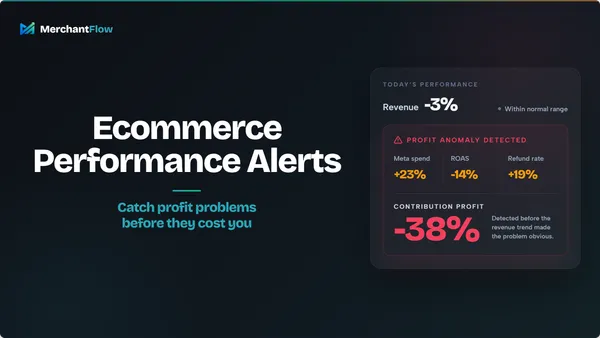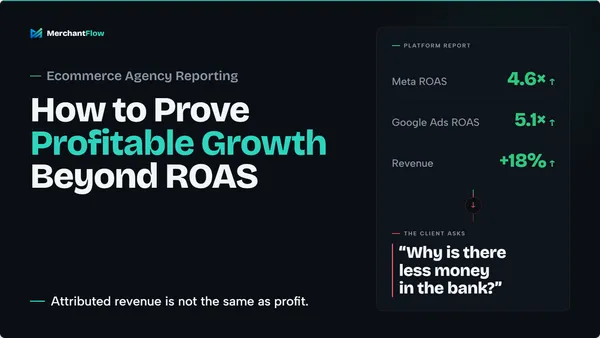
Selling into more countries can make an ecommerce brand look like it is growing well.
Orders start coming in from Australia, the United States, the United Kingdom, New Zealand, Canada or Europe. Shopify shows more international sales. Google Ads and Meta Ads show conversions across multiple locations. The business looks more diversified, more scalable and less dependent on one market.
But revenue by country can be misleading.
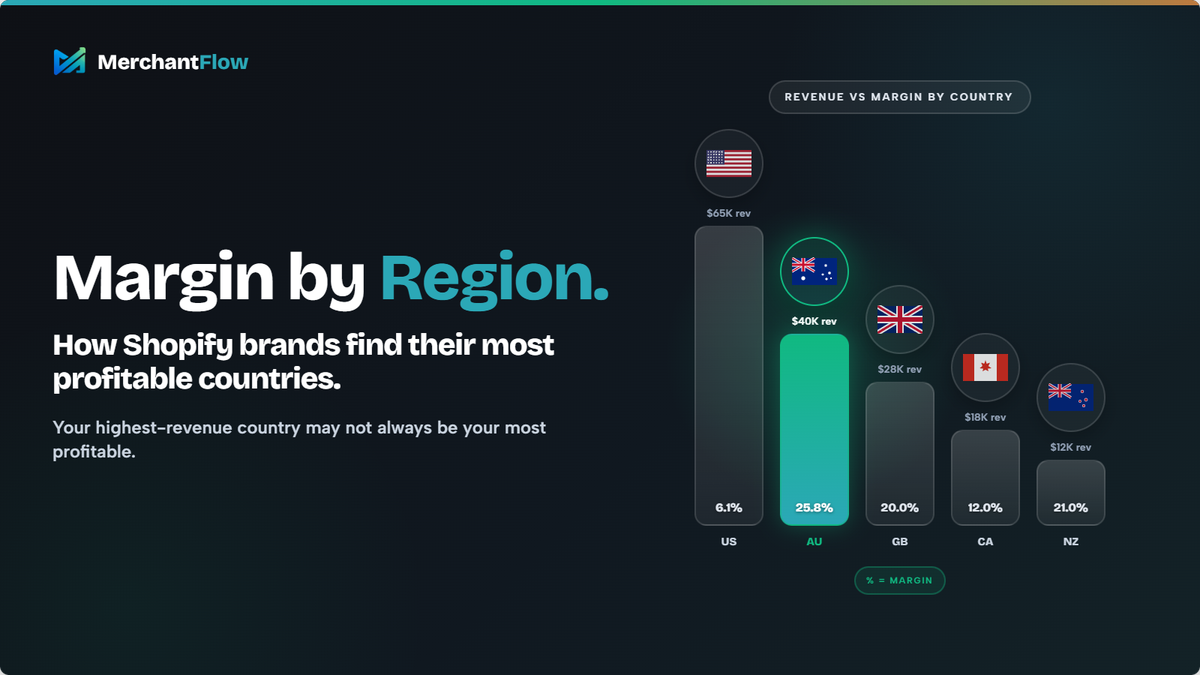
Your highest-revenue country is not always your most profitable country. A market can generate strong sales while quietly losing margin through higher shipping costs, fulfillment fees, refunds, payment fees, duties, discounts and ad spend.
The opposite can also be true. A smaller country might produce fewer orders, but better profit because delivery is cheaper, return rates are lower and customers buy higher-margin products.
That is why margin by region matters.
For Shopify and ecommerce brands selling internationally, country-level margin helps answer a much better question than:
“where are we selling?”
It helps answer:
“where are we actually making money?”
What is margin by region?
Margin by region means measuring profitability by country, region or geographic market instead of only looking at total store performance.
Most ecommerce teams already know where revenue is coming from. They can usually see sales by country in Shopify, location performance in Google Ads and country breakdowns in Meta Ads.
The harder question is what profit is left after the costs of serving each market are included.
A practical margin by region view looks at revenue from each country, then compares it against costs such as:
- Product costs
- Discounts
- Refunds
- Shipping costs
- Fulfillment costs
- Payment fees
- Duties and import tax treatment
- Ad spend
- Return costs
- Currency and pricing differences
This matters because ecommerce costs are not evenly distributed across countries.
A $120 domestic order and a $120 international order may look identical in a revenue report. But once you factor in shipping, fulfillment, refunds, payment fees and acquisition costs, the profit result may be very different.
Why sales by country can hide weak profit
Sales by country is useful, but it is not the same as profit by country.
Shopify, Google Ads and Meta Ads can all help merchants understand where orders, conversions and revenue are coming from. That visibility is valuable. The problem is that each platform usually shows only part of the picture.
Shopify can show sales and product performance. Google Ads can show campaign performance by location. Meta Ads can break down advertising results by country or region.
But those reports do not always bring together the full cost base behind each sale.
That is where ecommerce teams can make poor decisions.
A brand might see that the United States is generating the most revenue, so it increases ad spend there. On the surface, that makes sense. But if US orders have higher shipping costs, higher return rates, more discounting and higher ad costs, the actual margin may be weaker than a smaller local market.
Another brand might reduce spend in New Zealand because order volume is lower. But if New Zealand has cheaper delivery, fewer refunds and stronger product mix, it may be one of the most profitable markets in the store.
The issue is not that revenue reporting is useless. It is that revenue alone does not tell you whether growth is healthy.
Gross margin is not enough for regional profitability
Gross margin is important, but it is only part of the answer.
In ecommerce, gross margin usually looks at revenue after product costs. That is useful for understanding whether a product has enough room to make money before other costs are added.
But regional profitability needs a wider view.
A product might have a strong gross margin before fulfillment and advertising. Once you add the cost of getting that product to the customer, the economics can change quickly.
This is especially true when selling across borders.
International orders may involve more expensive shipping, longer delivery routes, duties, import taxes, different return processes and more customer service friction. If those costs are not included in your reporting, a country can look better than it really is.
For ecommerce founders and marketing managers, the key point is simple.
A country is not profitable just because it produces revenue.
It is profitable when the money left after costs is strong enough to justify the spend, effort and operational complexity required to serve that market.
Contribution margin is the better lens
For margin by region, contribution margin is usually more useful than gross margin alone.
Contribution margin shows what is left after variable costs are deducted from revenue. In ecommerce, that makes it helpful because many of the biggest costs change from order to order and market to market.
A practical ecommerce version could look like this:
Revenue
minus discounts
minus refunds
minus product costs
minus payment fees
minus shipping costs
minus fulfillment costs
minus ad spend
equals contribution profit
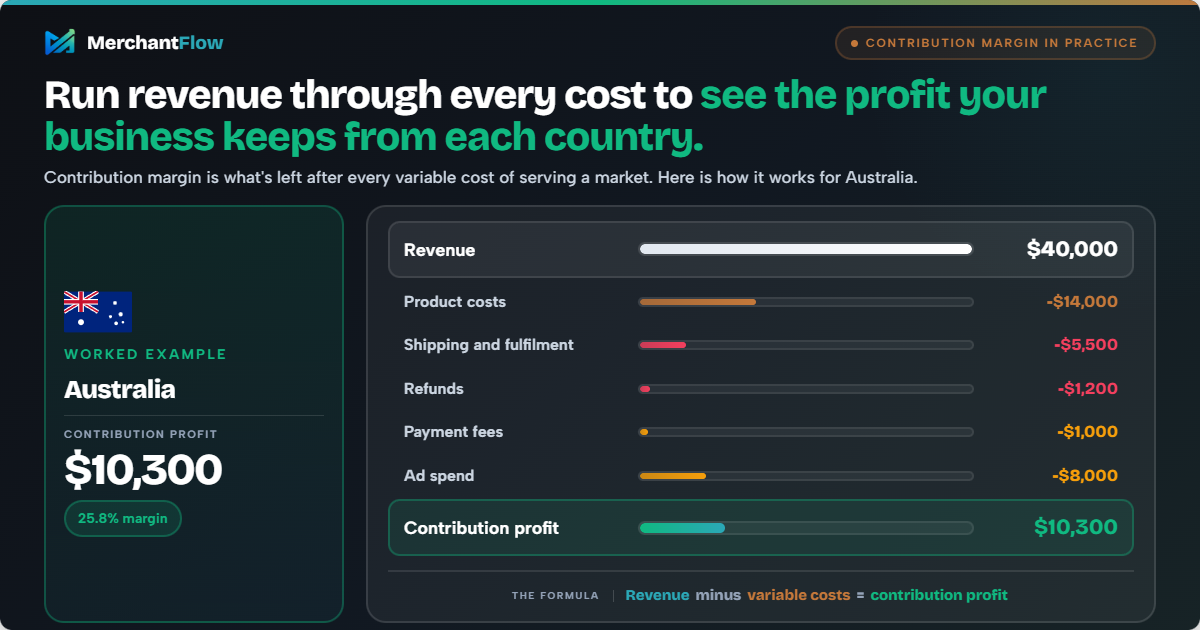
Contribution margin is then contribution profit shown as a percentage of revenue.
This gives merchants a clearer way to compare countries.
Instead of only asking which country generated the most sales, you can ask which country produced the strongest profit after the costs of selling there.
Example: two countries with very different margins
Imagine a Shopify brand selling the same product into Australia and the United States.
At first glance, the United States looks like the better growth market.
| Metric | Australia | United States |
|---|---|---|
| Revenue | $40,000 | $65,000 |
| Orders | 500 | 850 |
| Average order value | $80 | $76 |
| Product costs | $14,000 | $22,750 |
| Shipping and fulfillment | $5,500 | $15,000 |
| Refunds | $1,200 | $4,500 |
| Payment fees | $1,000 | $1,800 |
| Ad spend | $8,000 | $17,000 |
| Profit after variable costs | $10,300 | $3,950 |
| Margin after variable costs | 25.8% | 6.1% |
The United States generated more revenue and more orders.
But Australia produced more actual profit.
This is the type of insight that is easy to miss when teams only review revenue, return on ad spend or store-wide margin.
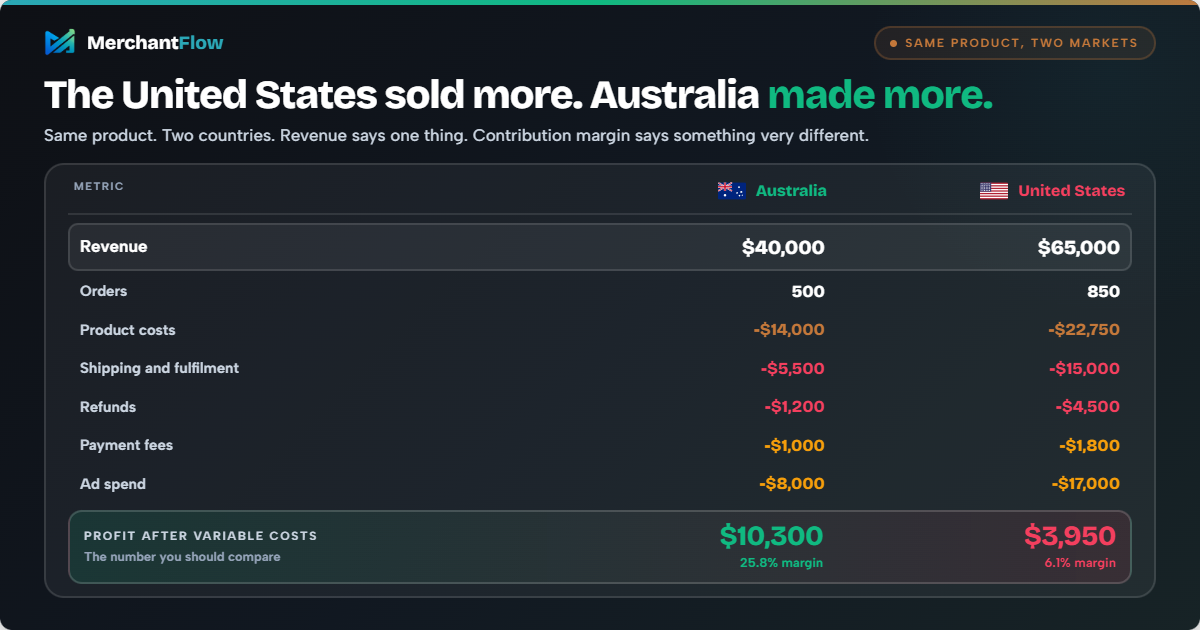
The point is not that the United States is a bad market. It may still be valuable. But it needs a different strategy. The brand might need to adjust pricing, change shipping thresholds, reduce wasted ad spend, improve return handling or promote higher-margin products in that market.
Without margin by region, the team might keep scaling the biggest-looking country.
With margin by region, they can see where growth is actually healthy.
Why margins vary so much by country
Country-level profit differences usually come from a mix of cost, customer behaviour, product mix and channel performance.
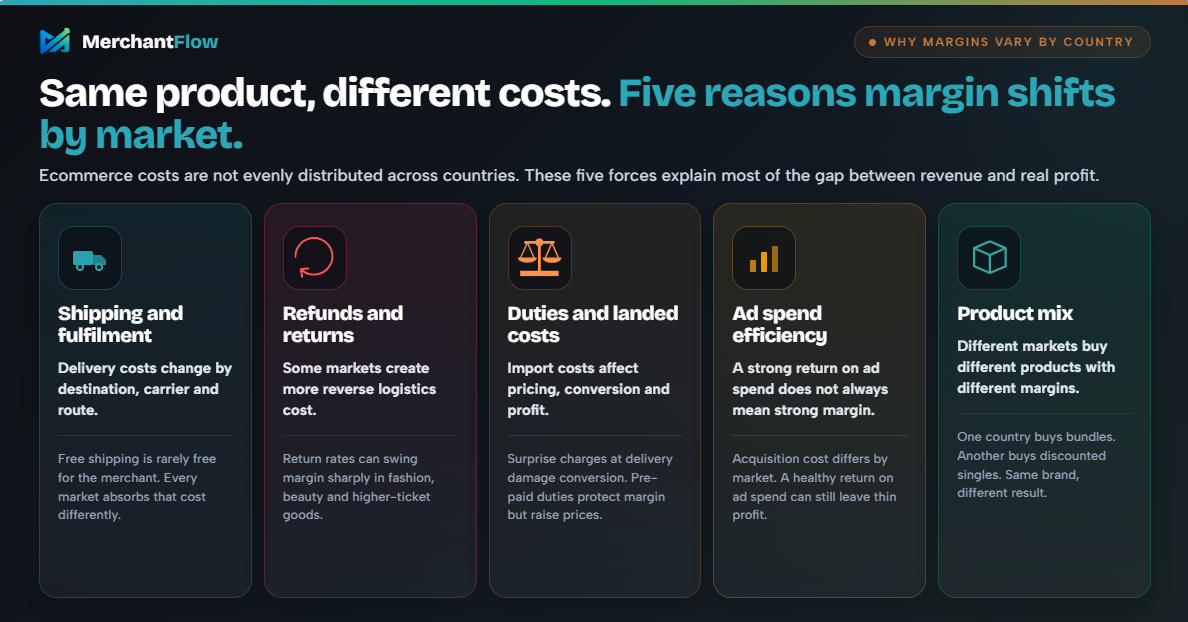
Shipping and fulfillment costs change by country
Shipping is one of the biggest reasons regional margins vary.
Many ecommerce brands offer free shipping because it improves conversion. But free shipping is only free to the customer. The merchant still pays for it.
That cost can change significantly by destination.
Domestic orders may be cheaper to fulfill. International orders may involve higher carrier fees, customs handling, longer delivery routes or third-party logistics support.
If your shipping offer is not priced correctly, you may end up subsidising growth in markets that look strong on revenue but weak on profit.
Margin by region helps show whether your shipping strategy is supporting profitable growth or quietly reducing margin in certain countries.
Duties, taxes and landed costs affect profit
International ecommerce also brings duties, import taxes and landed cost considerations.
If customers are surprised by extra charges at delivery, conversion and customer satisfaction can suffer. If the merchant absorbs too much of the landed cost, profit can suffer.
This is why regional margin is not only a finance metric. It is also a customer experience metric.
You need to know whether the way you price, ship and communicate costs in each country still leaves enough profit after the sale.
Ad spend efficiency differs by country
Performance marketers often review campaign results by country inside Google Ads or Meta Ads.
That is useful, but ad platform reporting is usually focused on metrics such as spend, conversions, cost per purchase, conversion value and return on ad spend.
The missing piece is what happens after the sale.
A country might show a strong return on ad spend but weak contribution margin because customers buy lower-margin products, shipping is expensive or refunds are high.
Another country might have a lower return on ad spend but stronger profit because customers buy bundles, shipping is cheaper and return rates are lower.
This is why country-level ad performance should be reviewed alongside margin by region, not separately.
Product mix changes by market
Not every country buys the same products.
A fashion brand might sell more lightweight accessories in one country and more bulky outerwear in another. A homewares brand might sell high-margin decor locally, but low-margin heavy items internationally. An outdoor brand might find that one market buys premium bundles while another responds mostly to discount offers.
If you only look at revenue by country, you miss the product mix underneath it.
Margin by region becomes even more useful when paired with product-level profitability. It helps answer questions such as:
- Which products are profitable in Australia but not in the United States?
- Are international customers buying our best-margin products or our worst-margin products?
- Are we promoting the right products in each market?
That is where ecommerce profitability becomes more strategic.
You are no longer just asking where sales are coming from. You are asking where the right sales are coming from.
Refund and return rates can vary by country
Returns are another hidden margin issue.
Two countries might generate similar revenue, but one may have a much higher refund rate. That difference can quickly reduce profit, especially in categories such as fashion, footwear, accessories, beauty or higher-ticket consumer goods.
Return costs may include the refunded revenue, the original shipping subsidy, reverse logistics, repackaging, damaged stock and customer service time.
For international orders, the return experience can be even more expensive.
A country with a high return rate may need better sizing guidance, clearer product descriptions, localised shipping expectations or a different product assortment.
Without regional margin visibility, returns often sit in the background as a general cost. With margin by region, they become easier to connect to specific markets.
What ecommerce teams should do with margin by region data
The value of margin by region is not just reporting. It is decision-making.
Once you can see profit by country, you can make better choices about where to spend, what to promote and how to price each market.
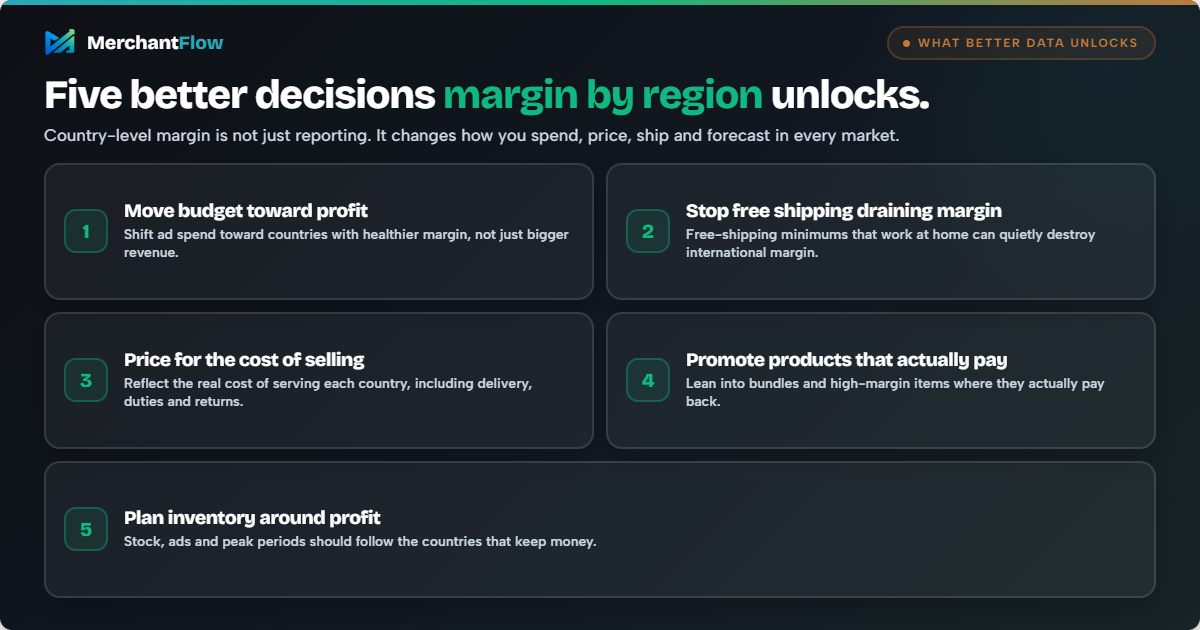
1. Reallocate ad spend based on profit
The most obvious use case is budget allocation.
If one country has strong revenue but weak margin, it may not deserve more budget until the economics improve. If another country has lower volume but stronger margin, it may be a better place to test incremental spend.
This does not mean you should immediately cut every low-margin country. Some markets are worth investing in for strategic reasons, such as brand awareness, wholesale opportunities or long-term expansion.
But the trade-off should be intentional.
A low-margin country should be a conscious investment, not an accidental drain on profit.
2. Review shipping thresholds by country
A single free shipping threshold across every market can create margin problems.
For example, free shipping over $100 might work well domestically. But if international shipping costs are much higher, that same threshold may be too low for overseas customers.
The better question is not only:
“Does free shipping improve conversion?”
It is:
“Does free shipping still leave enough profit in this country after shipping, fulfillment, refunds and ad spend?”
Sometimes the answer will be yes. Sometimes the answer will be no. Sometimes the threshold simply needs to change.
Margin by region helps you test that with numbers instead of assumptions.
3. Adjust pricing by market
Regional margin data can highlight where pricing needs to change.
If a country consistently produces weak margin, the issue may not be demand. It may be that your pricing does not reflect the cost of serving that market.
Regional pricing decisions might include:
- Increasing prices in countries with higher fulfillment costs
- Creating market-specific free shipping thresholds
- Offering bundles that improve average order value
- Reducing discounts that attract unprofitable orders
- Testing local currency pricing to improve clarity for customers
The goal is not to charge more for the sake of it.
The goal is to make sure each market has a realistic path to profitability.
4. Build country-specific product strategies
Once you understand margin by country, you can shape product strategy by market.
A bulky low-margin product might sell well overseas, but reduce profit because shipping costs are too high. A premium bundle might perform better in a smaller market because average order value is stronger. A lightweight accessory might be ideal for international expansion because it is cheaper to ship and has healthy margin.
This is where marketing, merchandising and operations need to work together.
Performance marketers should not be expected to optimise campaigns using only revenue and return on ad spend. They need to know which products create healthy profit in each country.
5. Improve forecasting and inventory planning
Regional margin data can also improve forecasting.
If a brand knows that certain countries produce stronger margin, it can plan inventory, fulfillment and promotional activity around those markets.
This is especially useful before peak periods such as Black Friday, Boxing Day, Christmas, EOFY campaigns or major product drops.
Revenue forecasts can tell you how much you expect to sell.
Margin by region can help you understand whether those sales are likely to be worth it.
Common mistakes merchants make with international growth
International growth can be valuable, but it becomes risky when decisions are made from incomplete numbers.
Treating all revenue as equal
A $100 order is not always a $100 order.
The country, product, shipping method, payment fee, discount and return risk all affect how much profit is left.
When merchants treat all revenue as equal, they can end up scaling low-quality growth.
Using return on ad spend as the final decision metric
Return on ad spend is useful, but it is not a profit metric.
A campaign can have a strong return on ad spend and still produce weak profit if the underlying costs are too high.
This is especially common when teams review ad platforms in isolation. Google Ads and Meta Ads can show where conversions are happening, but they do not automatically include every cost needed to understand true ecommerce profitability.
Ignoring fulfillment complexity
A country that is harder to serve may need a stronger margin to be worth scaling.
Long delivery windows, expensive shipping, customs issues, customer service load and return friction can all reduce the value of a market.
Margin by region helps reveal whether that extra complexity is being rewarded with enough profit.
Looking only at store-wide margin
Store-wide margin is useful, but it can hide regional problems.
A healthy overall margin might be supported by one or two strong countries while other markets quietly underperform. The reverse can also happen. A weak store-wide result might hide a few countries that are actually performing well and deserve more attention.
Country-level margin gives teams a sharper view.
What to check before acting on margin by region data
Margin by region is powerful, but it depends on the quality of the data underneath it.
Before making major decisions, check the inputs.
First, make sure product costs are up to date. If cost of goods sold is missing or outdated, margin will be unreliable.
Second, check whether shipping and fulfillment costs are being captured properly. If international fulfillment costs are averaged too broadly, you may understate the cost of certain countries.
Third, review how ad spend is being allocated. Country-level ad spend can be difficult when campaigns target multiple markets, so it is important to understand the method being used.
Fourth, consider timing. Refunds and returns may happen after the original sale, so short reporting windows can make a region look better than it really is.
Finally, remember that margin is a decision-making tool, not the only factor. A lower-margin country may still matter for strategic expansion, brand presence or long-term customer value.
The key is knowing the numbers clearly enough to make that choice intentionally.
A simple framework for reviewing margin by region
If you are reviewing regional profitability for the first time, keep the process simple.
Start with your top five countries by revenue.
For each country, review:
- Revenue
- Orders
- Average order value
- Product costs
- Discounts
- Refunds
- Payment fees
- Shipping and fulfillment costs
- Ad spend
- Profit after variable costs
- Margin after variable costs
Then group each country into one of three categories.
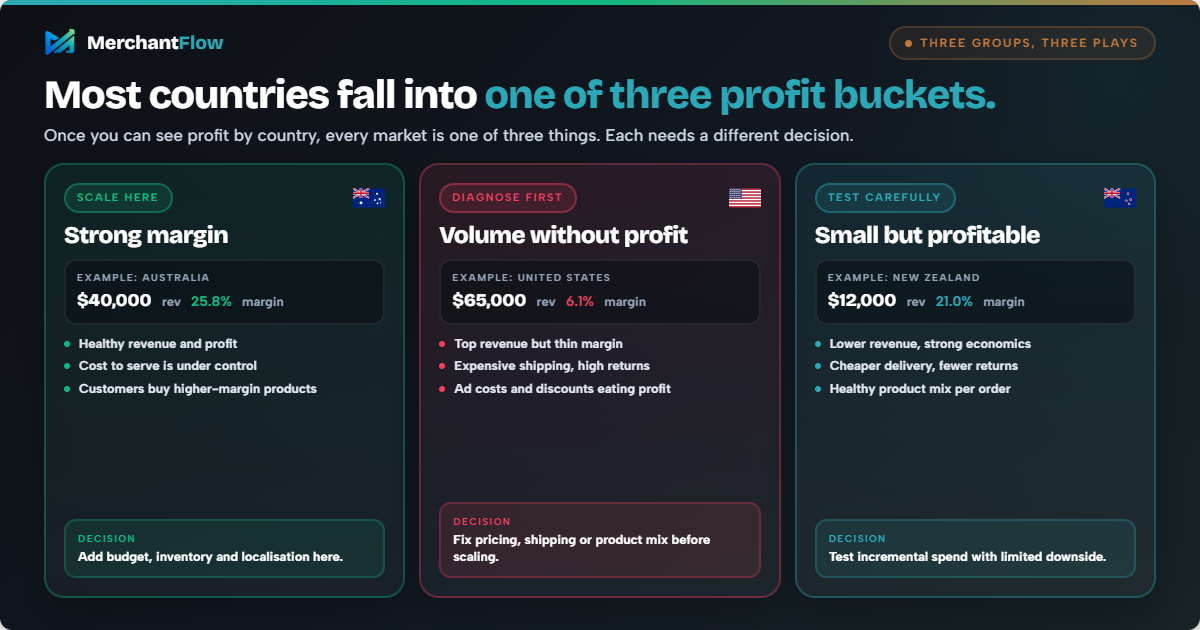
Strong margin countries
These are markets where revenue and profit are both healthy. They may be candidates for more budget, more inventory, stronger localisation or deeper customer acquisition testing.
Volume without profit countries
These are markets where revenue looks good, but margin is weak. They need deeper review before scaling. The issue may be shipping, pricing, product mix, refunds, discounts or ad spend efficiency.
Small but profitable countries
These are markets with lower revenue but strong economics. They may be useful testing grounds for careful expansion, especially if the cost to serve the market is manageable.
Once you have these groups, decide what each market needs.
Some countries may need more budget. Others may need pricing changes, better shipping thresholds, different products, reduced discounting or improved return handling.
That is how regional margin analysis becomes practical.
It turns international sales data into clearer decisions.
How MerchantFlow helps merchants see margin by region
For many ecommerce teams, the challenge is not understanding that margin matters. The challenge is getting the data into one place.
Revenue might sit in Shopify. Ad spend might sit across Google Ads, Meta Ads, TikTok Ads or other platforms. Product costs might be incomplete or managed in spreadsheets. Shipping, refunds, payment fees and fulfillment costs may be tracked separately.
That makes it hard to answer a simple question:
“Which countries are actually making us money?”
MerchantFlow’s margin by region feature is designed to help ecommerce teams understand profitability by country, not just total store performance.
Instead of only seeing where revenue came from, merchants can review how each country contributes to profit after key costs are considered.
For Shopify and ecommerce brands, this helps answer questions like:
- Which countries have the strongest margin?
- Are we losing profit in markets that look good on revenue?
- Should we change pricing, shipping or ad spend in certain countries?
- Which markets are worth scaling?
- Where are refunds or fulfillment costs hurting performance?
MerchantFlow brings together revenue, ad spend, product costs, shipping, refunds, payment fees and fulfillment costs into a profit-focused view. Margin by region adds another layer by showing how those economics differ across countries.
The goal is not to create another dashboard for the sake of it.
The goal is to help merchants make better growth decisions with clearer profit data.
Final thoughts
Ecommerce growth is not just about selling into more countries.
It is about knowing which countries are actually worth scaling.
Revenue by region tells you where customers are buying. Margin by region tells you where the business is making money.
For Shopify merchants, performance marketers and ecommerce founders, that distinction matters. It can change how you allocate ad spend, set prices, structure shipping offers, choose products and plan international growth.
A country with high revenue but weak margin may need fixing before scaling. A country with modest revenue but strong margin may deserve more attention. A market that looks average at store level may become far more interesting once you understand the costs underneath.
Profit-focused growth starts with knowing not just what sold, but where it actually made money.
If you want a clearer view of which countries, products and campaigns are contributing to profit, MerchantFlow helps bring your revenue, ad spend, product costs, shipping, refunds, payment fees and fulfillment costs into one profit-focused dashboard.
Frequently Asked Questions (FAQs)
What is margin by region in ecommerce?
Margin by region is the process of measuring profitability by country, region or market. It helps ecommerce merchants understand which locations are profitable after costs such as product costs, shipping, refunds, payment fees, fulfillment and ad spend are considered.
Why is margin by country important for Shopify stores?
Margin by country is important because each market can have different shipping costs, return rates, payment fees, product demand, advertising costs and fulfillment complexity. A country with high revenue may not always be the most profitable market.
Is margin by region the same as sales by country?
No. Sales by country shows where revenue comes from. Margin by region shows how much profit remains after costs. Sales by country is useful, but it does not provide a full view of profitability.
What costs should be included in regional margin analysis?
A useful regional margin analysis should include revenue, discounts, refunds, product costs, payment fees, shipping costs, fulfillment costs, return costs and ad spend. Depending on the business, it may also include duties, import taxes and currency-related pricing differences.
How can ecommerce brands improve margin by region?
Brands can improve regional margin by adjusting pricing, changing shipping thresholds, reducing unnecessary discounts, improving product mix, reviewing ad spend by country and reducing refunds or fulfillment costs in weaker markets.
Should I stop selling to countries with low margin?
Not always. A low-margin country may still be valuable for long-term growth, brand awareness or strategic expansion. However, you should understand why the margin is low and decide whether to improve the economics, reduce spend or keep investing intentionally.
How does MerchantFlow help with margin by region?
MerchantFlow helps ecommerce merchants see profitability by country by combining revenue, ad spend, product costs, shipping, refunds, payment fees and fulfillment costs into one profit-focused dashboard. This gives merchants a clearer view of which regions are actually contributing to profit.

About the author
Georgia CarapetisGeorgia Carapetis is Head of Marketing at MerchantFlow, helping ecommerce brands stop obsessing over ROAS and start focusing on profit. She writes about Google Shopping, contribution margins, and scaling without shrinking your margins.