
Most ecommerce founders know their revenue.
Far fewer know what their store is actually worth.
That gap matters because revenue is not the same as value. A Shopify store can show strong sales, Meta Ads can claim purchases, Google Shopping can keep spending, and the business can still be worth less than the founder expects.
Valuation asks a harder question:
How much reliable profit does this store produce, and how risky is that profit for a future buyer?
For most owner-operated ecommerce stores, the practical valuation model is simple:
The formula is simple. The hard part is getting the inputs right.
If your product costs are outdated, your ad spend is split across platforms, your refunds are not properly included, or your best-selling products are not actually profitable, the valuation can quickly become misleading.
This guide explains how ecommerce store valuation works, what numbers matter most, and how Shopify brands can build a clearer view of what their business may be worth.
Why ecommerce store valuation is usually misunderstood
Many founders start with the wrong number.
They think valuation begins with revenue.
It does not.
Revenue shows the size of the store. Profit shows the earning power of the business. Buyers, brokers, lenders and investors will look at revenue, but they usually care more about what is left after the costs required to generate that revenue.
That means the larger store is not always the more valuable store.
Store A might look more impressive in screenshots. Store B may be the better business.
That is why ecommerce valuation forces founders to look beyond vanity metrics. A store is not valuable because it is busy. It is valuable when it can produce reliable profit with manageable risk.
The basic ecommerce valuation formula
At a practical level, many ecommerce valuations use this structure:
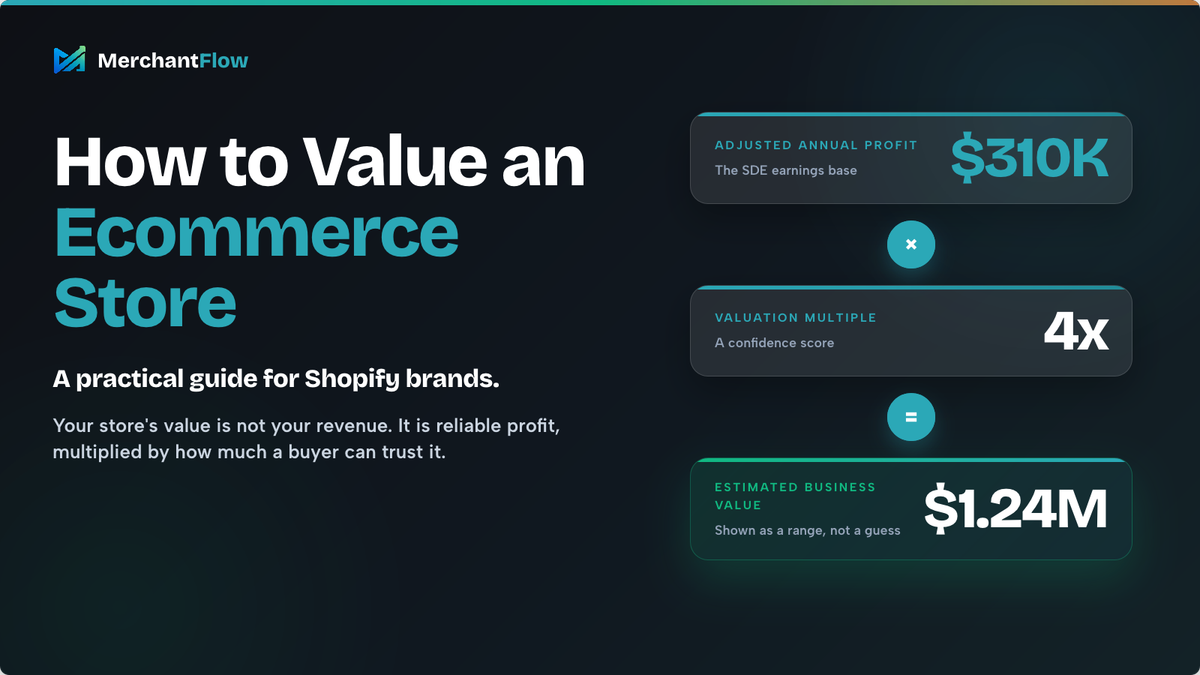
Adjusted annual profit x valuation multiple = estimated business value
The adjusted profit figure may be based on SDE, EBITDA or another earnings measure, depending on the size and maturity of the store.
For smaller and owner-operated ecommerce businesses, SDE is often the most relevant starting point.
What is SDE in ecommerce valuation?
SDE stands for seller discretionary earnings.
In simple terms, SDE estimates the financial benefit a single owner-operator can reasonably take from the business after adjusting for certain owner-related, discretionary or one-off expenses.
A simplified version looks like this:
Valid add-backs might include owner compensation, genuine one-off expenses or certain discretionary costs that would not continue under a new owner.
The word “valid” matters.
Not every cost can be added back. A buyer will usually challenge expenses that are recurring, necessary or poorly documented. If the business needs that cost to keep operating, it probably should not be treated as an add-back.
This is where clean reporting becomes important. A founder who can explain profit, costs and add-backs clearly is in a much stronger position than one who has to rebuild the numbers from memory.
How the valuation multiple works
The multiple is the number applied to adjusted earnings.
For example, if a store has $300,000 in adjusted annual profit and receives a 4x multiple, the estimated value would be:
$300,000 x 4 = $1.2 million
But the multiple is not random.
A stronger business may justify a higher multiple. A riskier business may receive a lower one.
Instead of thinking about the multiple as a mystery number, think of it as a confidence score. The stronger the business fundamentals, the more confidence a buyer can have in future earnings.
This is where many founders get stuck.
They might know their profit, but not what multiple should apply. Or they might have heard that “stores sell for 3x profit” without knowing whether their business deserves more, less or something in between.
That uncertainty is one of the reasons MerchantFlow’s valuation feature is useful. It does not just show a number. It shows the multiple applied and the scorecard behind it.
What MerchantFlow’s business valuation feature shows
MerchantFlow estimates your business value with an SDE-multiple model that factors in growth, margin, marketing efficiency and risk.
The goal is not to give founders a mysterious black-box number.
The goal is to give a valuation that explains itself.
In MerchantFlow, the valuation view is designed to show the number and the logic behind it.
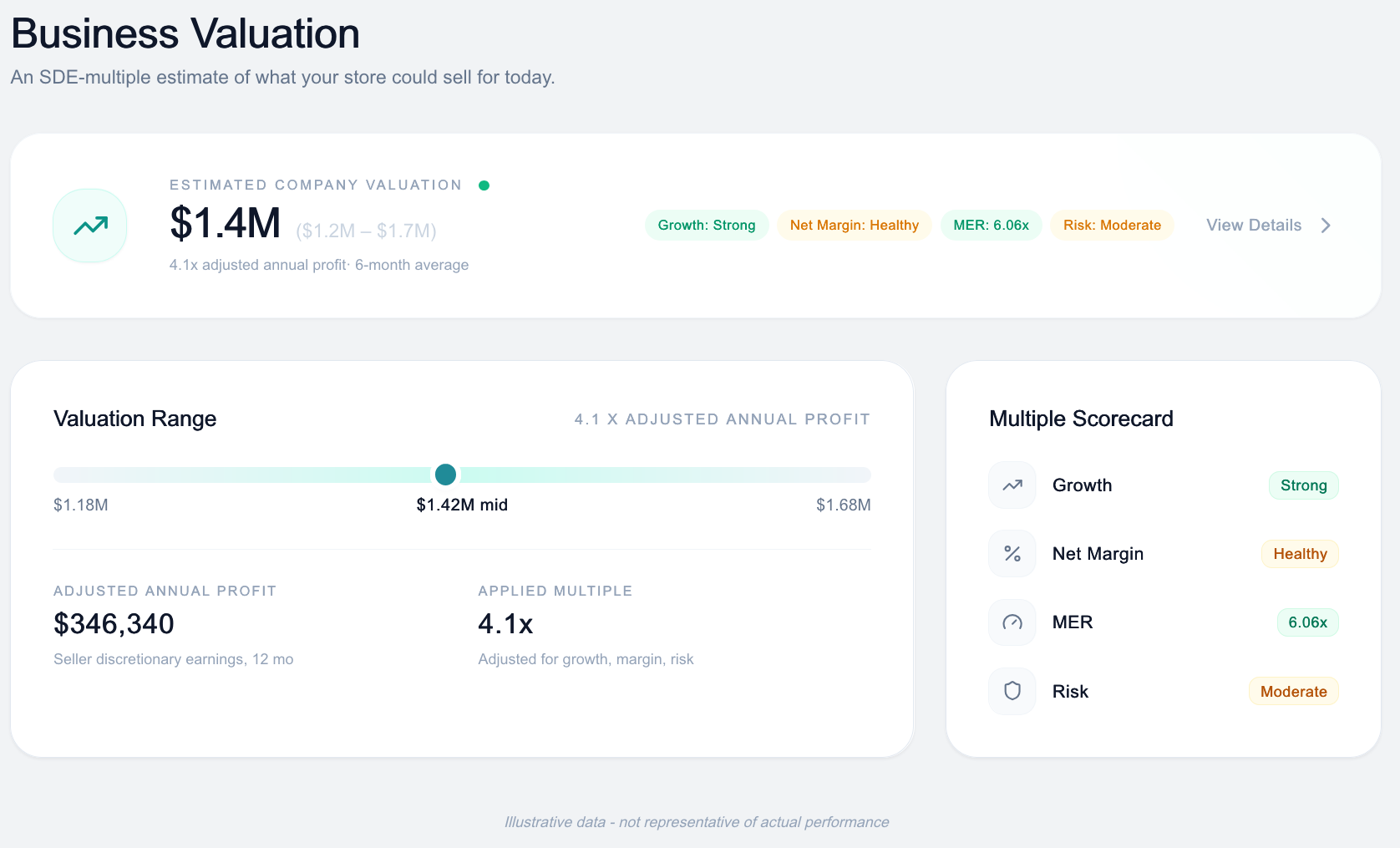
That matters because the founder is not left staring at a number with no explanation.
They can see why the estimate looks the way it does.
They can also see what might move it.
Why an always-on valuation matters
Most founders only think about valuation when something big is happening.
They are preparing to sell. They are talking to investors. They have received an offer. They are applying for funding. They are trying to work out whether the business is worth continuing, scaling or restructuring.
The problem is that by then, valuation becomes stressful.
You are trying to understand one of the most important numbers in your business at the exact moment the stakes are highest.
That is not ideal.
Valuation should not only happen at the exit. It should be something you understand while you are building.
Your store value changes as your business changes.
If growth improves, the valuation may improve.
If margins weaken, the valuation may fall.
If paid acquisition becomes less efficient, the multiple may come under pressure.
If revenue becomes too concentrated in one product or channel, risk increases.
If COGS is inaccurate, the entire valuation estimate can become unreliable.
A one-time appraisal can become stale quickly. An always-on valuation helps founders understand how the business is trending before a buyer, broker or lender starts asking questions.
That turns valuation from a stressful event into a management tool.
The inputs that matter most in ecommerce valuation
A useful ecommerce valuation is not built from one number.
It is built from a combination of profit, growth, efficiency and risk.
1. Adjusted annual profit
Profit is the foundation of most ecommerce valuations.
For a Shopify store, that means looking beyond gross sales and understanding what is left after the real costs of selling are included.
Those costs usually include product costs, ad spend, shipping, refunds, payment fees, fulfilment, software, operating expenses and owner compensation.
This is where many ecommerce brands struggle. Their data is split across Shopify, Google Ads, Meta Ads, Google Merchant Center, spreadsheets, accounting tools and fulfilment systems.
Each platform tells part of the story. None of them gives the full profit picture by default.
The more accurately you understand profit, the more useful your valuation becomes.
2. Growth quality
Growth can support a stronger valuation, but only when the growth is healthy.
A store growing revenue by 40 percent while margins collapse may not be as attractive as it looks. A store growing more slowly while improving contribution margin, repeat purchase rate and marketing efficiency may be building more durable value.
For valuation, the quality of growth matters more than the headline growth rate.
A founder might say, “We doubled revenue this year.”
A buyer may ask, “What did it cost to do that?”
That difference matters.
3. Net margin
Net margin shows how much of each dollar of revenue remains after costs.
A store with healthy net margin has more room to reinvest, absorb supplier increases and survive changes in ad costs. A store with thin margins has less room for error.
In ecommerce, margin can be squeezed by supplier cost increases, freight, packaging, discounting, returns, payment fees, fulfilment costs, exchange rate movements and damaged or obsolete inventory.
This is why valuation is closely tied to cost visibility.
If your product costs are outdated, your margin view may be wrong. If your margin view is wrong, your valuation may be overstated.
4. Marketing efficiency
Ad spend is one of the biggest levers in ecommerce valuation.
A store can look like it is scaling well while quietly relying on increasingly expensive paid acquisition.
One useful metric is MER, or marketing efficiency ratio.
The simple version is:
Revenue ÷ total marketing spend = MER
For example:
MER does not replace channel-level analysis, but it gives founders a business-level view of marketing efficiency.
This matters because platform ROAS can be misleading. Google Ads, Meta Ads and GA4 can all tell different stories. One platform may claim a sale, another may claim the same sale, and neither may account for product margin, fulfilment costs or refunds.
Valuation needs a profit view, not just an attribution view.
5. Risk
Risk is what pulls the multiple down.
A store can have strong profit and still receive a lower valuation if the profit feels fragile.
Common ecommerce risks include:
- One product drives too much revenue
- One channel drives too much acquisition
- One supplier controls the key product line
- The founder is required for daily operations
- COGS is unclear or outdated
- Financial reporting is messy
- Return rates are high
- Inventory is slow-moving
- Paid ads are becoming less efficient
- Merchant Center issues affect key products
- Customer repeat purchase behaviour is weak
Risk does not mean the business has no value. Every ecommerce store has risk.
The issue is whether that risk is visible, measured and improving.
A buyer can price risk they understand. Hidden risk creates doubt.
6. Supply chain risk
Supply chain risk is another major factor in ecommerce valuation because it affects how reliable future profit really is.
A store may look profitable today, but if that profit depends on one supplier, one manufacturer, one country of origin or one fragile fulfilment process, a buyer may see more risk in the business.
For ecommerce brands, supply chain risk can include:
- One supplier producing the main product line
- Long or unpredictable lead times
- No backup manufacturer
- Rising freight or duty costs
- Poor inventory forecasting
- Frequent stockouts
- Quality control issues
- Limited control over packaging or fulfilment
- Supplier pricing that changes without warning
- Products that are difficult to replace or reorder
This matters because valuation is not only based on what the store earned in the past. It is also based on how likely those earnings are to continue.
For example, a Shopify store might have strong revenue and healthy margins, but if 70 percent of sales come from one product made by one overseas supplier, the business carries more risk. If that supplier increases prices, delays production, changes quality standards or stops supplying the product, profit can fall quickly.
A stronger business usually has more supply chain resilience. That might mean multiple supplier options, documented supplier relationships, clearer inventory planning, better reorder processes, reliable fulfilment partners and enough margin buffer to absorb cost increases.
This is also where accurate COGS becomes important. If supplier costs, freight, duties or packaging costs are outdated, the business may look more profitable than it really is. A valuation built on old cost data can overstate the quality of earnings.
Supply chain risk does not automatically make a store unattractive. Many ecommerce businesses rely heavily on external suppliers. The issue is whether the risk is understood, documented and actively managed.
A buyer will usually feel more confident when the founder can explain where products come from, how costs are tracked, what backup options exist and how inventory issues are handled.
In valuation terms, a reliable supply chain can support confidence in future earnings. A fragile supply chain can put pressure on the multiple.
7. Store and brand defensibility
Profit matters, but buyers also care about how defensible that profit is.
A store can be profitable today and still feel risky if it has no clear moat. If customers only buy because of paid ads, discounts or a trending product, the business may be easier for competitors to copy.
Defensibility is about what makes the store harder to replace.
For ecommerce brands, this can include a recognisable brand, direct search demand, repeat purchase behaviour, a loyal email or SMS audience, positive reviews, exclusive supplier relationships, proprietary products, strong organic traffic or a clear niche community.
Compare two stores with similar profit.
One gets most of its sales from paid traffic to generic products that competitors can easily copy.
The other has branded search demand, repeat customers, strong reviews, email revenue and a clear reason customers choose it over alternatives.
The second store is usually more valuable because the profit feels more durable.
A strong valuation is not only built on what the store earns today. It is also built on how likely those earnings are to continue.
Why product-level profitability changes the valuation conversation
Most ecommerce founders look at store-level metrics first.
Revenue. Orders. AOV. ROAS. Gross margin. Net profit.
Those numbers matter, but they can hide the real drivers of value.
A store might be profitable overall while still carrying products that quietly damage margin. Another store might have a lower-revenue product that contributes more profit because it has better margins, lower return rates or lower ad spend pressure.
This is why product-level profitability matters.
A buyer does not only want to know that the store is profitable. They want to know where the profit comes from.
Are the best-selling products also the most profitable?
Are some products only working because they are heavily discounted?
Are Google Shopping campaigns scaling products that actually produce contribution profit?
Are fulfilment and shipping costs eroding margin on bulky items?
Is profit spread across a healthy product mix or concentrated in one item?
This is where MerchantFlow’s broader value proposition connects naturally to ecommerce valuation.
MerchantFlow helps merchants understand which products are actually making money after product costs, ad spend, shipping, refunds, payment fees and fulfilment are included. That visibility matters because valuation is not just about estimating value. It is about understanding what supports that value.
Why Google Shopping feed health can affect store value
For ecommerce brands that rely on Google Shopping, feed health is not just a technical issue.
It can affect revenue quality, growth reliability and buyer confidence.
If key products are disapproved, missing required attributes, under-optimised or inconsistent with the website, performance can suffer. If a large share of revenue depends on Google Shopping, product feed issues become part of the risk story.
A buyer may ask:
Are top products approved and visible?
Are product titles and attributes optimised?
Are disapprovals resolved quickly?
Is revenue exposed to feed errors?
Are product data issues limiting growth?
This is why valuation should not be treated as a pure finance exercise. In ecommerce, operational details affect financial value.
A practical ecommerce valuation example
Let’s use a simplified Shopify store example.
The store sells premium home fitness accessories.
Here is how the estimate could work in a simplified example.
But the number is only part of the story.
A stronger business might justify a higher multiple if it has:
- Strong growth
- Healthy net margin
- Efficient marketing
- Repeat customers
- Brand defensibility and customer trust
- Clean financial reporting
- Low product concentration
- Low supplier risk
- Documented operations
A weaker business might receive a lower multiple if it has:
- High channel dependence
- Unclear COGS
- Weak margins
- High return rates
- Poor inventory visibility
- Founder dependency
- Weak brand defensibility
- Unresolved feed issues
- Messy reporting
This is why a valuation range is more useful than a single fixed number.
A range acknowledges uncertainty.
A midpoint gives you a practical estimate.
A scorecard explains what is pushing the number up or down.
That is the approach MerchantFlow takes with its business valuation feature.
What moves your ecommerce valuation up or down?
If you want to improve your store value, focus on the inputs that affect both profit and multiple.
The simplest way to think about this is value up versus value down.
Improve real profit
Start by making sure you know your real profit after the major costs are included.
That means revenue minus product costs, ad spend, shipping, refunds, payment fees, fulfilment and operating costs.
If you are still relying on spreadsheets or separate dashboards to piece this together, you may be missing important costs.
Keep product costs accurate
COGS should not be a one-time setup task.
Supplier costs change. Freight changes. Packaging changes. Duties change. Fulfilment costs change.
If your costs are outdated, your margins are outdated.
Accurate COGS supports better pricing, better ad decisions and better valuation estimates.
Improve marketing efficiency
Do not only ask whether campaigns are generating sales.
Ask whether they are generating profitable sales.
A campaign that produces revenue but pushes low-margin products may not be helping the value of the business.
Track marketing efficiency at a business level, then connect it to product-level profitability.
Reduce concentration risk
A business is riskier when too much depends on one thing.
That might be one product, one supplier, one ad platform, one region or one founder.
Reducing concentration does not always mean changing everything. It might mean expanding supporting products, improving email revenue, documenting supplier alternatives or building more repeat purchase behaviour.
Clean up reporting
Good reporting increases confidence.
If the numbers are clear, explainable and current, a founder can make better decisions and a buyer can trust the business faster.
Messy numbers do the opposite.
They slow due diligence, create doubt and can reduce perceived value.
Do not wait until you sell
The biggest mistake is treating valuation as something you only need at the end.
Valuation is not just an exit number. It is a business health metric.
If your valuation is moving up, you can ask why.
If it is flat, you can investigate what is holding it back.
If it is falling, you can identify whether the issue is margin, growth, marketing efficiency or risk.
That is why MerchantFlow keeps the valuation current. It helps founders track value while they are still building.
Common mistakes when valuing an ecommerce store
Mistake 1: Using revenue as the valuation base
Revenue is not enough.
A store with high revenue and weak profit may be less valuable than a smaller store with stronger margins.
Use revenue as context, not the final answer.
Mistake 2: Trusting platform ROAS too much
Google Ads, Meta Ads and GA4 can all tell different stories.
Attribution is useful, but it does not replace profit analysis.
A sale is only valuable if it contributes profit after costs.
Mistake 3: Ignoring product-level profit
Blended profit can hide weak products.
If you do not know which products make money after ad spend, shipping, refunds and fulfilment, you do not fully understand what supports the value of the store.
Mistake 4: Overstating add-backs
Add-backs need to be defensible.
If a cost is required to operate the business, a buyer may not accept it as an add-back.
Overstated SDE can damage trust.
Mistake 5: Ignoring risk
Risk affects the multiple.
Even a profitable business can be valued lower if it relies too heavily on one channel, one product, one supplier or one person.
Mistake 6: Treating valuation as static
Your store value is not fixed.
It moves as growth, margin, efficiency and risk move.
A valuation from six months ago may no longer reflect the business today.
Ecommerce valuation checklist
Before you rely on any valuation estimate, make sure the inputs behind the number are clear.
A valuation is only useful if it is built on numbers you can trust. If your product costs are outdated, your net margin is unclear, or you cannot see which products are actually profitable after ad spend and fulfilment, the valuation may still give you a rough direction, but it will be harder to defend.
Use the checklist below as a quick valuation readiness check. The more boxes you can confidently tick, the stronger your foundation is for understanding what your store could be worth.
This checklist is not about making the business look perfect. Most ecommerce stores will have gaps.
The goal is to identify which parts of the valuation are solid and which parts need more work. If several boxes are still unchecked, that does not mean your store has no value. It means the estimate may carry more uncertainty because the profit, risk or transferability of the business is not fully clear yet.
This is where an always-on valuation view becomes useful. Instead of checking these inputs only when you are preparing to sell or raise capital, you can track the key drivers regularly and see whether the business is becoming more valuable over time.
How MerchantFlow helps founders understand store value
Most founders are not short on dashboards.
They are short on one clear view of profit.
Shopify shows orders and revenue. Google Ads and Meta Ads show platform performance. Merchant Center shows feed issues. Spreadsheets may hold product costs. Accounting tools may show a delayed financial picture.
The challenge is connecting those inputs into one profit-focused view.
MerchantFlow helps ecommerce founders understand true profitability by combining revenue, ad spend, product costs, shipping, refunds, payment fees and fulfilment costs into one dashboard.
For valuation, that matters because the quality of the estimate depends on the quality of the inputs.
MerchantFlow’s business valuation feature is designed to give founders a current, explainable valuation estimate using real profit, adjusted annual earnings, growth, net margin, marketing efficiency and risk.
It can show:
- A valuation range
- A midpoint estimate
- Adjusted annual profit
- The applied multiple
- Growth score
- Net margin score
- MER
- Risk level
It is not a formal appraisal. It is not a promise of what a buyer will pay.
But it gives ecommerce founders something useful: a clearer view of what their store could be worth today, and which operating levers may be pushing that value up or down.
Instead of asking only, “How much revenue did we make?”
You can start asking, “Are we building a more valuable business?”
That is the better question.
Ecommerce valuation FAQs
How do you value an ecommerce store?
Most ecommerce stores are valued using adjusted annual profit multiplied by a valuation multiple. For owner-operated ecommerce businesses, the profit figure is often based on SDE, or seller discretionary earnings. The multiple depends on business quality, growth, margin, marketing efficiency and risk.
What is SDE in ecommerce valuation?
SDE stands for seller discretionary earnings. It estimates the profit a single owner-operator can reasonably take from the business after adjusting for valid owner-related, discretionary or one-off expenses.
Is ecommerce valuation based on revenue or profit?
Profit is usually more important than revenue. Revenue shows the size of the store, but profit shows earning power. A store with lower revenue but stronger margins may be more valuable than a larger store with weak profitability.
What affects an ecommerce valuation multiple?
An ecommerce valuation multiple can be affected by growth, net margin, marketing efficiency, customer retention, product concentration, channel risk, supplier risk, reporting quality and owner dependency.
Why does product-level profitability matter in valuation?
Product-level profitability shows which products actually create profit after costs. This matters because a store’s top-selling product may not be the product that contributes the most value after ad spend, shipping, refunds and fulfilment are included.
How often should I check my store valuation?
You should review valuation regularly because your business value changes as your numbers change. Growth, margin, marketing efficiency and risk can all move over time. A current valuation helps you understand whether the store is becoming more or less valuable.

About the author
Georgia CarapetisGeorgia Carapetis is Head of Marketing at MerchantFlow, helping ecommerce brands stop obsessing over ROAS and start focusing on profit. She writes about Google Shopping, contribution margins, and scaling without shrinking your margins.