Your supplier quotes $12 per product. You place an order, pay the invoice and work out a selling price that leaves a comfortable profit margin.
Then the shipment arrives.
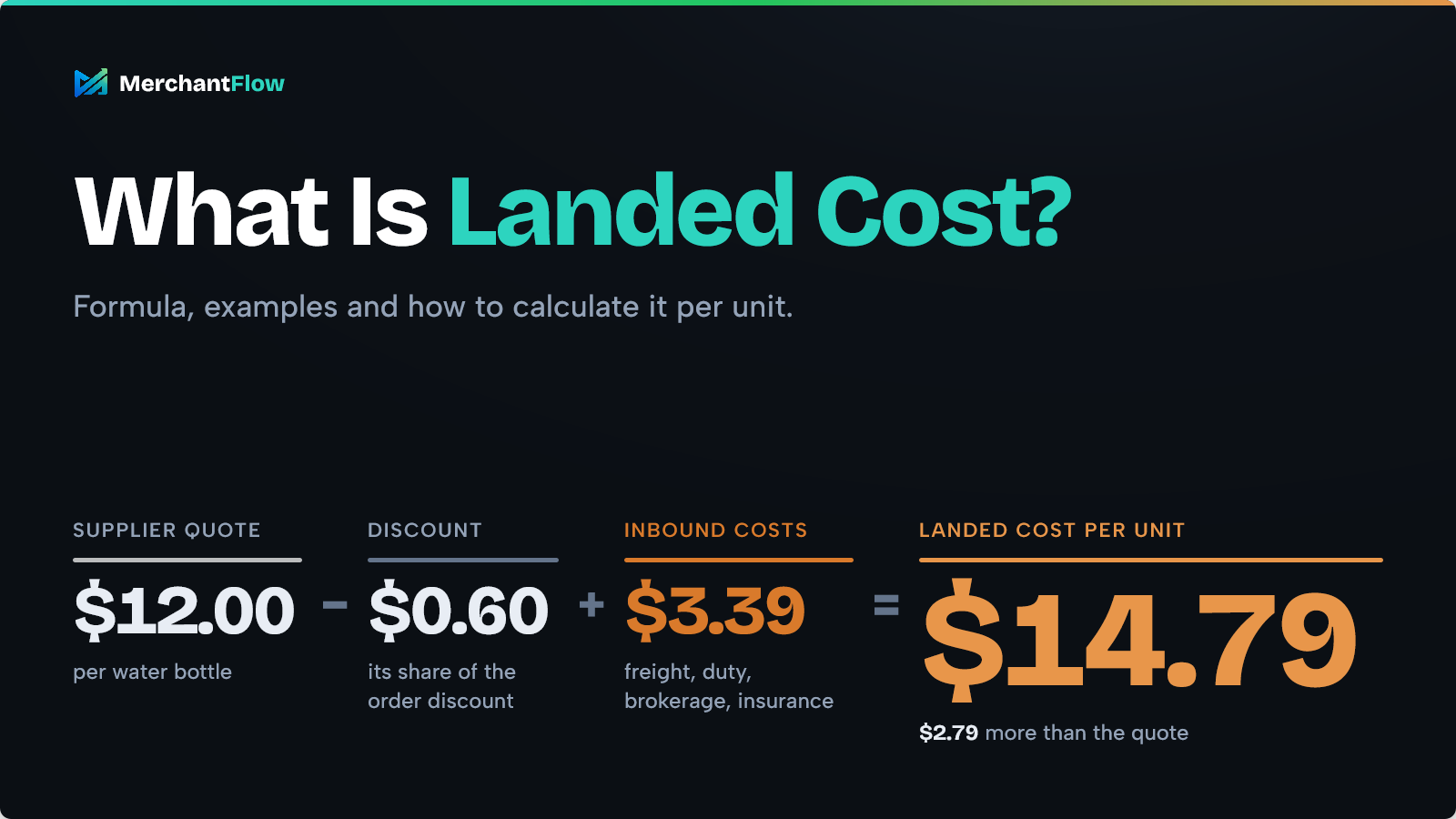
There's international freight, import duty, customs clearance and insurance to account for. Once those expenses are included, that $12 product might actually cost $14.79 to get into your warehouse.
If you're calculating profit using the supplier price alone, your margins could look healthier than they really are.
That's where landed cost comes in. It helps ecommerce businesses understand what their inventory actually costs to acquire, including expenses that don't appear in the supplier's original unit price.
This guide explains the landed cost formula, what to include and how to calculate an accurate cost per unit, even when multiple products share the same shipping and import charges.
What is landed cost?
Landed cost is the total cost of purchasing a product and getting it to its intended destination, including relevant freight, import duties, insurance and handling expenses.
For an ecommerce business importing inventory, it represents what each unit costs to acquire and bring into saleable condition, rather than simply what the supplier charges.
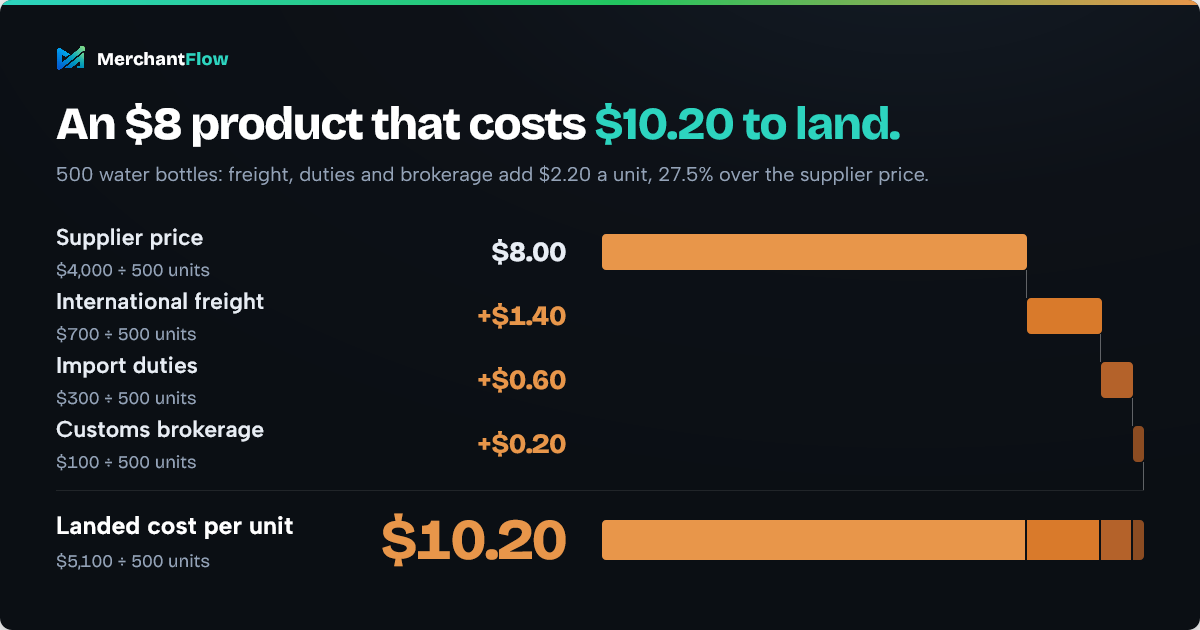
For example, suppose you purchase 500 products for $8 each. The supplier invoice totals $4,000, but freight, customs duties and other inbound expenses add another $1,100.
Your total landed cost is $5,100, or $10.20 per unit.
The supplier price is still $8. The full acquisition cost of each unit is $10.20.
That difference affects how you value inventory, calculate cost of goods sold (COGS) and evaluate product margins.
One distinction is worth making: logistics providers sometimes use landed cost more broadly to describe getting products all the way to an end customer. In this guide, we're focusing on landed inventory cost, which covers acquiring stock and bringing it to the location and condition needed for sale.
Customer delivery and advertising expenses are considered separately when evaluating the profitability of an order.
The landed cost formula
The basic calculation is:
Total landed cost = Net purchase cost + Inbound freight + Import duties + Insurance + Customs and handling fees + Other attributable acquisition costs
To calculate the cost per unit:
Landed cost per unit = Total landed cost ÷ Number of units
Here's a straightforward example.
An ecommerce store imports 500 reusable water bottles:
| Cost | Amount |
|---|---|
| Products: 500 × $8 | $4,000 |
| International freight | $700 |
| Import duties | $300 |
| Customs brokerage | $100 |
| Total landed cost | $5,100 |
The calculation is:
$5,100 ÷ 500 = $10.20 per bottle
The additional expenses increase the unit cost by $2.20, or 27.5% compared with the supplier price.
If you have a shipment to calculate, MerchantFlow's free Landed Cost Calculator lets you enter your products and allocate shared freight, duty and other charges to work out the cost per unit.
If every unit in a shipment is identical, calculating landed cost is usually relatively simple. The challenge comes when different SKUs share freight, customs clearance or other shipment-level expenses.
In that situation, dividing the shipment's total cost by the total number of units can give you a misleading cost for individual products.
What costs should be included in landed cost?
The starting point is to identify the expenses necessary to acquire your inventory and bring it to its current location and condition.
The inventory accounting principles in IAS 2 Inventories include qualifying purchase costs, import duties, transport and handling expenses, while excluding recoverable taxes from inventory cost.
For a typical ecommerce importer, the calculation may include:
| Expense | Treatment |
|---|---|
| Supplier purchase price | Include the net cost of the products |
| Supplier discounts and rebates | Deduct applicable discounts from purchase cost |
| Inbound freight | Include relevant transport to the intended inventory location |
| Cargo insurance | Include insurance directly attributable to acquiring the shipment |
| Import duties and tariffs | Include applicable non-recoverable duties |
| Customs brokerage and clearance | Include relevant import processing charges |
| Inbound handling and local transport | Include qualifying costs of bringing stock into its intended location and condition |
| Import GST or VAT | Include only where non-recoverable and appropriate under the applicable accounting rules |
Not every shipment will involve all these expenses. A domestic purchase might only require the supplier price and inbound delivery, while an international shipment can involve multiple carriers, customs charges and processing fees.
What shouldn't be included?
Landed inventory cost isn't a measure of every expense involved in selling a product.
Advertising, customer delivery, payment processing and general business overheads aren't normally part of the cost of acquiring inventory. Ongoing storage after products are ready for sale is also generally treated separately.
Those expenses still matter, but they belong elsewhere in your profitability calculations.
For example, if a product costs $15 to acquire and another $8 to advertise, pack and deliver to a customer, its landed inventory cost is not automatically $23. The additional $8 should be considered when evaluating the sale's contribution profit.
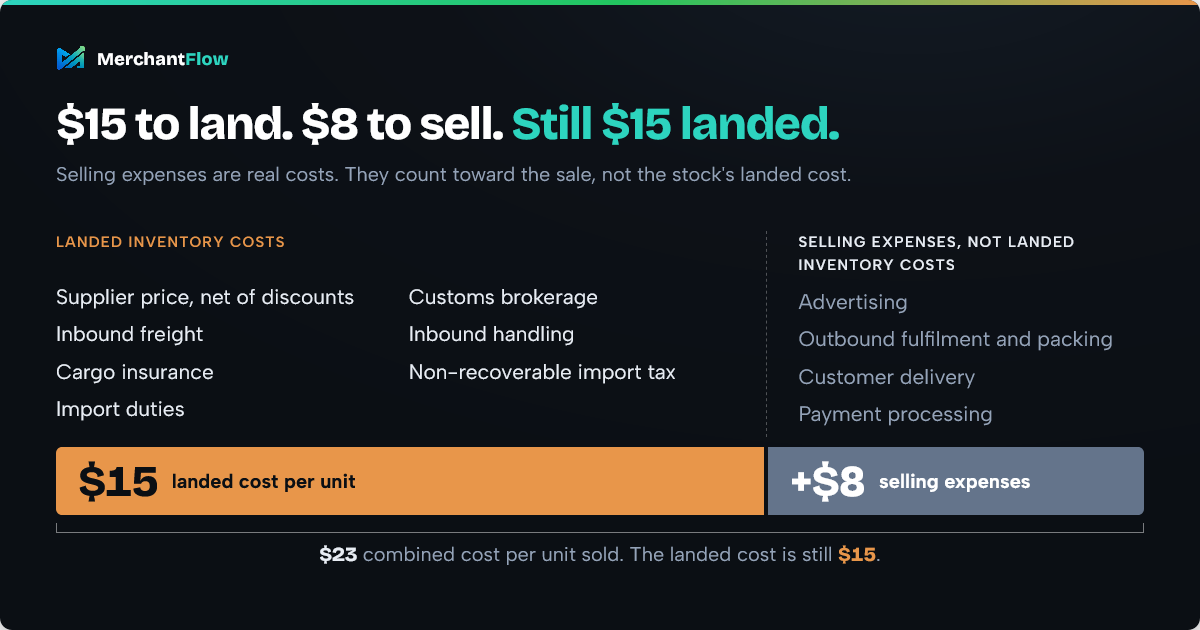
Keeping these costs separate helps prevent double-counting and makes your margins more useful for different business decisions.
How to calculate landed cost per unit
The calculation follows four main steps, whether you're working from a spreadsheet, supplier invoice or landed cost calculator.
Step 1: Calculate the net purchase cost
Start with your supplier invoice. Record the quantity, unit price and total purchase value for each SKU, then subtract applicable discounts and rebates.
If the invoice is in a foreign currency, convert the product costs into your reporting currency using the appropriate transaction rate for your records.
Keep the original currency amounts and exchange-rate information. Freight and customs charges may be billed separately, and customs authorities may apply different valuation and currency-conversion rules.
Step 2: Gather the additional shipment costs
Check your freight invoices, customs documents, insurance invoices and local delivery charges.
It's also important to review the delivery terms agreed with your supplier.
For example, an EXW (Ex Works) agreement generally places more transportation and import responsibilities on the buyer, while a DDP (Delivered Duty Paid) agreement places substantially more responsibility on the seller.
The International Chamber of Commerce's explanation of EXW and DDP describes how those responsibilities differ.
If your supplier's delivered price already includes freight or duty, don't add the same expense again simply because it would normally form part of landed cost.
Step 3: Allocate shared charges to each SKU
When a shipment contains multiple products, determine how much of each additional expense belongs to each SKU.
An international freight invoice might show $900 for an entire shipment without identifying what it cost to transport each product separately.
You could allocate that charge by purchase value, quantity, weight or another reasonable basis, depending on what drove the expense.
You shouldn't automatically divide the freight bill equally between product lines. A lightweight accessory and a heavy insulated product may contribute very differently to shipping costs.
Where charges can be attributed directly to particular products, such as item-specific customs duties, use those amounts rather than spreading them arbitrarily.
Step 4: Calculate and reconcile the final unit costs
Once each shared expense has been allocated, add the relevant charges to each SKU's net purchase cost.
SKU landed cost = Net SKU purchase cost + Allocated acquisition charges
Then divide by the quantity:
Landed cost per unit = SKU landed cost ÷ Units received
For a shipment in which all units are received in normal saleable condition, that gives you the acquired cost per unit for each SKU.
Finally, check that all allocated amounts add up to the actual shipment expenses. If they don't, investigate missing costs, duplicated charges, exchange-rate issues or rounding differences.
Worked example: Calculating landed cost for two imported products
Imagine an ecommerce store importing two products from the same supplier:
- 200 reusable water bottles at $12 each
- 100 insulated tumblers at $24 each
Both product lines have a gross purchase value of $2,400. The supplier provides a $240 discount across the order.
The shipment also incurs $900 in international freight, $570 in import duties, $120 in customs brokerage and $60 in insurance.
For this hypothetical example, all amounts are expressed in the same currency, all units are received in saleable condition and the duty amounts are assumed to come from product-specific customs assessments. No recoverable taxes are included.
Step 1: Calculate the net product costs
The gross purchase value is $4,800.
Because each product line represents 50% of the purchase value, the $240 supplier discount is allocated equally.
That leaves:
- Water bottles: $2,400 minus $120 = $2,280
- Insulated tumblers: $2,400 minus $120 = $2,280
Step 2: Allocate freight by weight
The water bottles have a combined shipment weight of 80 kg. The tumblers weigh 120 kg.
Total weight = 200 kg
Water bottle freight = $900 × (80 ÷ 200) = $360
Tumbler freight = $900 × (120 ÷ 200) = $540
The tumblers receive a larger share of the freight bill because they account for more of the shipment's weight.
The $570 in import duties is attributed to the relevant product lines according to the hypothetical customs assessment. Brokerage and insurance are split by purchase value, which is equal for both lines.
Step 3: Calculate each product's landed cost
| Cost | Water bottles | Tumblers |
|---|---|---|
| Quantity | 200 | 100 |
| Gross supplier cost | $2,400 | $2,400 |
| Supplier discount | -$120 | -$120 |
| Net purchase cost | $2,280 | $2,280 |
| Allocated freight | $360 | $540 |
| Import duties | $228 | $342 |
| Customs brokerage | $60 | $60 |
| Insurance | $30 | $30 |
| Total landed cost | $2,958 | $3,252 |
| Landed cost per unit | $14.79 | $32.52 |
For the water bottles:
($2,280 + $360 + $228 + $60 + $30) ÷ 200 = $14.79 per unit
For the tumblers:
($2,280 + $540 + $342 + $60 + $30) ÷ 100 = $32.52 per unit
The combined landed cost is $6,210.
You could divide that by all 300 units to get a shipment-wide average of $20.70, but applying that average to either product would distort its actual acquisition cost.
The bottles cost $14.79 each to acquire. The tumblers cost $32.52.
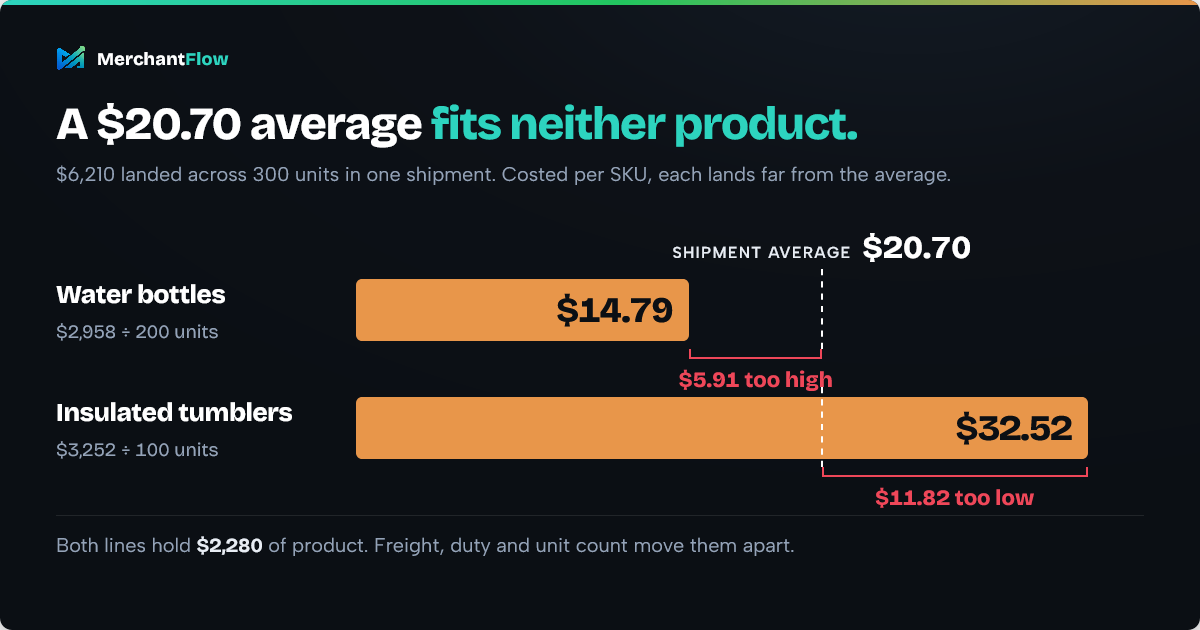
That distinction becomes important when calculating product margins and deciding which products to promote.
Should you allocate freight by weight, value or quantity?
There's no single allocation method that's appropriate for every shipment charge.
The aim is to use a reasonable, consistent method that reflects how the expense arose.
| Method | Best suited to |
|---|---|
| By weight | Freight driven primarily by shipment weight |
| By volume or chargeable weight | Bulky products where shipping space influences cost |
| By purchase value | Shared expenses linked to product value, such as certain insurance charges |
| By quantity | Similar products or charges incurred on a per-unit basis |
| Direct attribution | Duties, inspections or charges that relate to identifiable products |
For value-based allocation, the formula is:
Allocated charge = Total shared charge × (SKU value ÷ Total shipment value)
Weight-based allocation follows the same principle, using the SKU's shipment weight rather than its purchase value.
Why the allocation method changes your margins
Return to our water bottles and tumblers.
We allocated the $900 freight bill by weight, assigning $360 to the bottles and $540 to the tumblers.
But what happens if you allocate freight by purchase value instead?
Because both product lines have equal net purchase values, they would each receive $450 in freight.
| Allocation method | Bottle cost/unit | Tumbler cost/unit |
|---|---|---|
| Freight by weight | $14.79 | $32.52 |
| Freight by purchase value | $15.24 | $31.62 |
The total shipment cost remains $6,210 either way. Only the amount assigned to each SKU changes.
In this example, allocating freight by purchase value increases the bottle's recorded acquisition cost by $0.45 per unit while reducing the tumbler's by $0.90.
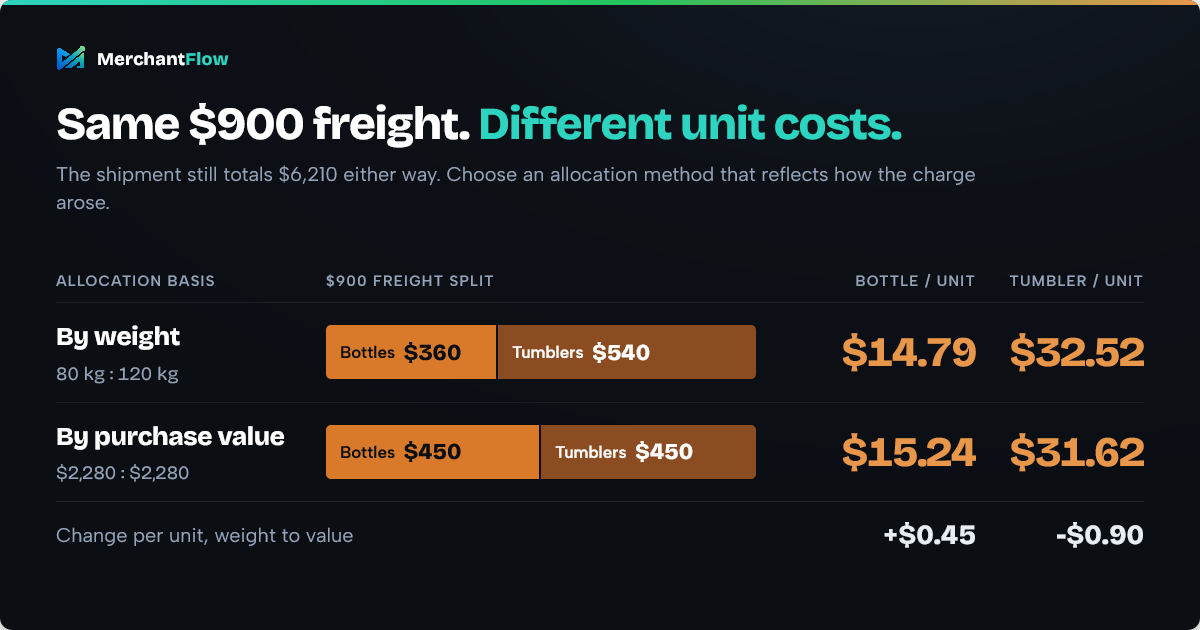
Neither method changes the amount paid to the freight provider. It changes how that expense is distributed across your products.
This is why allocation deserves attention, particularly when your catalogue contains products with very different weights, sizes or purchase values.
You can experiment with these allocation methods using MerchantFlow's free landed cost calculator. It supports multiple product lines and lets you allocate shared charges by value, weight or quantity, so you can compare the resulting unit costs.
Calculating landed cost for imported goods: Three things to check
Importing adds several complications that don't appear in a simple domestic purchase.
1. Customs value isn't necessarily landed cost
Customs duties aren't always calculated using the same value you use for inventory costing.
Customs authorities apply their own rules for assessing imported goods. The customs value can depend on the destination country, product classification, transaction terms and required adjustments.
For example, US customs transaction valuation rules under 19 CFR § 152.103 distinguish the value of imported merchandise from qualifying international freight and insurance costs under specified conditions.
That means you shouldn't take your total landed cost and simply apply an assumed tariff percentage to it.
Use the actual assessed duties where available, or obtain a properly supported estimate based on the relevant customs rules.
2. Recoverable import taxes shouldn't inflate inventory cost
Import GST or VAT can create a significant cash payment without necessarily increasing your accounting cost of inventory.
Where the tax is recoverable, it's generally not included in inventory acquisition cost. Non-recoverable taxes may qualify for inclusion.
The distinction is important when evaluating imported products. A large amount paid at customs doesn't automatically mean the entire payment belongs in your product's landed cost.
3. Currency movements can change your actual cost
Your supplier might quote in USD while freight, customs and local delivery are billed in another currency.
Even if the supplier's product price stays the same, an unfavourable exchange-rate movement can increase the amount you pay in your reporting currency.
Compare shipment costs using appropriate recorded rates rather than assuming the exchange rate shown on the supplier's original quote is what you ultimately paid.
For international purchases, retaining the source documents and currency conversions also makes later reconciliation easier.
How landed cost affects pricing and gross profit
Knowing your landed cost matters because it changes the margin you can expect to earn on a product.
Let's return to our two imported products.
Suppose water bottles sell for $30 and tumblers sell for $60, excluding sales tax and before any customer discounts.
If the business uses only the discounted supplier purchase cost, both products appear to have a 62% gross margin.
But when the full landed inventory cost is included, their margins are different.
| Metric | Water bottle | Tumbler |
|---|---|---|
| Selling price | $30.00 | $60.00 |
| Net supplier cost | $11.40 | $22.80 |
| Margin using supplier cost | 62.0% | 62.0% |
| Landed cost per unit | $14.79 | $32.52 |
| Margin using landed cost | 50.7% | 45.8% |
| Gross profit per unit | $15.21 | $27.48 |
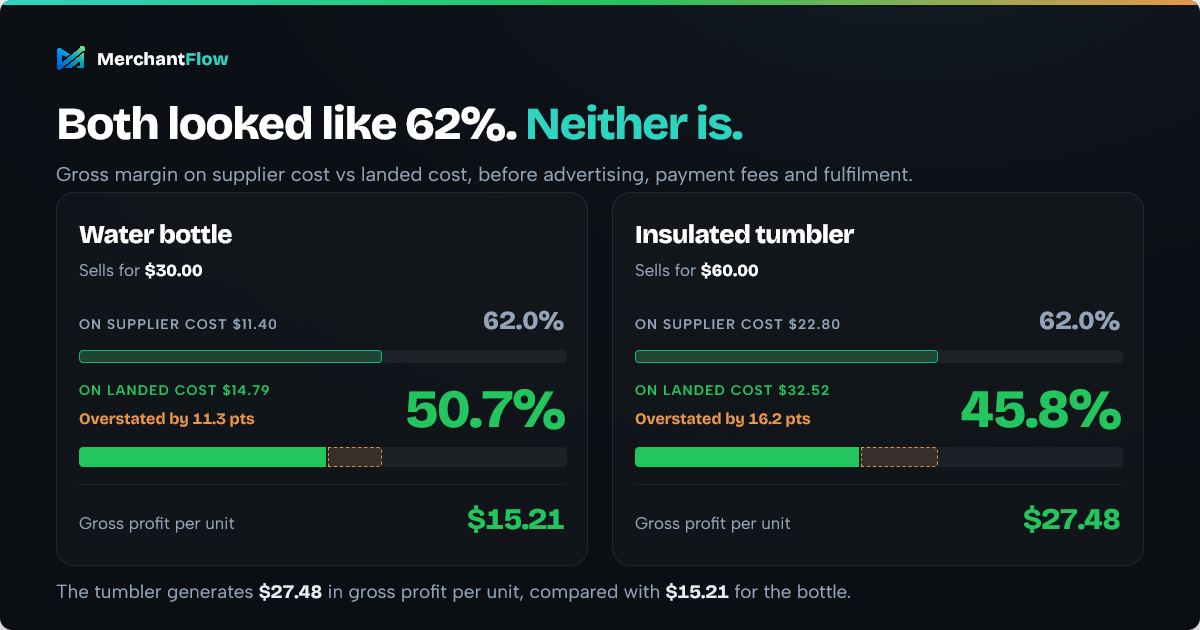
These are simplified gross margins based on the costs in our example. They don't yet account for advertising, payment fees, outbound fulfilment or other selling expenses.
The tumbler has a lower gross margin percentage, but it still generates more gross profit dollars per unit than the bottle.
That matters when deciding which product is more attractive to sell.
A higher margin percentage doesn't automatically make one SKU the better commercial choice. Selling price, gross profit dollars, customer demand, advertising efficiency, stock turnover and other costs all influence the decision.
The purpose of calculating landed cost isn't simply to find the cheapest product. It's to make those decisions using an accurate starting point.
Landed cost vs COGS: What's the difference?
Landed cost and cost of goods sold are closely related, but they describe different stages of inventory accounting.
Landed cost is the cost of acquiring a product and bringing it into inventory.
COGS is the relevant inventory cost recognised when those products are sold.
For example, if you acquire 200 bottles at a landed cost of $14.79 each, the shipment contains $2,958 of inventory cost.
If you sell 80 of those units, a simplified calculation for those units would be:
80 × $14.79 = $1,183.20 in COGS
The remaining units continue to be held as inventory, subject to the business's applicable inventory valuation method and any necessary adjustments.
For a more detailed explanation of how inventory purchases become cost of goods sold, see our guide to calculating Shopify COGS.
Does Shopify's Cost per item include landed costs?
Not automatically.
Shopify's Cost per item documentation explains that merchants can record product or variant costs. Its reseller example uses the price paid to the manufacturer, excluding taxes, shipping and other costs.
That means the amount recorded in Shopify may not represent the full landed inventory cost you use in your accounting or profitability analysis.
There's another detail worth knowing: Shopify records Cost per item on an order when it's created. Updating a product's cost later doesn't automatically update the recorded cost of earlier orders.
If your inbound freight bill arrives after you've already started selling a shipment, simply updating the current product cost might not correct historical Shopify profit reports.
You need a consistent approach for recording inventory costs and understanding how your reporting tools apply cost changes over time.
What about advertising and fulfilment?
Landed cost improves your gross profit calculation, but it doesn't tell you whether the full sale is profitable.
Customer shipping, payment processing and advertising can substantially reduce the amount remaining from an order.
That's why it's useful to follow gross margin with contribution margin, which considers the additional variable expenses associated with generating and fulfilling sales.
Landed cost tells you what a product costs to acquire. Contribution margin helps you understand what remains after selling it.
Common landed cost mistakes to avoid
The arithmetic is usually the easiest part of landed cost. Most errors happen because the underlying information is incomplete or inconsistent.
Using supplier price instead of actual acquisition cost. Missing freight, duty and brokerage charges can make products appear more profitable than they are. Check the complete shipment documentation rather than relying on the original supplier quote.
Double-counting expenses already included in the invoice. If freight or duty is included in the agreed delivered price, make sure you're not adding the same amount again.
Allocating every expense by the same method. Weight may make sense for some freight charges, while purchase value may be more appropriate for insurance. Use directly attributable amounts when available.
Forgetting discounts, exchange rates or later invoices. These can change the final acquisition cost even when the supplier's unit price remains unchanged.
Applying one shipment's cost to every future order. Freight rates, supplier prices and exchange rates can change between purchases. A product that landed at $14.79 in one shipment may cost more or less to acquire the next time.
A useful practice is to reconcile every shipment against the relevant supplier, freight and customs invoices, then record the resulting costs at SKU level.
When the same product is purchased repeatedly at different costs, consider how your inventory valuation method handles those batches rather than automatically assuming the newest landed cost applies to every unit.
From landed cost to actual ecommerce profitability
Calculating landed cost gives you a more accurate starting point for understanding product profitability. But it only answers one part of the question: how much did the product cost to acquire?
Once you start selling that product, there are other costs to account for. Advertising, payment processing, fulfilment, shipping and refunds can all affect how much profit remains.
A product might look attractive based on its gross margin, only to generate very little profit after those expenses. Another product with a lower gross margin might perform better once you consider its selling price, advertising efficiency and fulfilment costs.
The challenge for many ecommerce businesses is that these numbers live in different places. Your supplier invoices contain purchase costs, Shopify or WooCommerce records orders, and advertising platforms report how much you've spent generating sales.
Bringing those figures together is what turns a landed cost calculation into a useful profitability decision.
How MerchantFlow helps you understand your real profit
MerchantFlow brings your ecommerce orders, product costs and advertising data into one profit-focused dashboard, helping you understand which products are actually making money.
Instead of relying on revenue or ROAS alone, you can examine product and order profitability with relevant costs accounted for. MerchantFlow also supports importing and maintaining COGS, so your profit reporting isn't limited to whatever supplier price happens to be recorded in your store.
For merchants regularly handling supplier invoices, MerchantFlow also offers an invoice import workflow that can extract product lines and charges, allocate relevant expenses and calculate landed costs per SKU.
The broader goal is to connect the costs of acquiring products with the revenue and expenses involved in selling them, so you can make better decisions about pricing, advertising and which products deserve more investment.
Frequently asked questions
Does landed cost include shipping?
Yes. For inventory costing, landed cost generally includes qualifying inbound freight required to bring products to their intended location and condition.
Customer delivery is normally treated separately as a selling or fulfilment expense. Some logistics providers use a broader customer-delivered definition of landed cost, so it's important to check which definition is being used.
Can I divide total landed cost by the total number of products?
Yes, if the units are sufficiently comparable and the resulting allocation is reasonable.
However, dividing the total shipment cost by every unit can be misleading when products have substantially different purchase prices, weights or import costs.
For mixed shipments, calculate landed cost separately for each SKU using appropriate charge allocations.
Is landed cost the same as purchase price?
No. Purchase price is what the supplier charges for the goods, adjusted for relevant discounts and rebates. Landed cost adds the qualifying expenses required to acquire the inventory.
For example, a product with a net supplier cost of $20 and $5 in allocated inbound expenses has a landed cost of $25 per unit.
How often should I update landed cost?
Review landed costs when new shipments arrive or material acquisition costs change.
Supplier price adjustments, exchange rates, freight costs and import duties can all affect the cost of new inventory. How those changes flow through to COGS depends on your inventory valuation and reporting methods.
Know what your products actually cost, and what they're making you
Your supplier invoice tells you what the goods cost to purchase. Landed cost tells you what it costs to get them into your inventory.
But knowing what a product costs is only the beginning. To understand whether it's genuinely profitable, you also need to consider what happens when you sell it, including advertising, fulfilment, payment fees and other expenses.
That's where MerchantFlow comes in.
MerchantFlow connects your Shopify or WooCommerce store with your advertising data and product costs, giving you a clearer picture of profitability across products and orders. Instead of piecing together spreadsheets and disconnected reports, you can see which products are generating revenue and which are actually contributing to your bottom line.
Want to understand what your products are really making after costs?
Start your 14-day free trial of MerchantFlow and bring your ecommerce sales, costs and advertising performance together in one place.

About the author
Georgia CarapetisGeorgia Carapetis is Head of Marketing at MerchantFlow, helping ecommerce brands stop obsessing over ROAS and start focusing on profit. She writes about Google Shopping, contribution margins, and scaling without shrinking your margins.