
For years, ecommerce merchants have tried to get shoppers onto their website.
Meta Muse points towards a slightly different future.
A shopper could tell an AI what they need, let it research the options, compare products and eventually complete much of the purchase process on their behalf. The customer may interact with the merchant's traditional storefront far less than they do today.
That is no longer just a hypothetical ecommerce trend.
Meta launched Muse, its personal AI agent, on 8 September 2026. Muse is designed to do more than answer questions. It can carry out tasks on a user's behalf, including researching products and making purchases with approval. Meta initially launched it in the US across mobile and web.
For Shopify merchants, Meta Muse is already part of a broader shift towards agentic commerce. Shopify's Agentic Storefronts can make eligible products discoverable across AI channels including Meta, ChatGPT, Google AI Mode, Gemini and Microsoft Copilot, with direct checkout supported on selected channels.
For ecommerce merchants, however, the useful question is not simply:
“Can people buy my products through AI?”
Instead, it is:
“What changes when AI becomes part of product discovery, checkout, attribution and the way I run my store?”
Because getting another order through Muse is one thing. Knowing whether that order, product or acquisition channel actually made money is another.
This guide looks at both sides.
In short: Meta Muse is Meta's personal AI agent. For Shopify merchants, it creates another surface where shoppers can discover products and, where eligible, complete purchases. The practical priorities for merchants are accurate product data, clear store policies, reliable channel measurement and understanding whether AI-driven orders are actually profitable.
What is Meta Muse?
The key difference between Muse and a traditional chatbot is that Muse is designed to take action, not simply generate a response.
A traditional chatbot might tell you how to find a product. An agent can potentially take more of the journey on itself.
A shopper could ask:
Find me a waterproof carry-on backpack under $150 that ships to Adelaide and has a separate laptop compartment.
An AI shopping agent can interpret those constraints, search available product information, compare alternatives and help the shopper progress towards a purchase.
That concept is commonly described as agentic commerce.
Muse is different from a traditional AI chatbot
The distinction is action.
Generative AI became popular because it could produce text, summarise information and answer questions.
Agentic AI adds the ability to use tools and services to complete parts of a task.
For ecommerce, that can include:
- searching product catalogues
- comparing products
- checking availability
- understanding shipping or return conditions
- building carts
- progressing through checkout
- tracking an existing order
The customer still determines what access the agent receives and approves sensitive actions. Meta says Muse asks for confirmation before activities such as purchases.
Why Shopify merchants should pay attention
Muse is arriving while Shopify is making a broader push into AI-assisted shopping.
Shopify has developed Agentic Storefronts so products can appear directly inside AI experiences, and its Universal Commerce Protocol provides infrastructure for agents to interact with commerce systems.
Shopify's Q2 2026 commerce data shows AI-referred sessions to Shopify storefronts grew 197% year over year, while AI-referred orders grew roughly 3x. Organic search still referred more sessions overall, suggesting AI is emerging as an additional ecommerce discovery surface rather than replacing traditional search.
Muse therefore matters partly because of Muse itself.
It matters even more because it is another sign that the ecommerce storefront is becoming less tied to a single website.
Muse is part of a bigger shift towards agentic commerce
Google Shopping gave merchants another place for products to be discovered.
Social commerce added Instagram, Facebook and TikTok.
Marketplaces introduced another storefront again.
AI agents may become another layer.
The important difference is that the interface is conversational.
Instead of navigating categories, filters and comparison pages themselves, shoppers can describe the outcome they want:
I need a non-toxic frying pan under $100 that works on induction and will arrive before Friday.
That changes what successful ecommerce discovery can depend on.
Product discovery is moving beyond search engines and social feeds
Traditional ecommerce acquisition usually involves getting a person to click.
You optimise a Google Shopping feed so the right product appears.
You optimise a Meta campaign so somebody stops scrolling.
You improve SEO so a product or category page ranks.
An AI agent can sit between the merchant and the shopper.
It may interpret the shopper's intent, inspect available product information and decide which products deserve to be presented.
That does not make traditional channels irrelevant.
It adds another layer to them.
For merchants, the practical implication is that product information needs to make sense not only to humans browsing a page, but also to systems trying to understand what the product is, who it is suitable for and under which conditions it should be recommended.
Your product data increasingly needs to make sense to machines
A beautiful product page can persuade a human.
An AI agent still needs reliable information underneath it.
That makes fundamentals such as these increasingly important:
- accurate product titles
- detailed descriptions
- correct variants
- price
- availability
- brand
- identifiers such as GTINs where relevant
- colour, size, material and other attributes
- shipping information
- return conditions
- structured product feeds
For Shopify merchants, much of this starts with Shopify Catalog. Shopify uses its catalogue infrastructure to make eligible products available to AI shopping channels, including Meta, and recommends keeping product information and store policies accurate and current.
If you already advertise through Google Shopping, the discipline will feel familiar. Accurate titles, complete attributes, correct variants, current pricing and reliable availability all make it easier for systems to understand what you actually sell.
The broader principle is simple: a product has to be understandable before an AI agent can confidently determine whether it matches a shopper's request.
What Meta Muse changes for Shopify and ecommerce merchants
Muse does not require merchants to abandon the way they currently operate.
It introduces several areas worth paying closer attention to.
1. AI becomes another product discovery surface
A customer searching Google for “best running shoes for flat feet” may eventually visit several stores before purchasing.
An AI agent can compress more of that research into a single interaction.
That makes AI visibility another form of product distribution.
Shopify already lets eligible merchants manage agentic channels through the Shopify admin, including Meta and other AI platforms.
The strategic question becomes:
Can an AI understand enough about your product to know when it should recommend it?
That is partly an AI question, but it is also a merchandising and product-data question.
2. Checkout can happen closer to the conversation
The traditional funnel looks roughly like this:
Ad or search result → product page → cart → checkout → purchase
Agentic commerce can shorten parts of that journey:
Customer request → AI recommendation → purchase flow
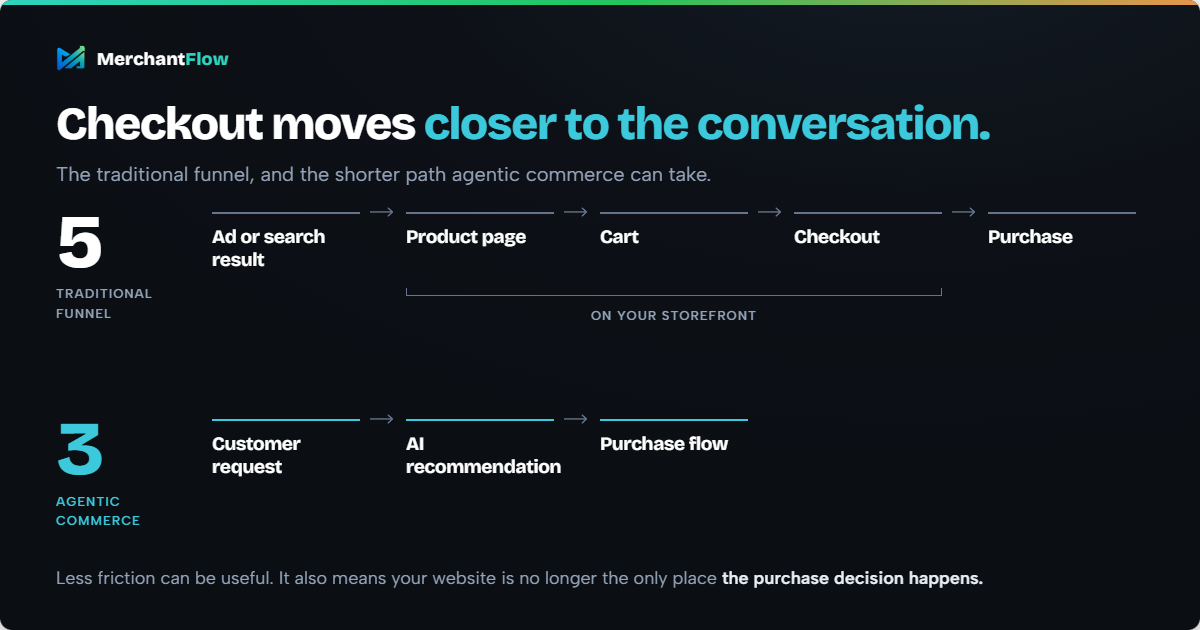
Shopify has been developing its commerce infrastructure specifically so AI channels can support product discovery and checkout rather than merely sending referral traffic to a website.
Less friction can be useful.
It also means merchants should stop assuming the website will always be the only place where the customer's purchase decision happens.
3. Product information becomes part of your acquisition strategy
Most merchants already understand feed optimisation for Google Shopping.
Agentic commerce widens the principle.
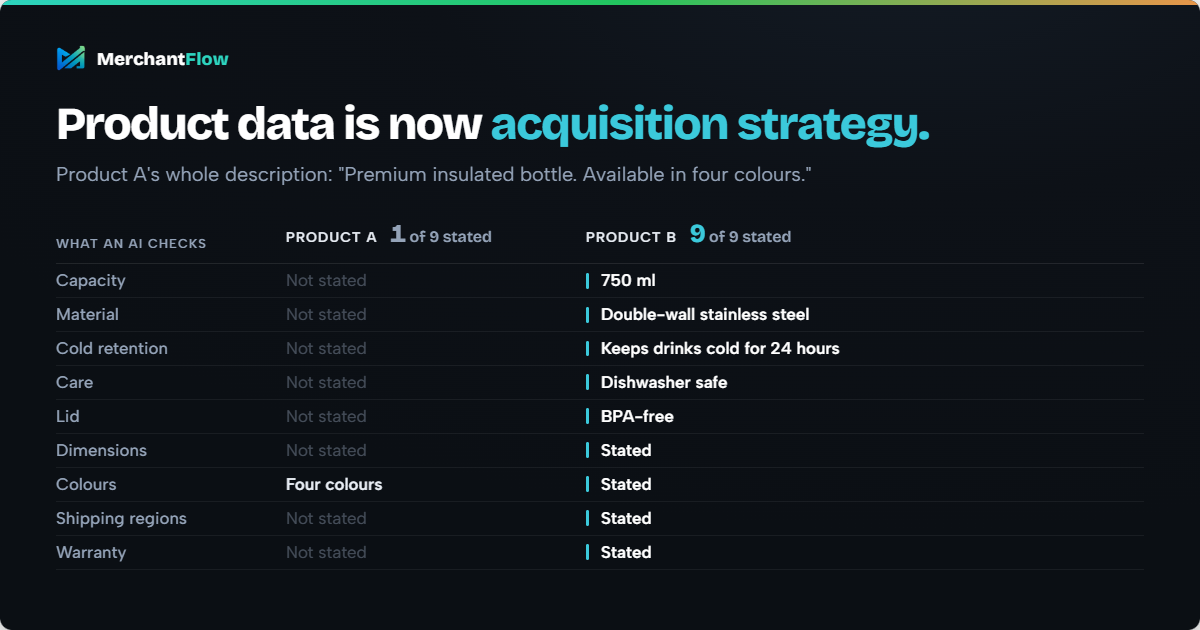
Consider two products.
Product A has a short description:
Premium insulated bottle. Available in four colours.
Product B clearly states:
- 750 ml capacity
- double-wall stainless steel
- keeps drinks cold for 24 hours
- dishwasher safe
- BPA-free lid
- dimensions
- available colours
- shipping regions
- warranty information
A human can investigate both.
An AI trying to satisfy a detailed request has considerably more reliable information available for Product B.
This does not mean merchants should create robotic product pages stuffed with attributes.
It means accurate, explicit product data is becoming more valuable.
4. Attribution becomes even more complicated
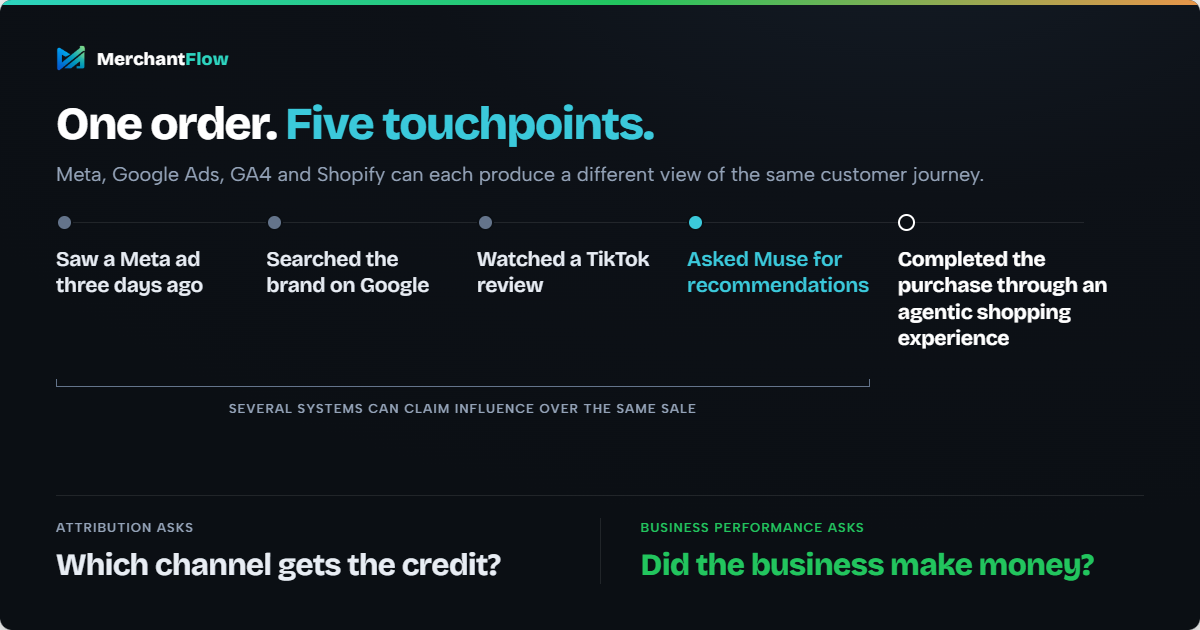
A purchase influenced by an AI agent might still involve several earlier touchpoints.
The shopper may have:
- seen a Meta ad three days ago
- searched the brand on Google
- watched a TikTok review
- asked Muse for recommendations
- completed the purchase through an agentic shopping experience
This is the same ecommerce attribution problem merchants already face across Meta, Google Ads, GA4 and Shopify: several systems can claim influence over the same sale while answering different questions.
Which channel gets the credit?
Potentially several of them, depending on which dashboard you open.
This problem already exists.
Meta, Google Ads, GA4 and Shopify can produce different views of the same customer journey because they are answering different attribution questions.
AI commerce adds another interaction rather than magically resolving the existing attribution problem.
Direct checkout can also change what your analytics sees. Shopify says orders completed through Meta direct checkout are attributed to Meta inside Shopify, but third-party analytics pixels do not fire when the checkout happens on the Meta surface because the shopper never loads your storefront checkout.
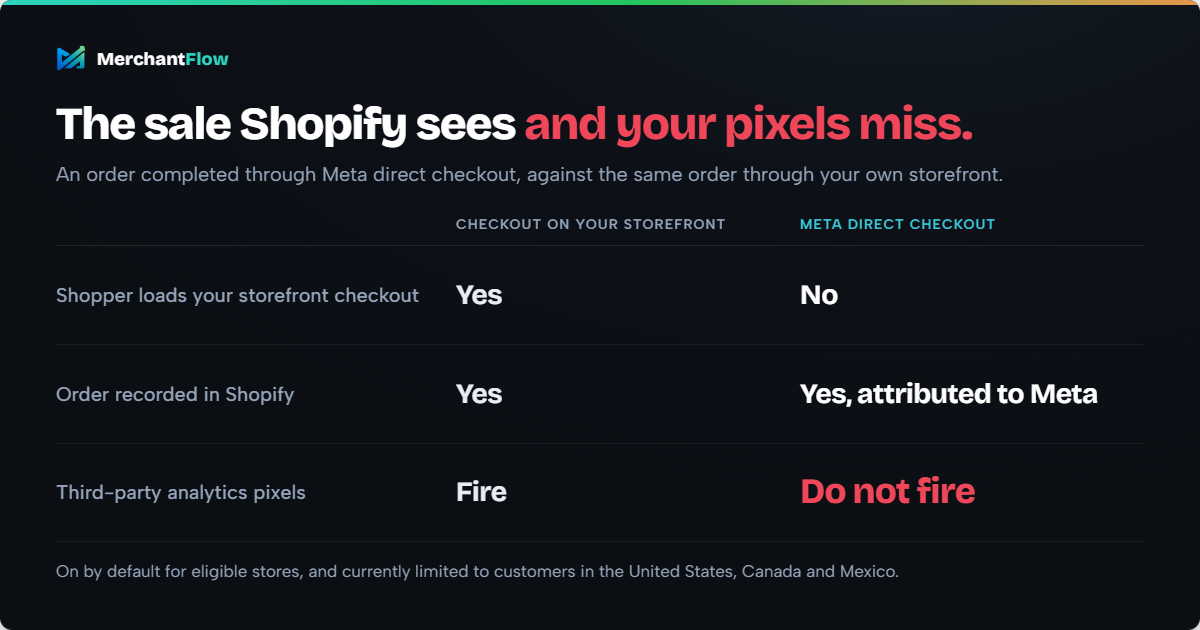
This is why merchants need to distinguish between attribution and business performance.
Attribution asks where a sale should receive credit.
Business performance asks whether the business made money.
Those are related questions, but they are not the same question.
5. More AI-driven sales do not automatically mean more profit
Imagine Muse becomes a meaningful acquisition channel for a store.
Orders increase by 15%.
Great.
But suppose the products receiving most AI-driven demand are:
- frequently discounted
- expensive to fulfil
- low-margin
- commonly returned
- expensive to acquire through paid marketing
Revenue has increased.
Order volume has increased.
The underlying economics may still have deteriorated.
This is the same trap merchants already encounter when scaling Meta Ads without losing profit, or pushing Google Shopping based purely on revenue or platform ROAS.
A channel should not be judged only by how much it sells.
You also need to know what was left after the sale.
How should Shopify merchants prepare for Meta Muse?
You do not need to redesign your entire ecommerce strategy because a new AI agent launched.
Start with the fundamentals.
1. Check your agentic commerce settings
If you use Shopify, review the Agentic section of your sales channel settings and understand where your products are currently eligible to appear.
Shopify makes eligible products available to Meta through its agentic commerce infrastructure. For eligible stores, Shopify-powered direct checkout on Meta is active by default and can allow customers to complete a purchase on Meta surfaces such as Muse without returning to the merchant's website. Shopify currently limits Meta direct checkout to customers in the United States, Canada and Mexico, and eligibility requirements still apply.
Do not assume every feature is available to every merchant or every customer yet.
These platforms are developing quickly.
2. Improve the product data behind your store
Start with the products that generate meaningful revenue or profit.
Check:
- Is the product title accurate and descriptive?
- Are important attributes explicitly stated?
- Are variants structured correctly?
- Is availability accurate?
- Are price and promotional information current?
- Are product identifiers populated where applicable?
- Do shipping and return details make sense?
If you already run Google Shopping, much of this work overlaps with good Merchant Center feed hygiene.
3. Make policies and product information easy to interpret
Consider the questions customers ask before purchasing.
Does this fit?
Can I return it?
Does it ship internationally?
Is it suitable for children?
How long does delivery take?
What is it made from?
Will it work with a particular device?
Important answers should not be hidden behind vague copy.
AI agents are useful when they can confidently match a customer's requirements to reliable information.
4. Create a separate view of AI-driven acquisition
As AI channels grow, avoid dumping them into an unexplained “Other” bucket.
Where reporting allows it, monitor:
- sessions
- orders
- conversion rate
- average order value
- new versus returning customers
- refunds
- discounts
- products purchased
- net revenue
- contribution margin
The goal is not merely to prove that AI generated orders.
The useful question is whether those orders behave differently from customers acquired elsewhere.
5. Measure the economics of the orders, not just the volume
Suppose AI-driven shopping generates:
$20,000 in revenue.
That sounds useful.
Now add:
$7,000 in COGS
$4,500 in advertising costs associated with broader acquisition
$1,500 in fulfilment and shipping
$800 in payment and platform fees
$1,000 in refunds
The original $20,000 headline tells only part of the story.
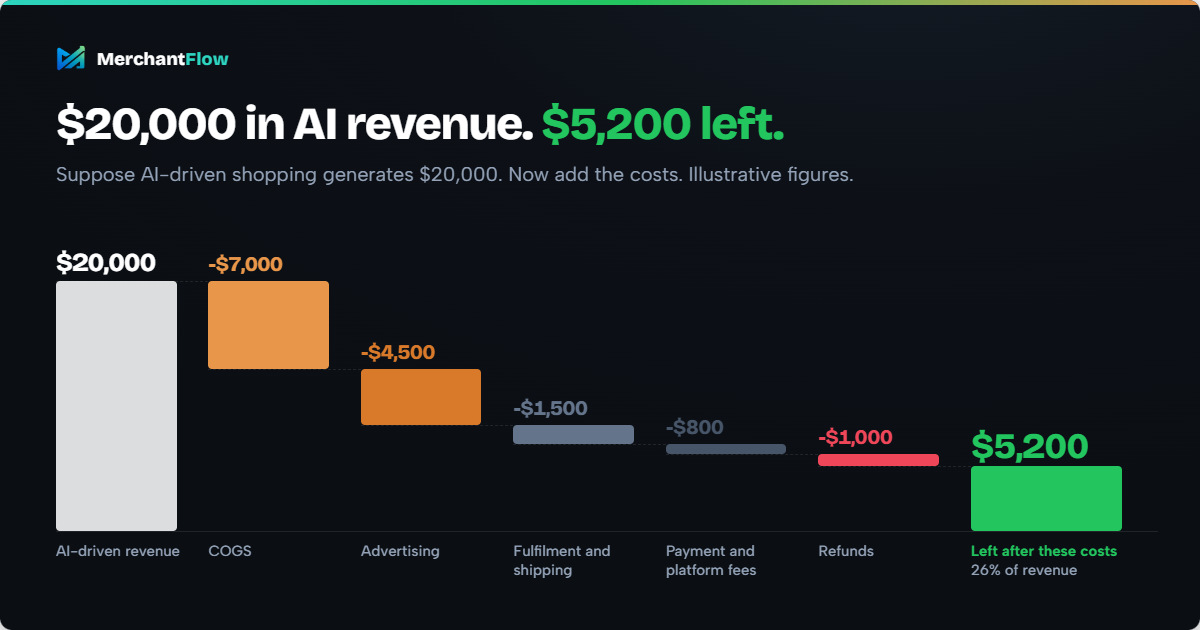
As ecommerce gains more acquisition surfaces, profit visibility becomes more valuable, not less.
If you want to build this calculation properly, our guide to calculating Shopify net profit breaks down how revenue, refunds, COGS, ad spend, fees, fulfilment and operating costs fit together.
There are actually two ways ecommerce businesses can use Muse
Most discussion around Muse and ecommerce is focused on shoppers.
That is only one side of the opportunity.
Customer-facing AI helps people buy
The first use case is the obvious one.
A consumer asks Muse to find something.
Muse searches available information, compares products and assists with the shopping process.
The merchant benefits when their products can be accurately discovered and purchased.
Merchant-facing AI helps operators make decisions
The second use case happens behind the store.
Instead of asking an AI:
Find me a pair of running shoes.
An ecommerce founder might ask:
Which five products contributed the most profit last month?
Revenue increased this week. Why did net profit fall?
Which products have strong sales but unusually high refund rates?
Compare Meta and Google Ads spend for the last 30 days and tell me what changed.
This is potentially much more valuable than asking a general-purpose AI for generic ecommerce advice.
But there is a catch.
The AI needs access to the right data.
That is where the difference between an AI that can browse your ecommerce stack and an AI that can understand your ecommerce business becomes important.
Muse can work across connected services and websites, but each system still contains only part of the picture. Your ecommerce platform knows what sold. Your advertising platforms know what was spent and what revenue they attribute to campaigns. Your cost of goods sold may live somewhere else again.
Why connecting an AI directly to Shopify is not enough
Connecting an AI to Shopify can be extremely useful.
Shopify knows a great deal about your store.
It knows orders, products, customers, discounts and refunds.
But profitability usually depends on information that lives outside Shopify as well.
| System | Useful information | What it may not know |
|---|---|---|
| Shopify or WooCommerce | Orders, products, discounts, refunds | Complete advertising and external operating costs |
| Meta Ads | Spend, clicks, conversions, attributed revenue | Your complete product economics |
| Google Ads | Spend, campaign performance, attributed conversions | Costs sitting elsewhere in the business |
| Merchant Center | Product feed status and eligibility | Whether an order was profitable |
| Spreadsheet | COGS, landed costs or manual expenses | Live changes happening across the rest of the stack |
For a fuller breakdown of how these numbers flow through an ecommerce business, our guide to ecommerce P&L explains the relationship between revenue, COGS, ad spend, fulfilment and profit.
The question:
“What did I sell?”
can often be answered from one system.
The question:
“What did I actually make?”
usually cannot.
Ecommerce profit lives across several systems
Consider a bestselling product showing $80,000 in Shopify revenue, 3.4x Meta ROAS and 4.1x Google Ads ROAS. On the surface, it looks healthy.
But those figures do not show that its COGS increased, fulfilment became more expensive, a promotion reduced its selling price or its refund rate rose.
An AI looking only at Shopify might reasonably identify it as one of your strongest products. An AI looking only at an advertising dashboard might reach a similar conclusion from ROAS.
Neither view necessarily answers the question the merchant actually cares about:
“Which products made me the most money?”
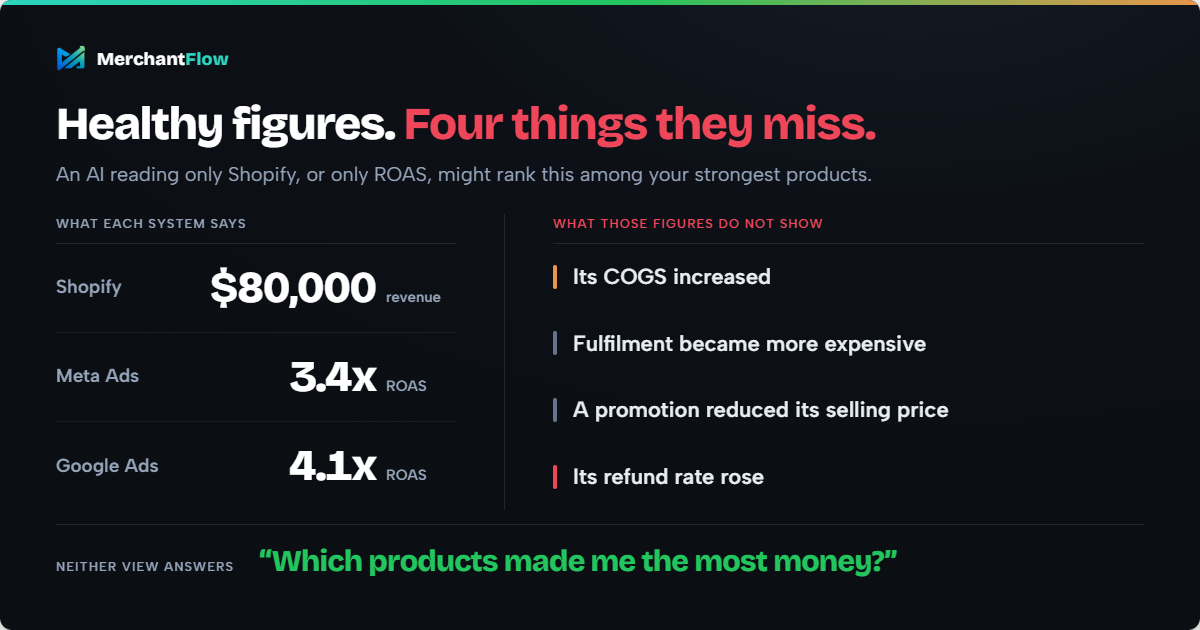
AI does not solve fragmented ecommerce data simply by being intelligent. It still needs access to the information required to answer the question.
Where MCP fits into ecommerce AI
Model Context Protocol, commonly shortened to MCP, is an open standard for connecting AI systems to external tools and data.
Instead of exporting a CSV, uploading it to an AI and repeating the process tomorrow, an MCP connection can allow a compatible AI client to request information from an external system when it needs it.
MCP support and setup differ between AI products. In practical terms, the protocol provides a structured way for compatible AI systems to request information from external data sources rather than relying on manual exports.
Using MerchantFlow to give Muse better ecommerce context
This is where MerchantFlow becomes relevant.
MerchantFlow brings together ecommerce, advertising and profitability data from sources such as Shopify, WooCommerce, Meta Ads, Google Ads, TikTok Ads and Snapchat Ads, alongside COGS and other cost inputs.
Through MerchantFlow's Muse connection, that reconciled data can be made available to Muse on a read-only basis. Instead of asking Muse to piece together isolated Shopify orders, advertising reports and product costs, you can ask questions against a more complete view of the business.
For example:
“Which products lost money after ad spend last month?”
“Why did revenue increase while net profit fell?”
“Which products have strong sales but weak contribution margin?”
“Compare Meta and Google advertising performance over the last 30 days.”
The value is not simply that Muse can access more data. It is that revenue, advertising spend and product costs can be analysed in the same context.
MerchantFlow's Muse connection is read-only, so Muse can retrieve and analyse the relevant information without being given permission to alter your MerchantFlow data.
If you want to see how the setup works, what Muse can access and the types of questions you can ask, see the MerchantFlow Muse integration.
Useful questions to ask AI about your ecommerce business
Once an AI has access to the right business context, the questions you can ask become much more useful. Instead of asking for generic ecommerce advice, you can start interrogating the actual performance of the business.
For example:
Profitability
What changed in net profit this month compared with last month?
Which SKUs had negative contribution margin over the last 30 days?
Which products increased revenue but decreased profit?
Advertising
Compare Meta and Google Ads spend and attributed revenue over the last four weeks.
Did advertising efficiency improve after our promotion started?
Which days had the largest change in marketing spend?
Remember that platform attribution and accounting profit are different concepts. If Meta and Google both claim influence over the same order, adding their attributed revenue together does not create additional revenue.
Products
Which products generate the most revenue but relatively little contribution profit?
Which products have the strongest margins?
Which products have seen COGS increase recently?
Operations
Were there any unusual changes in refunds, fulfilment costs or discounts last week?
Which markets have grown revenue without growing profit?
These prompts are only useful when the AI has enough business context to investigate them properly.
Five checks before trusting an AI-generated ecommerce answer
AI makes analysing data easier.
It does not remove the need for data discipline.
Before making a meaningful business decision from an AI-generated answer, check five things.
1. What data could it actually access?
If you asked about profit but the AI could only access revenue, the answer is incomplete.
2. How fresh is the data?
Yesterday's advertising spend combined with last month's orders can create a misleading comparison.
3. Are currencies and time periods aligned?
A store operating internationally may have multiple currencies, time zones and reporting cut-offs.
Comparisons need to refer to the same period.
4. Is the answer based on attribution or actual revenue?
Meta attributed revenue, Google attributed revenue and Shopify order revenue are not interchangeable.
Understand which figure the AI is discussing.
5. Are the underlying costs complete?
Product profitability becomes unreliable when COGS is missing for a large portion of the catalogue.
A useful AI system should identify those limitations rather than quietly inventing an answer.
What should you measure as agentic commerce grows?
It will be tempting to create a dashboard showing one number:
Revenue from AI
That is worth tracking.
It should not be the end of the analysis.
As Muse and other AI commerce channels develop, useful questions include:
- How much traffic comes from AI channels?
- Which products do AI shoppers purchase?
- What is their conversion rate?
- What is average order value?
- How heavily are those orders discounted?
- What is their refund rate?
- Are they new customers?
- What contribution margin do those orders generate?
- Do certain products dominate AI recommendations?
- How does profitability compare with paid search, paid social and organic acquisition?
That last question matters.
A channel producing $100,000 in revenue at 8% contribution margin is economically different from one producing $70,000 at 25%.
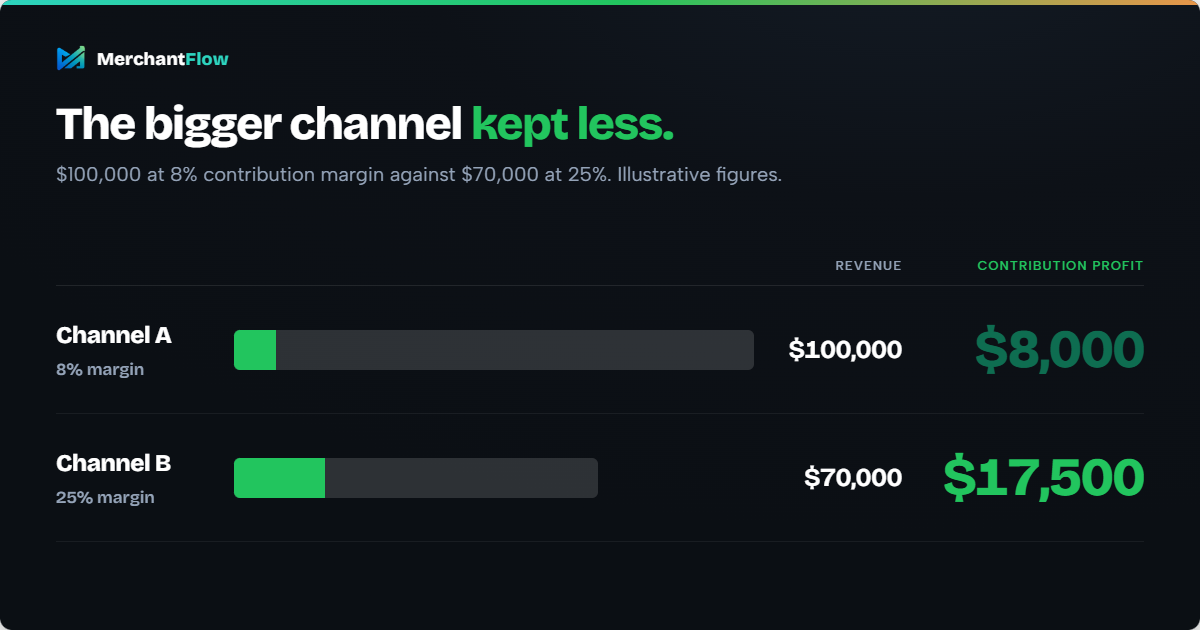
The larger revenue number is not automatically the better business outcome.
Prepare for AI commerce without losing sight of the economics
Muse matters because it is part of a broader change in how people interact with ecommerce. Customers can increasingly discover and buy products through AI conversations, while ecommerce operators can increasingly use the same conversational interface to understand their own businesses.
But merchants do not need to rebuild their ecommerce strategy around every new AI platform.
The fundamentals still matter.
Keep your product data accurate. Make your store easy for AI shopping systems to understand. Measure AI-driven acquisition separately where possible. Pay attention to how attribution changes when purchases happen outside your traditional storefront.
Most importantly, do not let another source of revenue distract you from the economics underneath it.
AI can help customers decide what to buy. It can also help merchants understand what is actually working. For that second use case, the quality of the answer depends on the quality of the data behind it.
If you want Muse to answer questions about what your store is actually making, it needs more than revenue or advertising data in isolation.
MerchantFlow brings revenue, advertising spend, product costs and profitability data together, then makes that context available to Muse through a read-only connection.
See how MerchantFlow connects your ecommerce data to Muse.
FAQ
What is Meta Muse for ecommerce?
Meta Muse is a personal AI agent that can help users research products, compare options and perform tasks on their behalf. For ecommerce, this means AI can increasingly participate in product discovery and parts of the purchase journey rather than simply answering shopping questions. Meta launched Muse in September 2026.
Can customers buy Shopify products directly through Meta Muse?
Yes, where supported. Shopify says eligible stores can use Shopify-powered direct checkout on Meta surfaces such as Muse, allowing customers to complete a purchase without leaving the Meta experience. Meta direct checkout currently applies to eligible customers in the United States, Canada and Mexico. Merchants can manage availability under Sales channels > Agentic in Shopify.
How should Shopify stores prepare for Muse and AI shopping agents?
Start with product data. Keep titles, descriptions, prices, inventory, variants, product attributes, shipping information and return policies accurate and explicit. Then monitor AI-generated traffic and orders separately so you can understand not just how much revenue AI channels generate, but which products sell and whether those sales are profitable.
How do Shopify products appear in Meta Muse?
Shopify makes eligible products available to Meta through its agentic commerce infrastructure and Shopify Catalog. Merchants should keep product titles, descriptions, variants, pricing, availability and store policies accurate because this information helps AI channels understand and present their products correctly.
What is MCP in ecommerce?
Model Context Protocol, or MCP, is an open standard that allows compatible AI systems to access external tools and data. In ecommerce, an MCP server can allow an AI assistant to query store, advertising or profitability data without repeatedly exporting spreadsheets. MerchantFlow provides an MCP server for accessing its ecommerce analytics through compatible AI clients.
Can I connect Muse to MerchantFlow?
Yes. MerchantFlow can connect with Muse to give it read-only access to your ecommerce performance and profitability data. After connecting your store and relevant advertising platforms to MerchantFlow, Muse can use that context to answer questions about areas such as P&L, product performance, margins, COGS and advertising efficiency.
You can see the setup process and supported use cases in the MerchantFlow Muse integration guide.

About the author
Georgia CarapetisGeorgia Carapetis is Head of Marketing at MerchantFlow, helping ecommerce brands stop obsessing over ROAS and start focusing on profit. She writes about Google Shopping, contribution margins, and scaling without shrinking your margins.